


A key prosecution witness on Monday testified that he delivered millions of dollars in payoffs destined for former Mexican secretary of public security Genaro Garcia Luna, but that the two did not directly discuss what the money was allegedly buying: impunity for the Sinaloa cartel.
Former member Jesus “El Rey” Zambada testified at Garcia Luna’s US drug trafficking trial four years after catalyzing the case by airing allegations about Garcia Luna at the trial of Sinaloa kingpin Joaquin “El Chapo” Guzman.
Garcia Luna was subsequently arrested.

Photo: Reuters
He denies the charges.
Zambada is the latest in a series of former cartel members and former law enforcement officials to testify against Garcia Luna. The former cartel member echoed descriptions of cocaine shipments by planes, trains and even submarines, abetted by police and officials under Garcia Luna’s oversight — and, Zambada said he was told, by the federal police leader-turned-presidential Cabinet member himself.
Zambada described an arm’s-length quid pro quo.
He said he made payments to Garcia Luna through an intermediary who told him that the official would shield the cartel, which the witness’ brother, Ismael “El Mayo” Zambada, helped lead.
The relayed message: “He was going to provide protection to my brother. He’s not going to bother him. He was going to let him keep on working just as he had been,” Jesus Zambada testified through an English-language interpreter.
He said he was told that when the cartel wanted friendly police commanders, Garcia Luna would help.
And indeed, the cartel got its preferred commanders placed, Zambada said.
The alleged intermediary died in 2010.
Zambada did not say he personally handed money to or got assurances from Garcia Luna.
Indeed, Zambada said he quickly excused himself when Garcia Luna showed up earlier than expected for a US$2 million meeting with the go-between in a Mexico City restaurant in 2006.
Zambada told jurors it had cost another US$3 million for a similar, earlier meeting.
On both occasions, Zambada said, he gave the money to the intermediary, who met with Garcia Luna in a private room at an upscale Mexico City eatery called Champs Elysees.
Zambada said that at least the first time, he waited in a bar area while the discussions happened and watched the security chief leave with luggage that had been packed with cartel cash.
Garcia Luna on Monday said that he does not plan to testify at his trial.
His lawyers have not yet had their turn to present witnesses.
The attorneys have argued that the prosecution is relying on untrustworthy criminals who are cooperating with the government to trim their own sentences or to avenge themselves on Garcia Luna for trying to crack down on the drug trade.
In questioning Zambada, defense lawyer Cesar de Castro said that the witness admitted to conspiring in cartel killings.
“That makes you responsible for these people’s deaths, right?” the attorney asked.
“Partly, yes,” Zambada said.
Zambada was arrested in Mexico in 2008 and extradited to the US four years later. He pleaded guilty to drug and other charges that could have gotten him life in prison.
He ultimately was sentenced to 12 years after cooperating with the US government. He is now on supervised release.
De Castro said that Zambada did not mention Garcia Luna until he had met with US prosecutors multiple times.
Garcia Luna led the Mexican Federal Investigation Agency from 2001 to 2005, then served as secretary of public security to then-Mexican president Felipe Calderon from 2006 to 2012.
In the latter role, Garcia Luna was in charge of fighting drug cartels.
He moved to Miami in 2012 and became a security consultant.
If convicted, the 54-year-old could face decades in prison.

The Bolivian government on Friday struck a deal with protesting miners, but was still grappling with blockades and demonstrations by other workers across La Paz. Other groups are still blocking access roads into the city, which is also the seat of the government. Police on Thursday prevented the miners from entering the main square by using tear gas, while the demonstrators hurled stones and explosives with slingshots. Protests against the policies of Bolivian President Rodrigo Paz have convulsed the Andean nation since early this month, and roadblocks were choking routes into La Paz throughout Friday, the national road authority said. Miners demanded that Paz
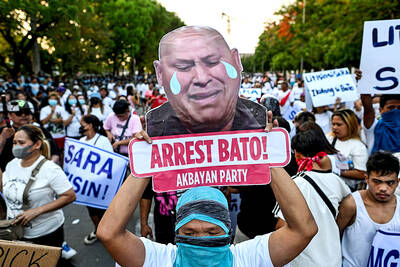
The Philippines said it has asked the country’s Supreme Court to allow it to arrest former Philippine president Rodrigo Duterte’s chief drug war enforcer to stand trial in an international tribunal. The International Criminal Court (ICC) last week unsealed an arrest warrant against Philippine Senator Ronald dela Rosa, accusing him along with Duterte and other “coperpetrators” of the “crime against humanity of murder.” Dela Rosa briefly sought refuge in the Philippine Senate last week while asking the Philippine Supreme Court to stop an ongoing attempt by government agents to arrest him. “By his own conduct, he has placed himself outside the protection of

A ship anchored off the United Arab Emirates (UAE) was seized and taken toward Iran and another — a cargo ship near Oman — sank after being attacked, authorities said on Thursday, as tensions escalated near the Strait of Hormuz. It was not immediately clear who was behind these incidents, but they happened as a senior Iranian official reiterated his country’s claim of control over the waterway and another said it had a right to seize oil tankers connected to the US. The turmoil in the strait has been a sticking point for weeks in talks between the US and Iran to

The researchers in Ireland looked at their computer screen, marveling at a medieval book tracked down in a Roman library. They flipped through its digitized pages and found their sought-after treasure: the oldest surviving English poem. “We were extremely surprised. We were speechless. We couldn’t believe our eyes when we first saw that,” said Elisabetta Magnanti, a visiting research fellow at Trinity College Dublin’s school of English. The poem was also within the main body of Latin text, she said, calling it “extraordinary.” Composed in Old English by a Northumbrian agricultural worker in the 7th century, Caedmon’s Hymn appears within some copies of


 RSS
RSS