


India is preparing to relaunch its INS Vikramaditya aircraft carrier after a major refit, a critical step toward fulfilling its plan to deploy two carrier battle groups as it seeks to strengthen its regional maritime power to counter China’s increasing assertiveness.
The Vikramaditya, a former Soviet carrier acquired from Russia, is expected to be launched imminently and would join India’s first domestically built carrier that was launched in September last year, the INS Vikrant, in undergoing outfitting and sea trials, with the plan to have both fully operational later this year.
“This is significant in terms of India’s power projection capabilities, primarily within the Indian Ocean,” said Viraj Solanki, a London-based expert on Indo-Pacific defense with the International Institute for Strategic Studies.
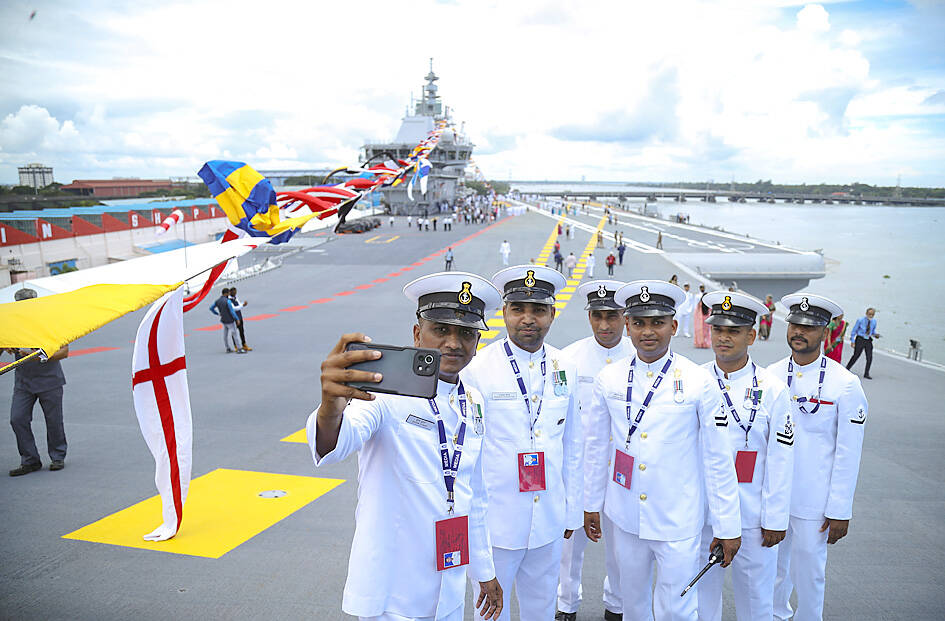
Photo: AP
“This really gives India an option to display its ability to counter China within the Indian Ocean, which is the Indian Navy’s priority,” he said.
The Chinese People’s Liberation Army Navy has been expanding and modernizing for more than a decade and is now the world’s largest. In June last year, it launched its first domestically designed and built aircraft carrier, the country’s third overall, as part of a program to extend its range and power and become more of a “blue water” force that can operate globally.
At the same time, the Chinese People’s Liberation Army has undertaken massive investment in ballistic and cruise missile technology, and the US Department of Defense says it would have the ability to conduct “long-range precision strikes against land targets from its submarine and surface combatants” in the “near term.”
As Beijing increases its naval presence around Taiwan and pushes its claims in the South China Sea, the US, the UK and other allies have responded with regular naval exercises in the region and passages through the Taiwan Strait as they pursue a policy of a “free and open Indo-Pacific.”
China has not yet sailed an aircraft carrier into the Indian Ocean, but is expected to do so within the next few years. It already has other vessels operating regularly in the region and has established its first overseas base in the Horn of Africa country of Djibouti, which gives it easy access to the Indian Ocean.
China set off alarm bells in New Delhi in August last year when it docked what India called a “spy ship” in Sri Lanka’s Hambantota International Port off of India’s southern coast, a facility that was leased to China in 2017 for 99 years.
“New Delhi sees Beijing as encroaching into its traditional sphere of influence, especially in the Indian Ocean region,” said Ridzwan Rahmat, a Singapore-based analyst with the defense intelligence company Janes.
“While a potential war with China will likely be fought inland, China’s presence in the Indian Ocean region can severely disrupt India’s sea lines of communication, which will be essential in sustaining the war effort. The Indian Navy’s recent modernization track is to ensure that scenarios like these will not take root,” Rahmat said.
Like China, India has nuclear weapons and has been building nuclear-powered ballistic missile submarines as part of its “nuclear triad” of air, sea and land-based platforms. It has two such subs and plans for two more, as well as nuclear-powered attack submarines.
Its fleet also includes 10 destroyers, 12 frigates and 20 corvettes.
India and China clashed on their land border in 2020, with 20 Indian and four Chinese soldiers killed. The skirmish turned into a long standoff in the rugged mountainous terrain where each side has tens of thousands of military personnel.
Indian Navy Admiral Arun Prakash, who was previously chief of the naval staff, said that experience could make the seas more important in the event of a future conflict.
“The 30-month-long Sino-Indian military impasse in the Himalayas and China’s strategic posturing in the South China Sea should be clear pointers for India’s decisionmakers that maritime power will have a critical role to play as an instrument of state policy in future outcomes,” Prakash wrote in December last year in the Indian Express.
With two carriers, India’s plan is to have one stationed on each coast, said Captain D.K. Sharma, a retired Indian Navy spokesman who now consults on defense issues.
India’s focus has tended to be toward Pakistan in the west, but with the presence of Chinese vessels in critical shipping lanes east of India, it is prudent for the Indian Navy to make its presence felt there as well, Rahmat said.
However, India still lacks many of the support systems, among other things, to make its carriers effective, he said.
“The vessels themselves may be operational, but the Indian Navy is still several years away from being able to project its forces credibly into the Indian Ocean region,” he said.
Indian Prime Minister Narendra Modi hailed the launch of the Vikrant as a victory in his “Make in India” campaign to become more self-reliant in defense.
The navy has been pushing for another carrier to be made at home, but political concerns coupled with the lengthy delays and massive cost overruns in the construction of the Vikrant have left many skeptical it will ever come to pass, Indian defense analyst Rahul Bedi said.
“The government doesn’t really have the money or the vision to go in for another aircraft carrier,” he said.
In its proposed 2023-24 budget presented on Wednesday last week, the government increased defense spending by less than 2 percent, further calling into question major new investments in carriers. Even if it does go ahead, a third carrier would take years to build.
As it outfits the Vikrant, India is expected to decide soon on the purchase of 26 maritime strike fighters — either the French Rafale-M or American F/A-18. The Indian Air Force already operates a version of Dassault Aviation’s Rafale, which would make maintenance easier, while Boeing’s F/A-18 can carry more missiles.
The Vikramaditya would continue to operate Russian-made MiG-29K fighters India already owns.
India has been seeking to lessen its reliance on equipment from Russia, which provides about 60 percent of its inventory, with the war in Ukraine raising questions about their effectiveness and the availability of spare parts. The US and other allies have been pitching themselves to New Delhi as alternatives and are increasing their cooperation with the key regional player as they intensify their own focus on the Indo-Pacific region.
However, experts say that even with domestic production and diversification of acquisitions, it could take India 20 years to get past its dependence on Russian supplies and spares.
Even before the Russia-Ukraine war, India was increasing its diplomatic engagement with the Quadrilateral Security Dialogue (Quad) grouping of the US, India, Japan and Australia, ASEAN members and other countries individually, Solanki said.
“This really accelerated after the June 2020 India-China clashes on the border,” he said. “That is when we’ve seen a real shift and focus to engage with the Quad, with France, to engage with the UK more actively, work with Europe further ... and work with the ASEAN countries as well.”

ROCKY RELATIONS: The figures on residents come as Chinese tourist numbers drop following Beijing’s warnings to avoid traveling to Japan The number of Chinese residents in Japan has continued to rise, even as ties between the two countries have become increasingly fractious, data released on Friday showed. As of the end of December last year, the number of Chinese residents had increased by 6.5 percent from the previous year to 930,428. Chinese people accounted for 22.6 percent of all foreign residents in Japan, making them by far the largest group, Japanese Ministry of Justice data showed. Beijing has criticized Tokyo in increasingly strident terms since Japanese Prime Minister Sanae Takaichi last year suggested that a military conflict around Taiwan could
A retired US colonel behind a privately financed rocket launch site in the Dominican Republic sees the project as a response to China’s dominance of the space race in Latin America. Florida-based Launch on Demand is slated to begin building a US$600 million facility in a remote region near the border with Haiti late this year. The project is designed to meet surging demand for the heavy-lift rockets needed to put clusters of satellites into orbit. It is also an answer to China’s growing presence in the region, said CEO Burton Catledge, a former commander of the US Air Force’s 45th Operations
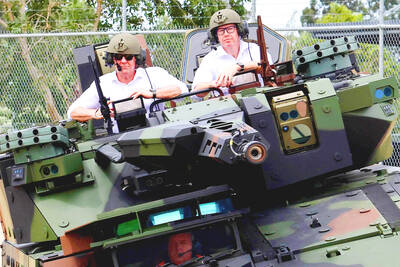
Germany is considering Australia’s Ghost Bat robot fighter as it looks to select a combat drone to modernize its air force, German Minister of Defense Boris Pistorius said yesterday. Germany has said it wants to field hundreds of uncrewed fighter jets by 2029, and would make a decision soon as it considers a range of German, European and US projects developing so-called “collaborative combat aircraft.” Australia has said it will integrate the Ghost Bat, jointly developed by Boeing Australia and the Royal Australian Air Force, into its military after a successful weapons test last year. After inspecting the Ghost Bat in Queensland yesterday,

A pro-Iran hacking group claimed to breach FBI Director Kash Patel’s personal e-mail inbox and posted some of the contents online. The e-mails provided by the hacking group include travel details, correspondence with leasing agents in Washington and global entry, and loyalty account numbers. The e-mail address the hackers claim to have compromised has been previously tied to Patel’s personal details, and the leaked e-mails contain photos of Patel and others, in addition to correspondence with family members and colleagues. “The FBI is aware of malicious actors targeting Director Patel’s personal email information,” the agency said in a statement on


 RSS
RSS