


The administration of US President Joe Biden on Tuesday proposed new standards that could make it more difficult to classify millions of US workers as independent contractors, and deny them minimum wage and benefits.
The US Department of Labor rule, which could take months to take effect, would replace a scrapped standard implemented by Biden’s predecessor that lowered the bar for classifying employees as contractors — workers who are not covered by federal minimum wage laws, and are not entitled to benefits including health insurance and paid sick days.
The reaction in markets for major gig companies was immediate. Shares of ride-hailing company Lyft fell 12 percent while Uber tumbled about 10 percent, although both firms dismissed the significance of the new proposal and its potential to affect their business.
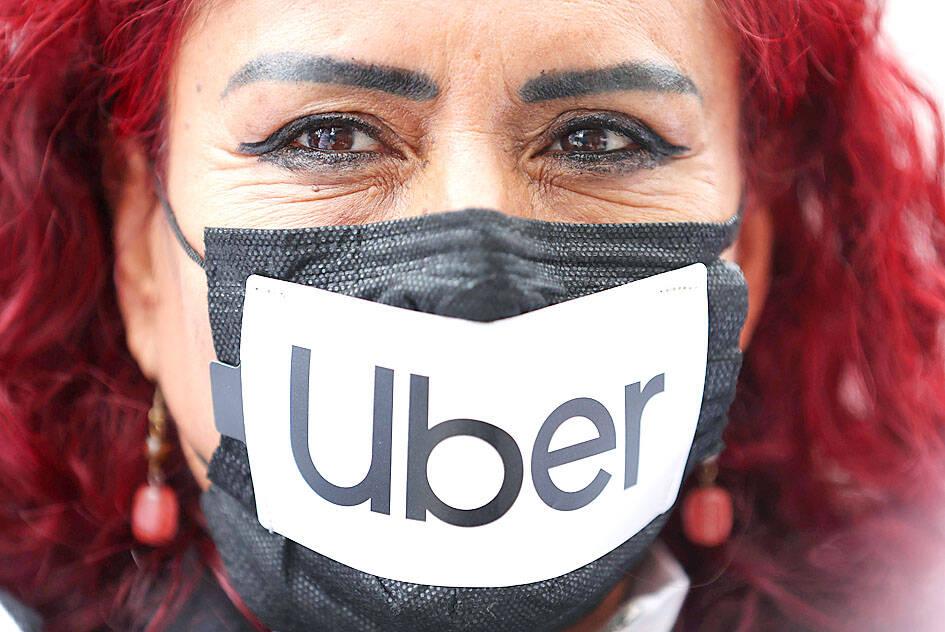
Photo: AFP
In one key change, employers are required to consider whether the work provided is an integral part of their business. That could affect app-based companies that rely almost entirely on freelance workers to provide their services.
The previous rule narrowed that criteria to whether the work is part of an integrated unit of production, and gave more weight to other considerations such as the worker’s opportunity to make a profit or loss.
The new rule directs employers to consider six criteria for determining whether a worker is an employee or a contractor, without predetermining whether one outweighs the other. The criteria also include the degree of control by the employer, whether the work requires special skills, the degree of permanence of the relationship between worker and employer, and the investment a worker makes, such as vehicle payments.
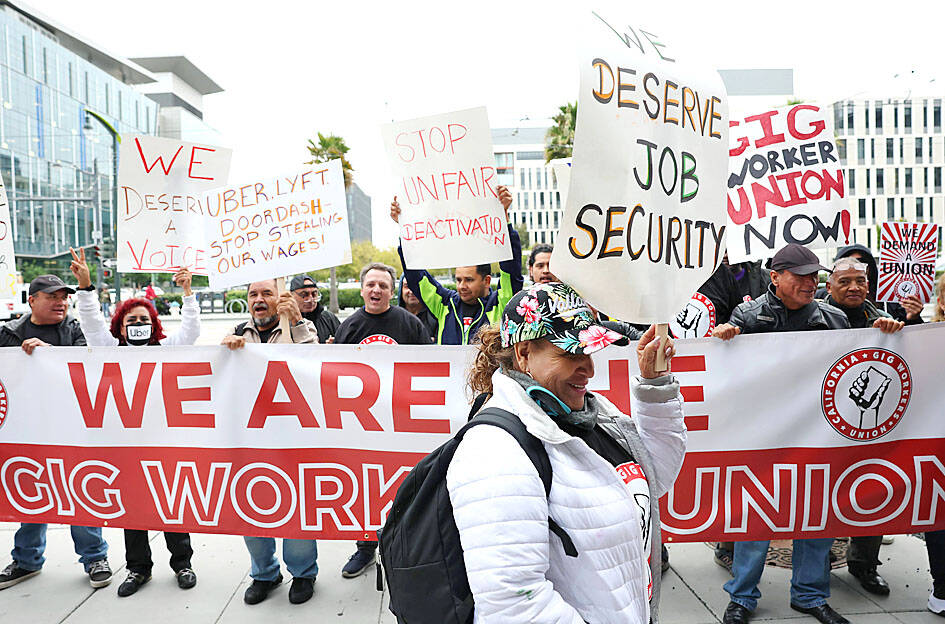
Photo: AFP
However, the rule does not carry the same weight as a law passed by the US Congress or state legislatures, nor does it specify whether any specific company or industry should reclassify their workers. Rather, it offers an interpretation of who should qualify for protections under the US Fair Labor Standards Act.
The rule could bolster labor advocates seeking to challenge worker classification in courts, or state lawmakers seeking to pass stricter laws for designating workers as contractors, said Patricia Campos-Medina, executive director of the Worker Institute at Cornell University’s School of Industrial and Labor Relations.
“It creates a base from which to work and it discourages predatory companies that want to lower their costs by denying basic rights to their employees,” she said.
Still, there is room for interpretation, as some companies might meet one set of criteria for contractor designation, but not others.
“I don’t think it will stop the debate,” Campos-Medina said. “The only thing the federal rule does is it creates a basic standard for evaluation.”

PRECARIOUS RELATIONS: Commentators in Saudi Arabia accuse the UAE of growing too bold, backing forces at odds with Saudi interests in various conflicts A Saudi Arabian media campaign targeting the United Arab Emirates (UAE) has deepened the Gulf’s worst row in years, stoking fears of a damaging fall-out in the financial heart of the Middle East. Fiery accusations of rights abuses and betrayal have circulated for weeks in state-run and social media after a brief conflict in Yemen, where Saudi airstrikes quelled an offensive by UAE-backed separatists. The United Arab Emirates is “investing in chaos and supporting secessionists” from Libya to Yemen and the Horn of Africa, Saudi Arabia’s al-Ekhbariya TV charged in a report this week. Such invective has been unheard of
US President Donald Trump on Saturday warned Canada that if it concludes a trade deal with China, he would impose a 100 percent tariff on all goods coming over the border. Relations between the US and its northern neighbor have been rocky since Trump returned to the White House a year ago, with spats over trade and Canadian Prime Minister Mark Carney decrying a “rupture” in the US-led global order. During a visit to Beijing earlier this month, Carney hailed a “new strategic partnership” with China that resulted in a “preliminary, but landmark trade agreement” to reduce tariffs — but
SCAM CLAMPDOWN: About 130 South Korean scam suspects have been sent home since October last year, and 60 more are still waiting for repatriation Dozens of South Koreans allegedly involved in online scams in Cambodia were yesterday returned to South Korea to face investigations in what was the largest group repatriation of Korean criminal suspects from abroad. The 73 South Korean suspects allegedly scammed fellow Koreans out of 48.6 billion won (US$33 million), South Korea said. Upon arrival in South Korea’s Incheon International Airport aboard a chartered plane, the suspects — 65 men and eight women — were sent to police stations. Local TV footage showed the suspects, in handcuffs and wearing masks, being escorted by police officers and boarding buses. They were among about 260 South

Chinese President Xi Jinping’s (習近平) purge of his most senior general is driven by his effort to both secure “total control” of his military and root out corruption, US Ambassador to China David Perdue said told Bloomberg Television yesterday. The probe into Zhang Youxia (張又俠), Xi’s second-in-command, announced over the weekend, is a “major development,” Perdue said, citing the family connections the vice chair of China’s apex military commission has with Xi. Chinese authorities said Zhang was being investigated for suspected serious discipline and law violations, without disclosing further details. “I take him at his word that there’s a corruption effort under


 RSS
RSS