


Bali bomb maker Umar Patek has said it was a mistake to become involved in the 2002 attacks that killed 202 people, including Taiwanese Eve Kuo (郭惠敏), 24, and four members of a Taipei-based rugby club — Australian James Hardman, 28; Englishman Daniel Braden, 28; and South Africans Godfrey Fitz, 39, and Craig Harty, 35.
In a 20-minute interview from inside the Indonesian jail from which he could soon be released, Patek said he “disagreed” with the plan to bomb two nightclubs.
In the since-deleted 20-minute video, Patek can be seen talking to the Porong prison governor as the two men stroll through the prison grounds.
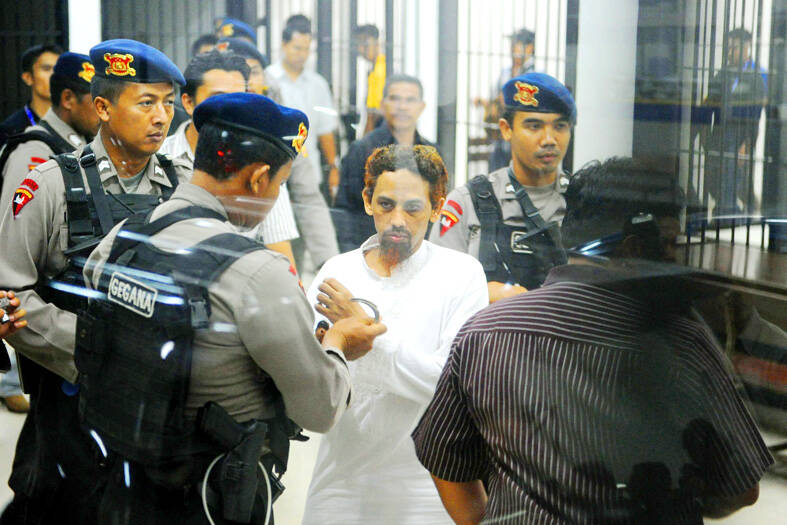
Photo: AFP
“This morning I joined our brother Umar Patek, our friend in Block F,” governor Jalu Yuswa Panjang said as he introduced the 52-year-old former member of the Jemaah Islamiyah terror group, which was linked to al-qaida.
“Today we are going to talk to him about, who exactly is Umar Patek?” the governor said.
Patek, whose real name is Hisyam bin Ali Zein, said he regretted his involvement in the 2002 nightclub bombings, and wanted to help deradicalize young terror convicts.
“My mistake was to be involved with the Bali bombing,” he said. “I told them I was against it, but they were 95 percent done with the project ... 950kg of explosives were packed and ready, and they insisted on going ahead with it,” Patek said.
“I didn’t come to Indonesia to join the Bali bomb project. Even when I found out about it I was so against it, I disagreed with it. I asked the others at the time, what were the reasons for the attack plan? There were no reasons,” he said.
It is not clear when the interview was conducted, but video footage was uploaded to the Porong prison official YouTube channel on Saturday.
Patek on Aug. 17 was granted a sentence reduction after serving two-thirds of his 20-year prison term and showing progress toward reform, East Java Ministry of Law and Human Rights spokesperson Teguh Wibowo said.
“He has dutifully undergone a deradicalization program and behaves well in the prison,” Wibowo said.
However, Australian Prime Minister Anthony Albanese said the decision would “cause further distress” to families of those caught in the bombings, which killed 88 Australians.
“I feel a great deal of common distress, along with all Australians, at this time,” Albanese said. “He was responsible for death and destruction on a major scale, and this decision by the Indonesian government will add to the trauma that families are feeling at this time.”
Patek was jailed for his role in building the bombs that ripped through the Sari Club and Paddy’s Bar in October 2002, killing 202 people, including 88 Australians.
The West Jakarta district court concluded that Patek played an important role in building the explosives used in the bombings. He was also sentenced for his involvement in attacks on Jakarta churches on Christmas Eve 2000, in which 19 people were killed.
Patek said he helped make the bombs, but said he did not know how they would be used.
Prosecutors said that he helped assemble the suicide vests, as well as the detonating cords and boosters connected to the explosives.
He was spared the death sentence after cooperating with police and apologizing to the victims’ families.
Upon his release, Patek wants to work with young convicted terrorists to help stamp out radicalism in Indonesia, he said.
“I’d like to work with millennials because they’re the ones more prone to get infected by the radicalism virus,” he said.
The video prompted anger among those who lost friends and family in the attacks.
Jan Laczynski, who lost five friends in the bombings, told a morning television show on Monday that he initially thought the video was a hoax, describing the footage of Patek laughing and smiling as “horrific” and “unbelievable.”
Additional reporting by staff writer

A US YouTuber who caused outrage for filming himself kissing a statue commemorating Korean wartime sex slaves has been sentenced to six months in prison, a court in Seoul said yesterday. Johnny Somali, 25, gained notoriety several years ago for recording himself doing a series of provocative stunts in South Korea and Japan, and streaming them on platforms such as YouTube and Twitch. South Korean authorities indicted Somali — whose real name is Ramsey Khalid Ismael — in 2024 on public order violations and obstruction of business, and banned him from leaving the country. “The court has sentenced him to six months in

Former Lima mayor Rafael Lopez Aliaga, a Peruvian presidential hopeful, gathered hundreds of supporters in Lima on Tuesday and gave authorities 24 hours to annul the first round of the country’s election over allegations of fraud. Lopez Aliaga is locked in a tight three-way race with two other candidates for second place in Sunday’s vote. The election runner-up wins a ticket to June’s presidential run-off against front-runner Keiko Fujimori. “I am giving them 24 hours to declare this electoral fraud null and void,” said Lopez Aliaga, surrounded by a crowd of several hundred supporters. “If it is not declared null and void tomorrow,

PAPAL RETORT: Pope Leo told reporters that he has ‘no fear, neither of the Trump administration nor speaking out loudly about the message of the Gospel’ US President Donald Trump has feuded with Pope Leo XIV over the Iran conflict — setting off an unholy row that could have serious political implications for the Republican leader back in the US. Trump has drawn barbs even from some allies over the attacks on the US-born pontiff, who has criticized the Trump administration over its immigration crackdown, the intervention in Venezuela and the Iran war. The president risks alienating the religious right in November’s crucial US midterm elections. So far the unprecedented clash between the leader of the most powerful military on Earth and the head of the world’s 1.4 billion

A 16-year-old boy has been charged with murder and aggravated sexual abuse in Florida in the death of his 18-year-old stepsister on a Carnival Cruise ship, the US Department of Justice said on Monday. Timothy Hudson was initially charged in February and subsequently indicted on March 10, but the breadth of the case was not known until a seal was lifted on Friday last week, weeks after US District Judge Beth Bloom in Miami said that he would be prosecuted as an adult at the request of the government. Anna Kepner had been traveling on the Carnival Horizon ship in November last


 RSS
RSS