


Two new studies have provided more evidence that the COVID-19 pandemic originated in a Wuhan, China, market where live animals were sold — further bolstering the theory that the virus emerged in the wild rather than escaping from a Chinese lab.
The research, published online on Tuesday by the journal Science, shows that the Huanan Seafood Wholesale Market was likely the early epicenter of the scourge that has killed nearly 6.4 million people around the world.
Scientists conclude that the virus that causes COVID-19, SARS-CoV-2, likely spilled from animals into people two separate times.

Photo: Reuters
“All this evidence tells us the same thing: It points right to this particular market in the middle of Wuhan,” said Kristian Andersen, a professor in the Department of Immunology and Microbiology at Scripps Research and coauthor of one of the studies.
“I was quite convinced of the lab leak myself until we dove into this very carefully and looked at it much closer,” Andersen said.
In one study, which incorporated data collected by Chinese scientists, University of Arizona evolutionary biologist Michael Worobey and his colleagues used mapping tools to estimate the locations of more than 150 of the earliest reported COVID-19 cases from December 2019.
They also mapped cases from January and February 2020 using data from a social media app that had created a channel for people with COVID-19 to get help.
They asked: “Of all the locations that the early cases could have lived, where did they live? And it turned out when we were able to look at this, there was this extraordinary pattern where the highest density of cases was both extremely near to and very centered on this market,” Worobey said at a news briefing.
“Crucially, this applies both to all cases in December and also to cases with no known link to the market. And this is an indication that the virus started spreading in people who worked at the market, but then started to spread into the local community,” he said.
Andersen said they found case clusters inside the market, too, “and that clustering is very, very specifically in the parts of the market” where they now know people were selling wildlife, such as raccoon dogs, that are susceptible to infection with the coronavirus.
In the other study, scientists analyzed the genomic diversity of the virus inside and outside of China starting with the earliest sample genomes in December 2019 and extending through mid-February 2020. They found that two lineages — A and B — marked the pandemic’s beginning in Wuhan.
Study coauthor Joel Wertheim, a viral evolution expert at the University of California, San Diego, said that lineage A is more genetically similar to bat coronaviruses, but lineage B appears to have begun spreading earlier in humans, particularly at the market.
“Now I realize it sounds like I just said that a once-in-a-generation event happened twice in short succession,” Wertheim said.
However, certain conditions were in place — such as people and animals in close proximity, and a virus that can spread from animals to people and from person to person.
So “barriers to spillover have been lowered such that multiple introductions, we believe, should actually be expected,” he said.

The Bolivian government on Friday struck a deal with protesting miners, but was still grappling with blockades and demonstrations by other workers across La Paz. Other groups are still blocking access roads into the city, which is also the seat of the government. Police on Thursday prevented the miners from entering the main square by using tear gas, while the demonstrators hurled stones and explosives with slingshots. Protests against the policies of Bolivian President Rodrigo Paz have convulsed the Andean nation since early this month, and roadblocks were choking routes into La Paz throughout Friday, the national road authority said. Miners demanded that Paz
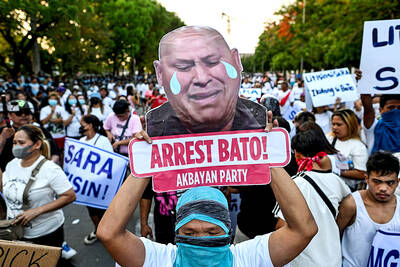
The Philippines said it has asked the country’s Supreme Court to allow it to arrest former Philippine president Rodrigo Duterte’s chief drug war enforcer to stand trial in an international tribunal. The International Criminal Court (ICC) last week unsealed an arrest warrant against Philippine Senator Ronald dela Rosa, accusing him along with Duterte and other “coperpetrators” of the “crime against humanity of murder.” Dela Rosa briefly sought refuge in the Philippine Senate last week while asking the Philippine Supreme Court to stop an ongoing attempt by government agents to arrest him. “By his own conduct, he has placed himself outside the protection of

A ship anchored off the United Arab Emirates (UAE) was seized and taken toward Iran and another — a cargo ship near Oman — sank after being attacked, authorities said on Thursday, as tensions escalated near the Strait of Hormuz. It was not immediately clear who was behind these incidents, but they happened as a senior Iranian official reiterated his country’s claim of control over the waterway and another said it had a right to seize oil tankers connected to the US. The turmoil in the strait has been a sticking point for weeks in talks between the US and Iran to

The researchers in Ireland looked at their computer screen, marveling at a medieval book tracked down in a Roman library. They flipped through its digitized pages and found their sought-after treasure: the oldest surviving English poem. “We were extremely surprised. We were speechless. We couldn’t believe our eyes when we first saw that,” said Elisabetta Magnanti, a visiting research fellow at Trinity College Dublin’s school of English. The poem was also within the main body of Latin text, she said, calling it “extraordinary.” Composed in Old English by a Northumbrian agricultural worker in the 7th century, Caedmon’s Hymn appears within some copies of


 RSS
RSS