


The James Webb Space Telescope has arrived at its cosmic parking spot, bringing it a step closer to its mission to unravel the mysteries of the universe, NASA said on Monday.
At about 2pm US Eastern Time, the observatory fired its thrusters for five minutes to reach the so-called second Lagrange point, or L2, where it will have access to nearly half the sky at any time.
The delicate burn added 5.76kph to Webb’s overall speed, just enough to bring it into a “halo” orbit around L2, 1.5 million kilometers from Earth.
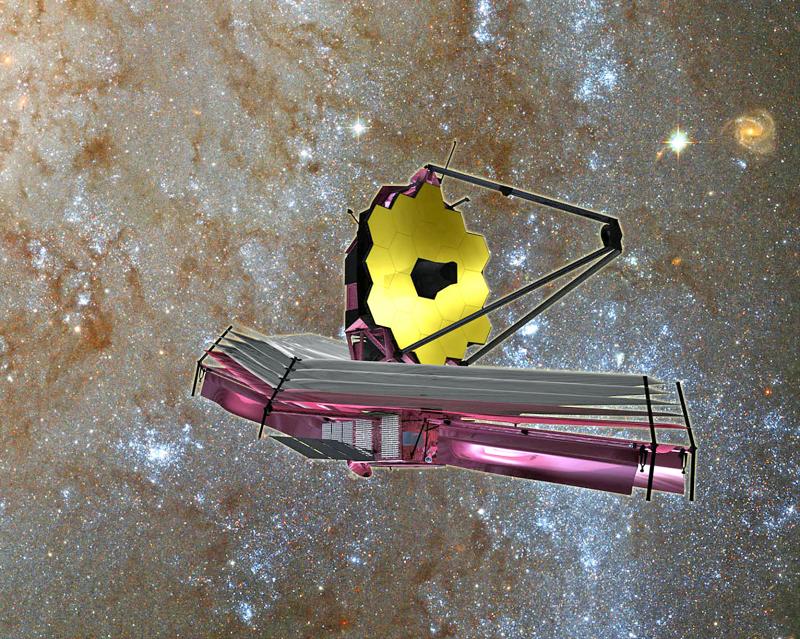
Photo: AFP
“Webb, welcome home,” NASA administrator Bill Nelson said in a statement.
Webb is to begin its science mission by summer, which includes using its high-resolution infrared instruments to distant galaxies.
At L2, it will stay in line with the Earth as it moves around the sun, allowing Webb’s sunshield to protect its sensitive equipment from heat and light.
For the giant parasol to offer effective protection, it needs the sun, Earth and moon to all be in the same direction, with the cold side operating at minus-225°C.
The thruster firing, known as an orbital burn, was the third such maneuver since Webb was launched on an Ariane 5 rocket on Dec. 25.
The plan was intentional, because if Webb had gotten too much thrust from the rocket, it would not be able to turn around to fly back to Earth, as that would expose its optics to the sun, overheating and destroying them.
It was therefore decided to slightly underburn the rocket firing and use the telescope’s own thrusters to make up the difference.
The burns went so well that Webb should easily be able to exceed its planned minimum life of five years, Webb observatory commissioning manager Keith Parrish told reporters on a call.
“Around 20 years, we think that’s probably a good ballpark, but we’re trying to refine that,” Parrish said.
It is possible, but not anticipated, that a future mission could go there and refuel it.
Webb, which is expected to cost NASA nearly US$10 billion, is one of the most expensive scientific platforms ever built, comparable to the Large Hadron Collider at CERN, and its predecessor telescope, Hubble.
While Hubble orbits the Earth, Webb will orbit in an area of space known as a Lagrange point, where the gravitational pull from the sun and Earth are balanced.
An object at one of these five points, first theorized by Italian French mathematician Joseph-Louis Lagrange, will remain stable and not fall into the gravity well of the sun or Earth, requiring only a little fuel for adjustments.
Webb will not sit precisely at L2, but rather go around it in a “halo” at a distance similar to that between the Earth and moon, completing a cycle every six months.
This will allow the telescope to remain thermally stable and to generate power from its solar panels.
Previous missions to L2 include the European Space Agency’s Herschel and Planck observatories, and NASA’s Wilkinson Microwave Anisotropy Probe.
Webb’s position will also allow continuous communications with Earth via the Deep Space Network — three large antennas in Australia, Spain and California.
Earlier this month, NASA completed the process of unfolding Webb’s massive golden mirror that is to collect infrared signals from stars and galaxies beyond our own.
Visible and ultraviolet light emitted by very distant luminous objects has been stretched and arrives in the form of infrared, which Webb is equipped to detect with unprecedented clarity.
Its mission also includes the study of distant planets, known as exoplanets.
Next steps include aligning the telescope’s optics and calibrating its scientific instruments.
It is expected to transmit its first images back to Earth in June or July.

The Bolivian government on Friday struck a deal with protesting miners, but was still grappling with blockades and demonstrations by other workers across La Paz. Other groups are still blocking access roads into the city, which is also the seat of the government. Police on Thursday prevented the miners from entering the main square by using tear gas, while the demonstrators hurled stones and explosives with slingshots. Protests against the policies of Bolivian President Rodrigo Paz have convulsed the Andean nation since early this month, and roadblocks were choking routes into La Paz throughout Friday, the national road authority said. Miners demanded that Paz
The Philippines said it has asked the country’s Supreme Court to allow it to arrest former Philippine president Rodrigo Duterte’s chief drug war enforcer to stand trial in an international tribunal. The International Criminal Court (ICC) last week unsealed an arrest warrant against Philippine Senator Ronald dela Rosa, accusing him along with Duterte and other “coperpetrators” of the “crime against humanity of murder.” Dela Rosa briefly sought refuge in the Philippine Senate last week while asking the Philippine Supreme Court to stop an ongoing attempt by government agents to arrest him. “By his own conduct, he has placed himself outside the protection of

A ship anchored off the United Arab Emirates (UAE) was seized and taken toward Iran and another — a cargo ship near Oman — sank after being attacked, authorities said on Thursday, as tensions escalated near the Strait of Hormuz. It was not immediately clear who was behind these incidents, but they happened as a senior Iranian official reiterated his country’s claim of control over the waterway and another said it had a right to seize oil tankers connected to the US. The turmoil in the strait has been a sticking point for weeks in talks between the US and Iran to

The researchers in Ireland looked at their computer screen, marveling at a medieval book tracked down in a Roman library. They flipped through its digitized pages and found their sought-after treasure: the oldest surviving English poem. “We were extremely surprised. We were speechless. We couldn’t believe our eyes when we first saw that,” said Elisabetta Magnanti, a visiting research fellow at Trinity College Dublin’s school of English. The poem was also within the main body of Latin text, she said, calling it “extraordinary.” Composed in Old English by a Northumbrian agricultural worker in the 7th century, Caedmon’s Hymn appears within some copies of


 RSS
RSS