


There have been precious few positives during the COVID-19 pandemic, but British academics might have unearthed one: People look more attractive in protective masks.
Researchers at Cardiff University were surprised to find that men and women were judged to look better with a face covering obscuring the lower half of their faces.
In what might be a blow for producers of fashionable coverings — and the environment — they also discovered that a face covered with a disposable-type surgical mask was likely to be deemed the most appealing.
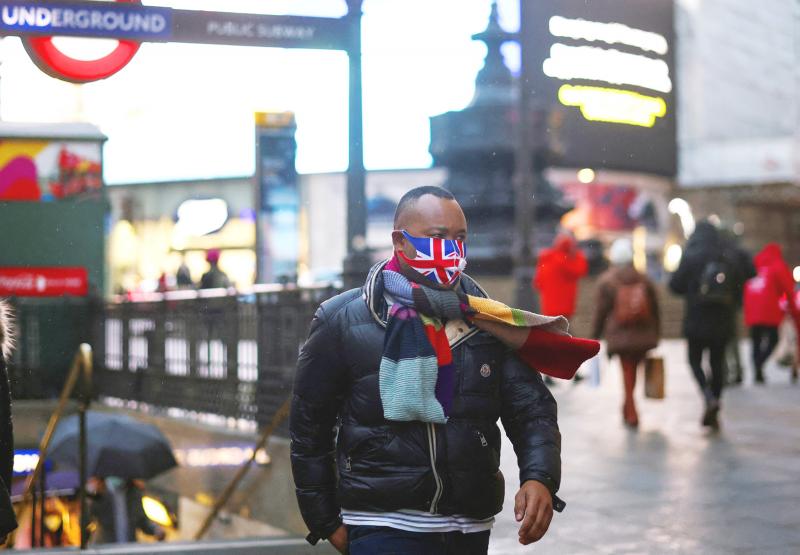
Photo: Reuters
Michael Lewis, a researcher from Cardiff University’s School of Psychology and an expert on faces, said that research carried out before the pandemic found that medical masks reduced attractiveness, because they were associated with disease or illness.
“We wanted to test whether this had changed since face coverings became ubiquitous, and understand whether the type of mask had any effect,” he said.
“Our study suggests faces are considered most attractive when covered by medical face masks. This may be because we’re used to healthcare workers wearing blue masks and now we associate these with people in caring or medical professions,” Lewis said. “At a time when we feel vulnerable, we may find the wearing of medical masks reassuring and so feel more positive towards the wearer.”
The first part of the research was carried out in February last year, by which time the British population had become used to wearing masks in some circumstances.
Forty-three women were asked to rate on a scale of one to 10 the attractiveness of images of male faces without a mask, wearing a plain cloth mask, a blue medical mask and holding a plain black book covering the area a mask would hide.
The participants said those wearing a cloth mask were significantly more attractive than the ones with no masks or whose faces were partly obscured by the book, but the surgical mask — which was just a normal, disposable one — made the wearer look even better.
“The results run counter to the pre-pandemic research where it was thought masks made people think about disease and the person should be avoided,” Lewis said. “The pandemic has changed our psychology in how we perceive the wearers of masks. When we see someone wearing a mask we no longer think: ‘That person has a disease, I need to stay away.’”
“This relates to evolutionary psychology and why we select the partners we do. Disease and evidence of disease can play a big role in mate selection — previously any cues to disease would be a big turn-off. Now we can observe a shift in our psychology such that face masks are no longer acting as a contamination cue,” he said.
Lewis said it was also possible that masks made people more attractive because they directed attention to the eyes.
He said other studies had found that covering the left or right half of a face also made people look more attractive, partly because the brain fills in the missing gaps and exaggerates the overall impact.
The results of the first study has been published in the journal Cognitive Research: Principles and Implications.
A second study has been carried out, in which a group of men look at women in masks.
It has yet to be published, but Lewis said the results were broadly the same.
The researchers did not ask the participants to clarify their sexual orientations.

Yemen’s separatist leader has vowed to keep working for an independent state in the country’s south, in his first social media post since he disappeared earlier this month after his group briefly seized swathes of territory. Aidarous al-Zubaidi’s United Arab Emirates (UAE)-backed Southern Transitional Council (STC) forces last month captured two Yemeni provinces in an offensive that was rolled back by Saudi strikes and Riyadh’s allied forces on the ground. Al-Zubaidi then disappeared after he failed to board a flight to Riyadh for talks earlier this month, with Saudi Arabia accusing him of fleeing to Abu Dhabi, while supporters insisted he was

The Chinese Embassy in Manila yesterday said it has filed a diplomatic protest against a Philippine Coast Guard spokesman over a social media post that included cartoonish images of Chinese President Xi Jinping (習近平). Philippine Coast Guard spokesman Jay Tarriela and an embassy official had been trading barbs since last week over issues concerning the disputed South China Sea. The crucial waterway, which Beijing claims historic rights to despite an international ruling that its assertion has no legal basis, has been the site of repeated clashes between Chinese and Philippine vessels. Tarriela’s Facebook post on Wednesday included a photo of him giving a
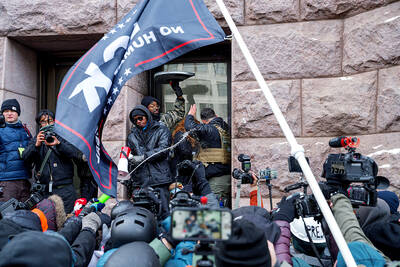
‘MOBILIZED’: While protesters countered ICE agents, Minnesota Governor Tim Walz activated the state’s National Guard to ‘support the rights of Minnesotans’ to assemble Hundreds of counterprotesters drowned out a far-right activist’s attempt to hold a small rally in support of US President Donald Trump’s latest immigration crackdown in Minneapolis, Minnesota, on Saturday, as the governor’s office announced that National Guard troops were mobilized and ready to assist law enforcement, although not yet deployed to city streets. There have been protests every day since the US Department of Homeland Security (DHS) ramped up immigration enforcement in the Twin Cities of Minneapolis and Saint Paul by bringing in more than 2,000 federal officers. Conservative influencer Jake Lang organized an anti-Islam, anti-Somali and pro-US Immigration and Customs Enforcement
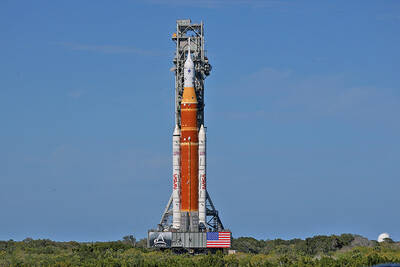
NASA on Saturday rolled out its towering Space Launch System (SLS) rocket and Orion spacecraft as it began preparations for its first crewed mission to the Moon in more than 50 years. The maneuver, which takes up to 12 hours, would allow the US space agency to begin a string of tests for the Artemis 2 mission, which could blast off as early as Feb. 6. The immense orange and white SLS rocket, and the Orion vessel were slowly wheeled out of the Vehicle Assembly Building at the Kennedy Space Center in Florida, and painstakingly moved 6.5km to Launch Pad 39B. If the


 RSS
RSS