


It is a hulking metal-and-concrete platform in the North Sea that has been run as an independent micronation in defiance of the British government for the past 54 years, but even on Sealand, about 11km off southeast England, visitors have to show a negative COVID-19 test before being winched up onto the deck.
“We have zero COVID cases,” Liam Bates, one of the self-declared “princes” of Sealand, said proudly.
“At the moment I think we’re one of the only countries in the world that can actually say that,” he said.
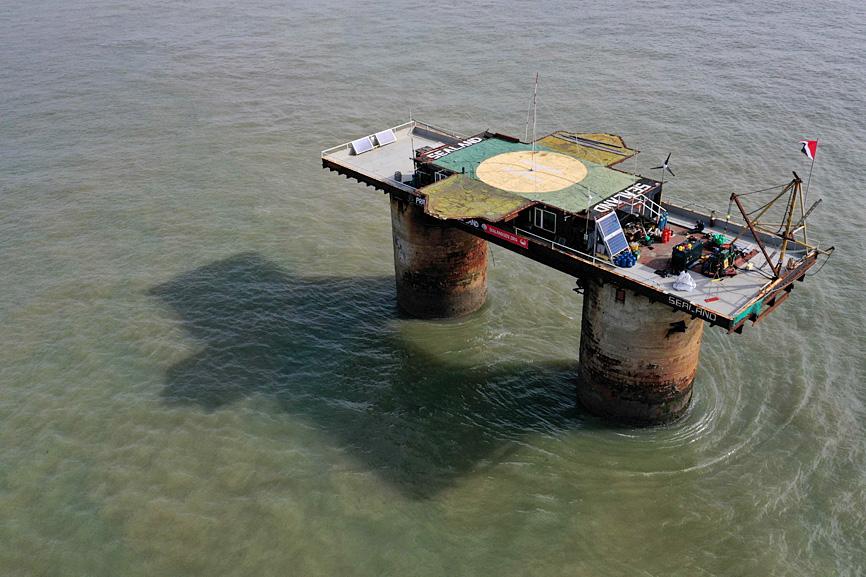
Photo: AFP
Sealand, a former anti-aircraft platform built atop two hollow concrete towers, had been due to be demolished after World War II, as it was outside UK waters.
However, when that did not happen, Bates’ grandfather Roy, a businessman with ventures in fishing and pirate radio, took over and declared independence.
The Principality of Sealand — motto “E Mare Libertas” (“From the Sea, Freedom”) — was born in 1967, with its own constitution, a national flag and even an anthem.
Since then, the windswept former fortification has survived an attempted “coup,” a collapsed data storage venture and a catastrophic fire.
With its black-red-and-white flag flying, Sealand still has a piratical air.
Engineer Joe Hamill, 58, winches up visitors in a wooden swing, as they tightly grip the ropes.
On board, the first formality is a Sealand passport stamp.
INSIDE
Close up, Sealand looks reassuringly shipshape with new decking and neatly stored tools, paints and tins of hot dogs.
The kitchen has pot plants and china plates, while the rooms are decorated with wallpaper, rugs and classic books, including Thomas Hardy’s Far From the Madding Crowd.
Liam Bates, now 33, has been visiting since he was three and springs onto the swing seat with practiced ease.
He focuses on the day-to-day operations, while his elder brother, James, runs the family’s cockle fishing and canning business.
Their father, Prince Michael, is recovering from surgery and “slowing down a bit,” Liam Bates said.
As he has an American fiancee and an elder brother, he jokes that he is Sealand’s “Prince Harry.”
Sealand keeps afloat by selling titles through its Web site. People can become a Lord of Sealand for £29.99 ($39.72) or a Duke for £499.99.
They sell “a good few,” Liam Bates said. “Enough to sustain Sealand now, which is just massive.”
Sealand does not pay UK tax and the “whole point ... is freedom of whatever you want, really: like religion, expression any kind of orientations,” he said.
While the Bates only visit, the platform is maintained by two men on two-week shifts: Hamill and 66-year-old Michael Barrington, head of homeland security.
During COVID-19 lockdowns, Hamill said that he volunteered to spend two 11-week periods on Sealand on his own, winching up supplies from a boat.
By the end, “I think my mental state was actually going a bit”, said the Londoner, who used to work in insurance. “It was pure isolation.”
At least Sealand is far more comfortable than in its early days, the men said.
Wind turbines and solar panels have replaced the old diesel generators, one of which caught fire in 2012, causing extensive damage.
Rooms inside the concrete towers include a chapel, a recreation room with a pool table and gym equipment, and a meeting room with a whiteboard.
Some are below the waterline and there is a constant sound of sloshing water.
Barrington, who first came to Sealand 33 years ago after working on pirate radio stations, calls it “a big man cave.”
There is little trace of Sealand’s World War II origins, beyond a painted sign about pumps.
Liam Bates said that most got ripped out in the early 2000s, when US entrepreneurs tried to set up a data haven in the towers.
It became “a victim of the dot.com bubble,” he said, while servers remain in one room “as part of our national history.”
He still sees the future of Sealand as digital, with plans to launch a cryptocurrency, although he gave few details.
DISPUTES
A small prison cell with an iron bedstead once housed the state’s only prisoner in 1978 during “the great coup of Sealand.”
After a dispute with Roy Bates, a German businessman sent mercenaries to storm the platform while he was away.
Roy Bates and his son Michael recaptured Sealand in a dawn raid in a helicopter and released the mercenaries, but held the businessman’s lawyer, accusing him of treason.
He was eventually freed after a German diplomat came out to investigate.
This is not the only violent episode in Sealand history.
In 1967, the Bates fought off a boarding party from Radio Caroline, a popular pirate radio station, throwing down Molotov cocktails.
In 1968, Roy and Michael Bates were tried for weapons offenses after firing on passing ships, but the court ruled that the fort was outside British jurisdiction.
“My dad [Michael] taught us to fire guns and all that sort of stuff,” said Liam Bates, who is cagey about whether there are weapons on board now.
“We’re equipped to protect ourselves, because obviously we’ve been attacked in the past,” he said.
Since 1987, the platform has been legally in British waters, although the UK is not trying to claim it back.
“I think they like to pretend we don’t exist, and just hope that one day we’ll pack up and leave,” Liam Bates said. “Which of course is never going to happen.”

School bullies in Singapore are to face caning under new guidelines, but the education minister on Tuesday said it would be meted out only as a last resort with strict safeguards. Human rights groups regularly criticize Singapore for the use of corporal punishment, which remains part of the school and criminal justice systems, but authorities have defended it as a deterrent to crime and serious misconduct. Caning was discussed in the parliament after legislators asked how it would be used in relation to bullying in schools. The debate followed stricter guidelines on serious student misconduct, including bullying, unveiled by the Singaporean Ministry of
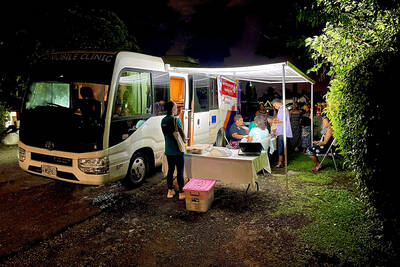
As evening falls in Fiji’s capital, a steady stream of people approaches a makeshift clinic that is a first line of defense against one of the world’s fastest-growing HIV epidemics. In the South Pacific nation — a popular tourist destination of just under a million people — more than 2,000 new HIV cases were recorded last year, a 26 percent increase from 2024. The government has declared an HIV outbreak and described it as a national crisis. “It’s spreading like wildfire,” said Siteri Dinawai, 46, who came to be tested. The Moonlight Clinic, a converted minibus parked in a suburban cul-de-sac in Suva, is
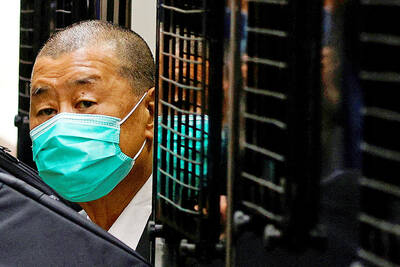
Jailed media entrepreneur Jimmy Lai (黎智英) has been awarded Deutsche Welle’s (DW) freedom of speech award for his contribution to Hong Kong’s pro-democracy movement. The German public broadcaster on Thursday said Lai would be presented in absentia with the 12th iteration of the award on June 23 at the DW Global Media Forum in Bonn. Deutsche Welle director-general Barbara Massing praised the 78-year-old founder of the now-shuttered news outlet Apple Daily for standing “unwaveringly for press freedom in Hong Kong at great personal risk.” “With Apple Daily, he gave journalists a platform for free reporting and a voice to the democracy movement in

A MESSAGE: Japan’s participation in the Balikatan drills is a clear deterrence signal to China not to attack Taiwan while the US is busy in the Middle East, an analyst said The Japan Self-Defense Forces yesterday fired a Type 88 anti-ship missile during a joint maritime exercise with US, Australian and Philippine forces, hitting a decommissioned Philippine Navy ship in waters facing the disputed South China Sea, in drills that underscore Tokyo’s rising willingness to project military power on China’s doorstep. The drill took place as Manila and Tokyo began talks on a potential defense equipment transfer, made possible by Japan’s decision to scrap restrictions on military exports. The discussions include the possible early transfer of Abukuma-class destroyers and TC-90 aircraft to the Philippines, Japanese Minister of Defense Shinjiro Koizumi said. Philippine Secretary of


 RSS
RSS