


A Singaporean court yesterday put the execution of a Malaysian man in a drug trafficking case on hold after a last-ditch legal challenge, his lawyer said, following criticism from campaigners who say he is mentally disabled.
Nagaenthran K. Dharmalingam was arrested in 2009 for carrying 43g — about 3 tablespoons — of heroin into the city-state, which has some of the world’s toughest anti-drugs laws.
He was sentenced to death the following year and was due to be hanged tomorrow after losing several appeals, despite supporters’ claims his intellectual disability means he cannot make rational decisions.
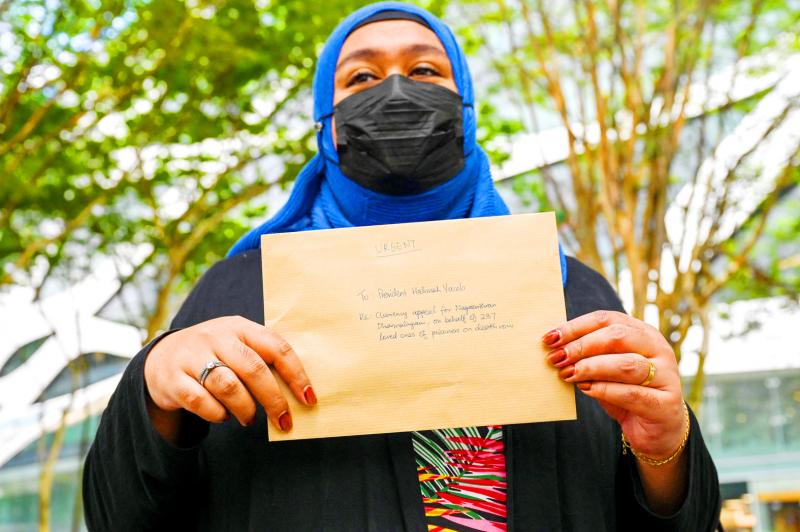
Photo: AFP
However, the Singapore High Court yesterday agreed to postpone the execution pending a new appeal from his lawyers, who are arguing that the hanging would be unconstitutional.
“Good news,” Nagaenthran’s lawyer, M. Ravi, wrote on Facebook, alongside the hashtags #End
CrimeNotLife and #DivineJustice.
The case is now to head to the Court of Appeal for further hearings. It was not immediately clear how long the execution would be halted.
Rights groups, including Amnesty International and Human Rights Watch, have labeled the planned execution “despicable” and “cruel,” while the EU at the weekend urged the city-state to commute the sentence.
More than 200 family members and friends of prisoners who have lived on death row in Singapore have also called for Nagaenthran to be spared, and for the death penalty to be abolished.
“There are no words to describe the pain of having a loved one on death row. Perhaps that is why we don’t often speak of it, and our suffering goes unnoticed,” they wrote in an open letter published by the Transformative Justice Collective.
“Nagen’s family has been unable to visit him for two years, during the pandemic border closure, and with two weeks’ notice that their worst nightmare has arrived, they have to scramble to see him through a glass wall for just a few days before the date of execution,” they said.
Malaysian Prime Minister Ismail Sabri Yaakob wrote to his Singapore counterpart urging the execution to be postponed on “humanitarian grounds,” reports said.
If it goes ahead, it will the first hanging since 2019 in Singapore, which defends its use of capital punishment as an effective deterrent against crime, in spite of mounting calls for its abolition.
Supporters say Nagaenthran has an IQ of 69, a level recognized as an intellectual disability, and was struggling with an alcohol problem at the time of the crime.
However, the Singaporean Ministry of Home Affairs has said that the legal rulings had found he “knew what he was doing” at the time of the offense.
Additional reporting by the Guardian

Crowds in Bangladesh are flocking to snap photographs with an unlikely social media star — an albino buffalo with flowing blond hair nicknamed “Donald Trump” that is due to be sacrificed within days. Owner Zia Uddin Mridha, 38, said his brother named the 700kg bull over its flowing helmet of hair resembling the signature look of the US president. “My younger brother picked this name because of the buffalo’s extraordinary hair,” he said at his farm in Narayanganj, just outside the capital, Dhaka. Mridha said that a constant stream of curious visitors — social media fans, onlookers and children — have come throughout

The Bolivian government on Friday struck a deal with protesting miners, but was still grappling with blockades and demonstrations by other workers across La Paz. Other groups are still blocking access roads into the city, which is also the seat of the government. Police on Thursday prevented the miners from entering the main square by using tear gas, while the demonstrators hurled stones and explosives with slingshots. Protests against the policies of Bolivian President Rodrigo Paz have convulsed the Andean nation since early this month, and roadblocks were choking routes into La Paz throughout Friday, the national road authority said. Miners demanded that Paz
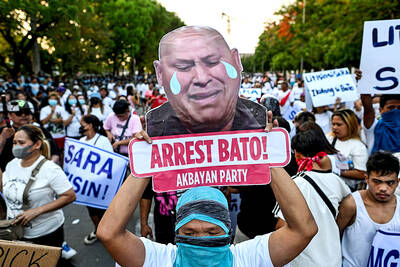
The Philippines said it has asked the country’s Supreme Court to allow it to arrest former Philippine president Rodrigo Duterte’s chief drug war enforcer to stand trial in an international tribunal. The International Criminal Court (ICC) last week unsealed an arrest warrant against Philippine Senator Ronald dela Rosa, accusing him along with Duterte and other “coperpetrators” of the “crime against humanity of murder.” Dela Rosa briefly sought refuge in the Philippine Senate last week while asking the Philippine Supreme Court to stop an ongoing attempt by government agents to arrest him. “By his own conduct, he has placed himself outside the protection of

The researchers in Ireland looked at their computer screen, marveling at a medieval book tracked down in a Roman library. They flipped through its digitized pages and found their sought-after treasure: the oldest surviving English poem. “We were extremely surprised. We were speechless. We couldn’t believe our eyes when we first saw that,” said Elisabetta Magnanti, a visiting research fellow at Trinity College Dublin’s school of English. The poem was also within the main body of Latin text, she said, calling it “extraordinary.” Composed in Old English by a Northumbrian agricultural worker in the 7th century, Caedmon’s Hymn appears within some copies of


 RSS
RSS