


China on Monday announced a drastic cut to children’s online gaming time to just three hours a week during the school term, the latest move in a broad crackdown on technology giants in the world’s biggest gaming market.
Gamers under 18 would only be allowed to play online between 8pm and 9pm on Fridays, Saturdays and Sundays, Xinhua news agency reported, in what it described as a bid to curb gaming addiction in the nation.
Gamers would be required to use their ID cards when registering to play online, to ensure minors do not lie about their age.
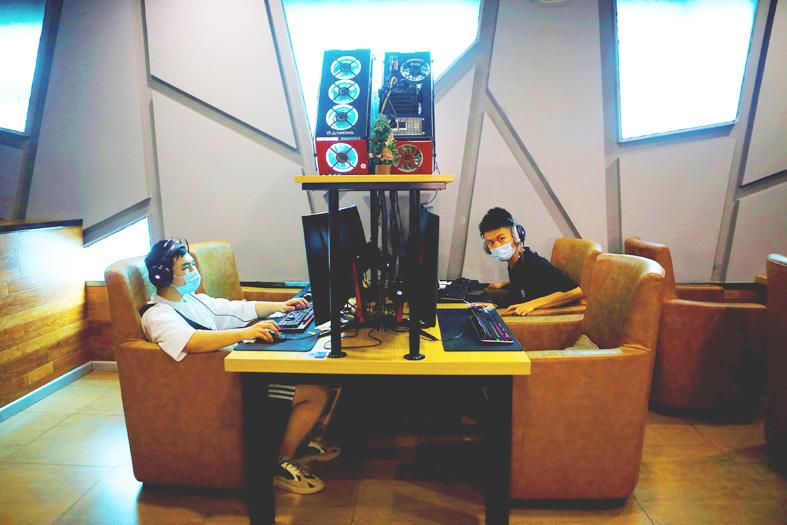
Photo: Reuters
On school holidays, children would be allowed to play a little longer, with the allocated time set at 60 minutes per day.
“Gaming addiction has affected studies and normal life ... and many parents have become miserable,” the National Press and Publication Administration said in a statement.
Companies are prohibited from offering gaming services outside the stipulated hours, although the statement did not make it clear how those breaking the rules would be punished.
An earlier restriction in place since late 2019 banned late-night games and restricted players to just 90 minutes of playing time on weekdays, and three hours on weekends and holidays.
The Chinese Communist Party has been reining in big technology and other powerful sectors that draw hundreds of millions of consumers.
Gaming seems to be the latest target for regulators, hit by a raft of rules introduced to weed out the excesses of the culture among Chinese youth, from worsening eyesight to online addiction.
The industry — which made revenue of 130 billion yuan (US$20.1 billion) in the first half of this year, according to the China Audio-Video and Digital Publishing Association — has been criticized in menacing state media reports, with one article labeling video games as “spiritual opium.”
Chinese technology giant Tencent in July rolled out a facial recognition “midnight patrol” function to root out children masquerading as adults to get around a government curfew on underage gamers.
In related news, a prominent blogger in a post widely circulated across state media said that the crackdown on celebrity culture and moves to rein in technology firms are a sign of “profound” political changes under way in the nation.
The Chinese government has taken action against what it has described as “chaotic” online fan club culture, and has also punished celebrities for tax evasion and other offenses.
In a wide-ranging series of interventions in the economy, it has also promised to tackle inequality, “excessively high” incomes, soaring property prices and profit-seeking educational institutions.
“This is a transformation from the capital at the center to people at the center,” Li Guangman (李光滿) wrote in an essay published by the People’s Daily. “This is also a return to the original intentions of the Chinese Communist Party ... a return to the essence of socialism.”
Li, a former editor at a state-run publication, said that China’s markets would “no longer be a paradise allowing capitalists to get rich overnight,” adding that culture would not be a haven for celebrities and public opinion would “no longer be a place to worship Western culture.”
“Therefore, we need to control all the cultural chaos, and build a lively, healthy, masculine, strong and people-oriented culture,” he wrote.
School bullies in Singapore are to face caning under new guidelines, but the education minister on Tuesday said it would be meted out only as a last resort with strict safeguards. Human rights groups regularly criticize Singapore for the use of corporal punishment, which remains part of the school and criminal justice systems, but authorities have defended it as a deterrent to crime and serious misconduct. Caning was discussed in the parliament after legislators asked how it would be used in relation to bullying in schools. The debate followed stricter guidelines on serious student misconduct, including bullying, unveiled by the Singaporean Ministry of

As evening falls in Fiji’s capital, a steady stream of people approaches a makeshift clinic that is a first line of defense against one of the world’s fastest-growing HIV epidemics. In the South Pacific nation — a popular tourist destination of just under a million people — more than 2,000 new HIV cases were recorded last year, a 26 percent increase from 2024. The government has declared an HIV outbreak and described it as a national crisis. “It’s spreading like wildfire,” said Siteri Dinawai, 46, who came to be tested. The Moonlight Clinic, a converted minibus parked in a suburban cul-de-sac in Suva, is

A MESSAGE: Japan’s participation in the Balikatan drills is a clear deterrence signal to China not to attack Taiwan while the US is busy in the Middle East, an analyst said The Japan Self-Defense Forces yesterday fired a Type 88 anti-ship missile during a joint maritime exercise with US, Australian and Philippine forces, hitting a decommissioned Philippine Navy ship in waters facing the disputed South China Sea, in drills that underscore Tokyo’s rising willingness to project military power on China’s doorstep. The drill took place as Manila and Tokyo began talks on a potential defense equipment transfer, made possible by Japan’s decision to scrap restrictions on military exports. The discussions include the possible early transfer of Abukuma-class destroyers and TC-90 aircraft to the Philippines, Japanese Minister of Defense Shinjiro Koizumi said. Philippine Secretary of

Separatists in Alberta are preparing to submit a petition tomorrow that they said has enough signatures to force a referendum on independence for the oil-rich Canadian province. Polls indicate the pro-independence camp remains a minority among Alberta’s 5 million people, but has hit a historic high of roughly 30 percent. Alberta separatists are also closer than ever to forcing a referendum, riding momentum fueled by intensifying grievances over Ottawa’s control of the provincial oil industry. They have also undeniably gotten a boost from the return to power of US President Donald Trump. After launching a petition in January, Stay Free Alberta, the group


 RSS
RSS