


Even before the final US flight left Kabul at midnight on Monday, many of the bright and garish sights and sounds of city life in Afghanistan were changing as those left behind tried to fit in with the tone of their new Taliban rulers.
The Taliban has so far been at pains to show a more conciliatory face to the world, with none of the harsh public punishments and outright bans on public entertainments that characterized their previous time in power before 2001.
Cultural activities are allowed, it says, as long as they do not go against Sharia law and Afghanistan’s Islamic culture.
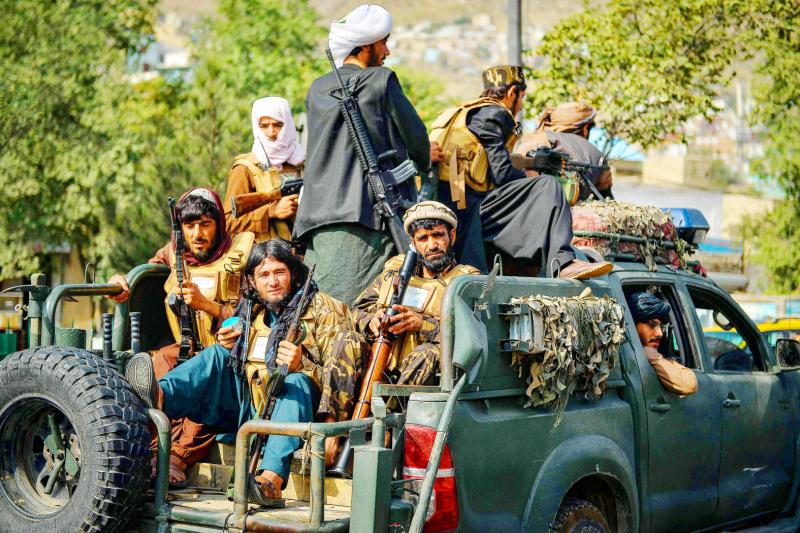
Photo: AFP
Taliban authorities in Kandahar, the birthplace of the movement, last week issued a formal order against radio stations playing music and female announcers, but for many, no formal order was necessary.
Already, colorful signs outside beauty parlors have been painted over, jeans have been replaced by traditional dress and radio stations have replaced their normal menu of Hindi and Persian pop and call-in shows with somber patriotic music.
“It’s not that the Taliban ordered us to change anything, we have altered the programming for now as we don’t want Taliban to force us to close down,” said Khalid Sediqqi, a producer at a private radio station in the central city of Ghazni.
“Also no one in this country is in the mood for entertainment, we are all in a state of shock,” Sediqqi said. “I am not even sure if anyone is tuning to radio anymore.”
During the 20 years of Western-backed government, a lively popular culture grew up in Kabul and other cities with a mash-up of body building, energy drinks, extravagant sculpted hairstyles and jangly pop songs. Turkish soap operas, call-in programs and television talent shows such as Afghan Star became major hits.
For senior Taliban, many raised in religious madrasahs and with the experience of years of fighting and hardship, the change is overdue.
“Our culture has become toxic, we see Russian and American influence everywhere even in the food we eat, that is something people should realize and make necessary changes,” a Taliban commander said. “This will take time, but it will happen.”
Across the country, the change has been noticeable.
While senior Taliban officials have said repeatedly their forces should treat the population respectfully and not hand out arbitrary punishments, many mistrust them or do not believe they can control the footsoldiers on the streets.
Zarifullah Sahel, a journalist in Laghman Province near Kabul, said that the head of the Taliban’s local cultural commission told the state-run public radio and six other private stations to adjust their programming to ensure it was in line with Shariah law.
Since then music programs and political, cultural and news programming not related to religious issues had dried up.
Even where formal orders have not been issued, the message that the freewheeling era has come to an end and that it is safer not to stand out has been clear.
“I fear the Taliban may target me if I was seen wearing jeans or Western shirts or a suit,” said Mustafa Ali Rahman, a former tax official in Lagman Province.
“One just doesn’t know what they can do to punish us,” he said.

A ship that appears to be taking on the identity of a scrapped gas carrier exited the Strait of Hormuz on Friday, showing how strategies to get through the waterway are evolving as the Middle East war progresses. The vessel identifying as liquefied natural gas (LNG) carrier Jamal left the Strait on Friday morning, ship-tracking data show. However, the same tanker was also recorded as having beached at an Indian demolition yard in October last year, where it is being broken up, according to market participants and port agent’s reports. The ship claiming to be Jamal is likely a zombie vessel that

Cannabis-based medicines have shown little evidence of effectiveness for treating most mental health and substance-use disorders, according to a large review of past studies published in a major medical journal on Monday. Medical use of cannabinoids has been expanding, including in the US, Canada and Australia, where many patients report using cannabis products to manage conditions such as anxiety, post-traumatic stress disorder and sleep problems. Researchers reviewed data from 54 randomized clinical trials conducted between 1980 and May last year involving 2,477 participants for their analysis published in The Lancet. The studies assessed cannabinoids as a primary treatment for mental disorders or substance-use
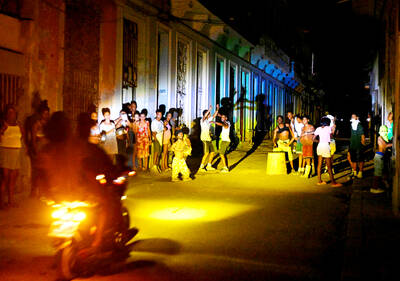
NATIONWIDE BLACKOUT: US President Donald Trump cut off Venezuelan oil shipments to Cuba, strangling the Caribbean island’s already antiquated grid Cuba’s national electric grid collapsed on Monday, the nation’s grid operator said, leaving about 10 million people without power amid a US-imposed oil blockade that has crippled the already obsolete generation system. Grid operator UNE on social media said that it is investigating the causes of the blackout, the latest in a series of widespread outages that last for hours or days and that this weekend sparked a rare violent protest in the communist-run nation. Officials ruled out a major power plant failure, but had still not pinpointed the root cause of the grid collapse, suggesting a problem with transmission. Officials said that

‘HEALTH ISSUE’: More than 250 women are hospitalized every day due to complications from unsafe abortions, and about three die, a study showed Jane had been bleeding heavily for days before finally seeking help, not from a hospital, but from the man who sold her the pills meant to end her six-week pregnancy. Abortions are strictly outlawed in the mainly Catholic Philippines, forcing women to turn to a patchwork of providers operating in the online shadows. While rare in practice, Philippine law allows for prison terms of up to six years for abortion patients and providers, leaving thousands of Filipinas to search for solutions in online forums where unlicensed sellers promote abortifacients. “It was very painful, as if my abdomen was being twisted,” said Jane, whose


 RSS
RSS