


Jin-hui, a cream-colored Pomeranian, was buried alive and left for dead in 2018 in the South Korean port city of Busan.
No charges were filed against its owner at the time, but animal abusers and those who abandon pets are soon to face harsher punishment as South Korea plans to amend its civil code to grant animals legal status, South Korean Office of Legal Counsel Director-General Choung Jae-min said in an interview.
The amendment, which must still be approved by the South Korean National Assembly, likely during its regular session next month, would make South Korea one of a handful of countries to recognize animals as beings, with a right to protection, enhanced welfare and respect for life.
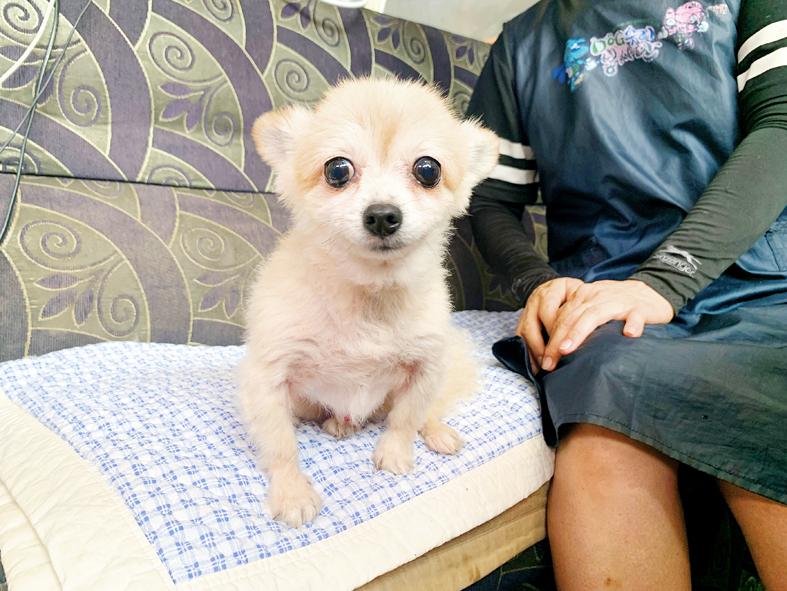
Photo: Reuters
The push for the amendment comes as the number of animal abuse cases increased to 914 in 2019 from 69 in 2010, data published by a lawmaker’s office showed, and the pet-owning population grew to more than 10 million people in the country of 52 million.
South Korea’s animal protection law states that anyone who abuses or is cruel to animals may be sentenced to a maximum of three years in prison or fined 30 million won (US$25,498), but the standards to decide penalties have been low as animals are treated as objects under the existing legal system, Choung said.
Once South Korea’s Civil Act states that animals are no longer simply things, judges and prosecutors would have more options when determining sentencing, he said.

Photo: Reuters
The proposal has met with skepticism from the Korea Pet Industry Retail Association, which said that laws are in place to protect animals.
“The revision will only call for means to regulate the industry by making it difficult to adopt pets, which will impact greatly not only the industry, but the society as a whole,” association director-general Kim Kyoung-seo said.
Choung said that the amended civil code would also pave the way for follow-up efforts, such as life insurance packages for animals and the obligation to rescue and report roadkill.
The amendment is likely to be passed, said lawmaker Park Hong-keun, who heads the Animal Welfare Parliamentary Forum, as there is widespread social consensus that animals should be protected and respected as living beings that coexist in harmony with people.
Animal rights groups welcomed the South Korean Ministry of Justice’s plan, while calling for stricter penalties for those who abandon or torture animals, as well as a ban on dog meat.
“Abuse, abandonment and neglect for pets have not improved in our society,” Korea Animal Rights Advocates head Cheon Chin-kyung said.
Despite a slight drop last year, animal abandonment rose to 130,401 cases last year from 89,732 in 2016, the South Korean Animal and Plant Quarantine Agency said.
South Korea has about 6 million dogs and 2.6 million cats.
Jin-hui, which means “true light” in Korean, now enjoys spending time with other dogs at an animal shelter south of Seoul.
“Its owner lost his temper and told his kids to bury it alive. We barely managed to save it after a call, but the owner wasn’t punished, as the dog was recognized as an object owned by him,” shelter manager Kim Gea-yeung said. “Animals are certainly not objects.”

PRECARIOUS RELATIONS: Commentators in Saudi Arabia accuse the UAE of growing too bold, backing forces at odds with Saudi interests in various conflicts A Saudi Arabian media campaign targeting the United Arab Emirates (UAE) has deepened the Gulf’s worst row in years, stoking fears of a damaging fall-out in the financial heart of the Middle East. Fiery accusations of rights abuses and betrayal have circulated for weeks in state-run and social media after a brief conflict in Yemen, where Saudi airstrikes quelled an offensive by UAE-backed separatists. The United Arab Emirates is “investing in chaos and supporting secessionists” from Libya to Yemen and the Horn of Africa, Saudi Arabia’s al-Ekhbariya TV charged in a report this week. Such invective has been unheard of
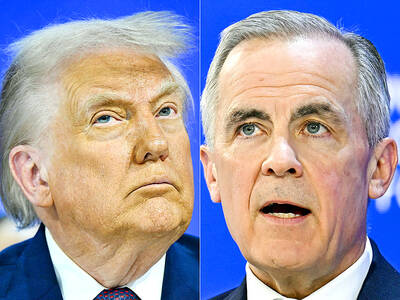
US President Donald Trump on Saturday warned Canada that if it concludes a trade deal with China, he would impose a 100 percent tariff on all goods coming over the border. Relations between the US and its northern neighbor have been rocky since Trump returned to the White House a year ago, with spats over trade and Canadian Prime Minister Mark Carney decrying a “rupture” in the US-led global order. During a visit to Beijing earlier this month, Carney hailed a “new strategic partnership” with China that resulted in a “preliminary, but landmark trade agreement” to reduce tariffs — but

Chinese President Xi Jinping’s (習近平) purge of his most senior general is driven by his effort to both secure “total control” of his military and root out corruption, US Ambassador to China David Perdue said told Bloomberg Television yesterday. The probe into Zhang Youxia (張又俠), Xi’s second-in-command, announced over the weekend, is a “major development,” Perdue said, citing the family connections the vice chair of China’s apex military commission has with Xi. Chinese authorities said Zhang was being investigated for suspected serious discipline and law violations, without disclosing further details. “I take him at his word that there’s a corruption effort under

China executed 11 people linked to Myanmar criminal gangs, including “key members” of telecom scam operations, state media reported yesterday, as Beijing toughens its response to the sprawling, transnational industry. Fraud compounds where scammers lure Internet users into fake romantic relationships and cryptocurrency investments have flourished across Southeast Asia, including in Myanmar. Initially largely targeting Chinese speakers, the criminal groups behind the compounds have expanded operations into multiple languages to steal from victims around the world. Those conducting the scams are sometimes willing con artists, and other times trafficked foreign nationals forced to work. In the past few years, Beijing has stepped up cooperation


 RSS
RSS