


African nations should build capacity to produce vaccines on the continent and work with pharmaceutical companies to ensure that the raw materials needed to produce the inoculations are available, WTO Director-General Ngozi Okonjo-Iweala said.
While a waiver on the Agreement on Trade-Related Aspects of Intellectual Property Rights that is being discussed at the WTO is seen as a way to improve the supply of COVID-19 vaccines to the world’s least inoculated continent, Okonjo-Iweala said that only a handful of African countries have the capacity to produce the life-saving drugs.
“There [are] a handful of countries — maybe Tunisia, Morocco to some extent, Senegal, South Africa — where we have some capacity; that’s why we are importing 99 percent of our vaccines,” Okonjo-Iweala said in a Webinar hosted by the UN Economic Commission for Africa.
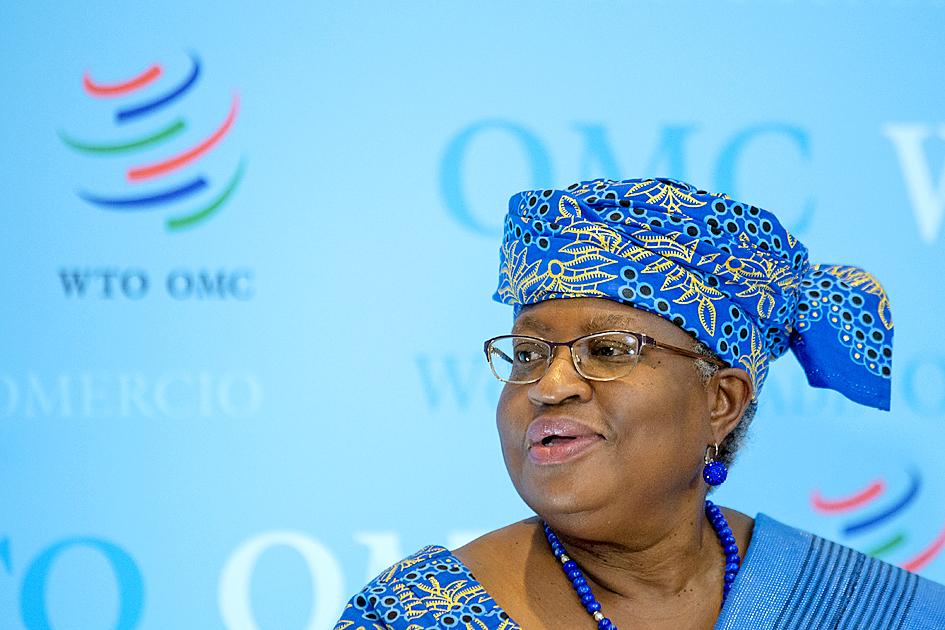
Photo: EPA-EFE
“If we get IP [intellectual property] today, we won’t be able to do anything with it because we don’t have investment, we don’t have manufacturing capacity,” she said.
WTO members are divided over the question of whether a waiver to the its intellectual property rules for vaccines is the best way to expand access to life-saving drugs in the developing world.
Negotiations are moving very slowly as parties try to come to a “pragmatic, sensible agreement that allows developing countries access to technology, know-how and find a solution on intellectual property that does not also disincentivize research and negotiations,” she said.
A meeting with heads of vaccine manufacturers including Johnson & Johnson, Pfizer Inc, Moderna Inc, the makers of Russia’s Sputnik jab and Sinopharm Group Co at the WTO last week showed that companies are interested in boosting investments on the continent, she said.
Johnson & Johnson is having its inoculations produced on a so-called fill-finish basis in South Africa by Aspen Pharmacare Holdings Ltd, where Aspen packages the doses using ingredients supplied by Johnson & Johnson.
Pfizer last week signed a similar agreement with the Biovac Institute in Cape Town and Sinopharm’s doses are made in Egypt.
So far just 1.4 percent of Africa’s 1.2 billion people have been fully vaccinated against the disease.
Africa needs adequate access to vaccines for a sustainable economic recovery, Okonjo-Iweala said. The continent-wide economy last year contracted for the first time in a quarter century as restrictions to curb the spread of COVID-19 weighed on activity.

An American scientist convicted of lying to US authorities about payments from China while he was at Harvard University has rebuilt his research lab in Shenzhen, China, to pursue technology the Chinese government has identified as a national priority: embedding electronics into the human brain. Charles Lieber, 67, is among the world’s leading researchers in brain-computer interfaces. The technology has shown promise in treating conditions such as amyotrophic lateral sclerosis and restoring movement in paralyzed people. It also has potential military applications: Scientists at the Chinese People’s Liberation Army have investigated brain interfaces as a way to engineer super soldiers by boosting
Indonesian police have arrested 13 people after shocking images of alleged abuse against small children at a daycare center went viral, sparking outrage across the nation, officials said on Monday. Police on Friday last week raided Little Aresha, a daycare center in Yogyakarta on Java island, following a report from a former employee. CCTV footage circulating on social media showed children, most younger than two, lying on the floor wearing only diapers, their hands and feet bound with rags. The police have confirmed that the footage is authentic. Police said they also found 20 children crammed into a room just 3m by 3m. “So
Jailed media entrepreneur Jimmy Lai (黎智英) has been awarded Deutsche Welle’s (DW) freedom of speech award for his contribution to Hong Kong’s pro-democracy movement. The German public broadcaster on Thursday said Lai would be presented in absentia with the 12th iteration of the award on June 23 at the DW Global Media Forum in Bonn. Deutsche Welle director-general Barbara Massing praised the 78-year-old founder of the now-shuttered news outlet Apple Daily for standing “unwaveringly for press freedom in Hong Kong at great personal risk.” “With Apple Daily, he gave journalists a platform for free reporting and a voice to the democracy movement in
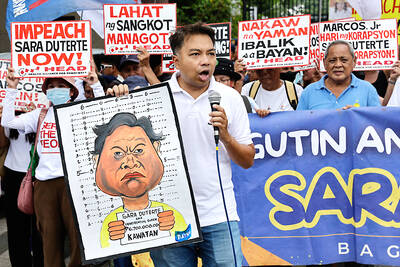
PHILIPPINE COMMITTEE: The head of the committee that made the decision said: ‘If there is nothing to hide, there is no reason to hide, there is no reason to obstruct’ A Philippine congressional committee on Wednesday ruled that there was “probable cause” to impeach Philippine Vice President Sara Duterte after hearing allegations of unexplained wealth, misuse of state funds and threats to have the president assassinated. The unanimous decision of the 53-member committee in the Philippine House of Representatives sends the two impeachment complaints to deliberations and voting by the entire lower chamber, which has more than 300 lawmakers. The complaints centered on Duterte’s alleged illegal use and mishandling of intelligence funds from the vice president’s office, and from her time as education secretary under Philippine President Ferdinand Marcos Jr. Duterte and the


 RSS
RSS