


In December 2019, police officers visited Ruslan Shaveddinov’s Moscow apartment, sawed through the door and placed him in handcuffs before whisking him away for forced military service in the Arctic.
Denied access to a cellphone — a breach of the rules, the 25-year-old opposition advocate said — he had to correspond with his loved ones via handwritten letters that took weeks to arrive.
“They sent me as far away as possible,” the ally of jailed Kremlin critic Alexei Navalny said.
Sequestered for one year to a military post accessible only by helicopter and surrounded by roaming polar bears, Shaveddinov said that he and the other four soldiers at the base even had to melt snow for drinking water.
“It was like I had been exiled, with no connection to the outside world, in unlivable conditions,” he said.
While military service is mandatory in Russia, with more than 250,000 men aged 18 to 27 conscripted each year, many Russians get out of it through medical or educational exemptions. Some also simply ignore the summons or pay bribes.
However, for those harboring opposition sympathies, avoiding service is a more complicated endeavor.
Opposition and rights advocates have said that conscription in recent years has become another weapon in the authorities’ arsenal in their drive to silence dissent.
In Shaveddinov’s case, the authorities had taken an interest in him that summer when Navalny’s aides organized protests in Moscow demanding fair elections.
Protesters also riled authorities that autumn by launching a voting strategy that saw Kremlin-linked candidates lose races in local polls.
Shaveddinov said he provided proof that he was medically unfit for military service, although his appeals were shut down three times.
However, Shaveddinov said that he did not think that his advocacy could result in forced conscription, in what he likened to the Soviet Union-era practice of exiling dissidents to the Gulag network of labor camps.
“It was impossible to imagine that such a practice would return to Russia,” he said. “That politically undesirable people would be sent into exile.”
Shaveddinov is one of three prominent Navalny allies who have been sent to the army against their will in the past five years. Four others have been prosecuted for evading military obligations.
Years before Shaveddinov’s case, human rights defender Oleg Kozlovsky was arrested in 2007 and sent to a military base in central Russia, despite being exempt as a full-time student.
“My case was a dangerous precedent. These methods began to be used over and over again,” the 36-year-old Amnesty International researcher said.
Describing conscription as “punishment without crime,” Kozlovsky said that it was “a way of isolating a person, cutting them off from contacts,” and is used “when it is difficult or impossible to fabricate a criminal case.”
The researcher believed that cases involving well-known opposition advocates were just the “tip of the iceberg.”
He pointed to Moscow rallies in the summer of 2019, when the Russian Investigative Committee, which probes major crimes, said that it had identified “134 cases of military evasion” among detained protesters.
This year, after rallies in support of Navalny in January and February, the committee’s head, Alexander Bastrykin, ordered investigators to probe if any had evaded service.
The Russian Ministry of Defense did not respond to requests for comment.

Four contenders are squaring up to succeed Antonio Guterres as secretary-general of the UN, which faces unprecedented global instability, wars and its own crushing budget crisis. Chile’s Michelle Bachelet, Argentina’s Rafael Grossi, Costa Rica’s Rebeca Grynspan and Senegal’s Macky Sall are each to face grillings by 193 member states and non-governmental organizations for three hours today and tomorrow. It is only the second time the UN has held a public question-and-answer, a format created in 2016 to boost transparency. Ultimately the five permanent members of the UN’s top body, the Security Council, hold the power, wielding vetoes over who leads the

A humanoid robot that won a half-marathon race for robots in Beijing on Sunday ran faster than the human world record in a show of China’s technological leaps. The winner from Honor, a Chinese smartphone maker, completed the 21km race in 50 minutes and 26 seconds, said a WeChat post by the Beijing Economic-Technological Development Area, also known as Beijing E-Town, where the race began. That was faster than the human world record holder, Ugandan Jacob Kiplimo, who finished the same distance in about 57 minutes in March at the Lisbon road race. The performance by the robot marked a significant step forward

An earthquake registering a preliminary magnitude of 7.7 off northern Japan on Monday prompted a short-lived tsunami alert and the advisory of a higher risk of a possible mega-quake for coastal areas there. The Cabinet Office and the Japan Meteorological Agency said there was a 1% chance for a mega-quake, compared to a 0.1% chance during normal times, in the next week or so following the powerful quake near the Chishima and Japan trenches. Officials said the advisory was not a quake prediction but urged residents in 182 towns along the northeastern coasts to raise their preparedness while continuing their daily lives. Prime
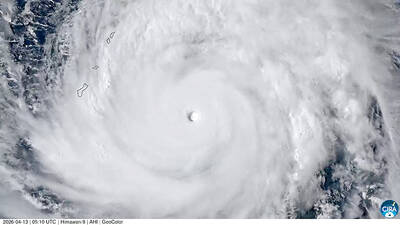
HAZARDOUS CONDITION: The typhoon’s sheer size, with winds extending 443km from its center, slowed down the ability of responders to help communities, an official said The US Coast Guard was searching for six people after losing contact with their disabled boat off the coast of Guam following Typhoon Sinlaku. The crew of the 44m dry cargo vessel, the US-registered Mariana, on Wednesday notified the coast guard that the boat had lost its starboard engine and needed assistance, Petty Officer 3rd Class Avery Tibbets said yesterday. The coast guard set up a one-hour communication schedule with the vessel, but lost contact on Thursday. A Coast Guard HC-130 Hercules aircraft was launched to search for the six people on board, but it had to return to Guam because of


 RSS
RSS