


The US Coast Guard was searching for six people after losing contact with their disabled boat off the coast of Guam following Typhoon Sinlaku.
The crew of the 44m dry cargo vessel, the US-registered Mariana, on Wednesday notified the coast guard that the boat had lost its starboard engine and needed assistance, Petty Officer 3rd Class Avery Tibbets said yesterday.
The coast guard set up a one-hour communication schedule with the vessel, but lost contact on Thursday. A Coast Guard HC-130 Hercules aircraft was launched to search for the six people on board, but it had to return to Guam because of heavy winds.
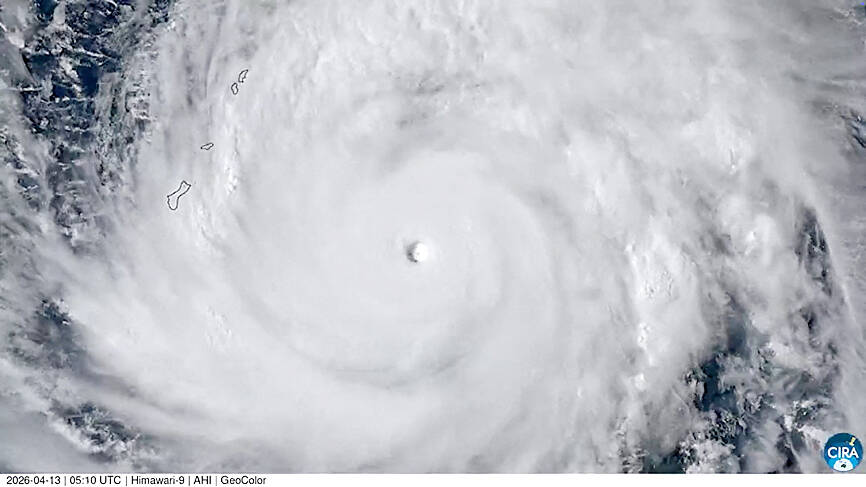
Photo: CSU/CIRA and JMA/JAXA via Reuters.
The search efforts were expected to resume at first light yesterday, Tibbets said, adding that the nationalities of the crew members were not known.
The last known position of the vessel was about 225km north-northwest of Saipan, the coast guard said.
Super Typhoon Sinlaku began battering the Northern Mariana Islands earlier this week, causing damage on the islands of Tinian and Saipan, and flash flooding in Guam, the site of several US military bases.
The typhoon was slowly moving northeast away from the island chain yesterday morning, and the storm is expected to weaken over the next few days, the National Weather Service said.
Tropical storm force gusts still remain a possibility and dangerous surf is expected to continue over the next few days, it added.
The Homeland Security and Emergency Management office for the Commonwealth of the Northern Mariana Islands (CNMI) issued a “hazardous seas warning” early yesterday morning for steep and dangerous swells reaching as high as 6m in the coastal waters surrounding the island chain.
The dangerous conditions could capsize or cause damage to vessels, and those conditions were expected to last until late yesterday afternoon, the announcement said.
The US Federal Emergency Management Agency (FEMA) and several other federal agencies are ramping up their response to Typhoon Sinlaku as the islands’ shelter-in-place orders begin to lift, said Robert Fenton, FEMA regional administrator for Region 9, which includes Guam and the Northern Mariana Islands.
“This is a very complex event, but we have a lot of experience and have worked very closely with Guam and CNMI over the years to prepare for these types of events and are well-positioned to do that again here today,” Fenton said.
A slew of federal agencies are on the ground to support the local governments, including the US Department of Defense, US Environmental Protection Agency, and US Health and Human Services.
The storm’s sheer size — with typhoon-force winds extending 443km from its center — was unique, Fenton said, adding that residents were subjected to roughly 48 hours of fierce winds, delaying responders’ ability to assess damage and help communities.
“It slows down our ability to respond to those needs, and I think it’s more physically and mentally impactful to those that have to go through that,” he said. “We think this will be a multimonth mission of emergency power.”
As the coast guard continues its search for the missing boat, US Air Force helicopters would be used to assess needs in some of the smaller, more remote and sparsely populated islands of the Northern Marianas, Fenton said.

‘CROSSING THE LINE’: China’s embassy in Seoul criticized US Forces Korea Commander General Xavier Brunson, asking if his ‘hostile’ remarks were authorized by Washington South Korea and the US are in talks over recent public remarks by the commander of US Forces Korea, Seoul’s presidential office said yesterday, after the comments drew sharp criticism from China. In a recent podcast interview, US Forces Korea Commander General Xavier Brunson described South Korea as “the dagger in the heart of Asia” from China’s east coast, prompting the Chinese embassy in Seoul to say that he had “truly crossed the line.” The interview came amid growing speculation that Washington might seek to expand the role of US Forces Korea in countering the growing regional influence of China, a key

SEEKING ORDER: Rodrigo Paz said that ‘anyone who wants to destroy the nation will have to deal with this president and the full force of the constitution’ Bolivian President Rodrigo Paz on Wednesday said that the nation was at a “breaking point” after nearly a month of protests that have caused shortages of food, fuel and medicine. Paz, who took office six months ago amid the worst economic crisis there in four decades, is battling a groundswell of fury over his policies. The political capital, La Paz, has been besieged by low-income workers and members of the indigenous majority calling for his resignation. “The country needs order and is reaching breaking point,” the 58-year-old said at a public event in La Paz, renewing his appeal for dialogue. On Tuesday, the Bolivian

Forecasters in Europe yesterday warned of exceptional heat as record temperatures driven by a “heat dome” push temperatures well above seasonal norms across the continent. The surge follows a record-breaking Monday, with France logging its hottest day in the month of May on record, its weather agency said, and the UK also posting unprecedented highs. A so-called “heat dome” of warm air from northern Africa trapped under a high-pressure system over western Europe is behind the high temperatures not usually seen until high summer. Restrictions on outdoor work were imposed in parts of Italy, beaches in southwest France filled earlier than usual and

Australian researchers have trained lab-grown brain cells on a silicon computer chip to play the 1990s shooter game Doom and said they are just scratching the surface of what the neurons could be capable of doing. It is the science-fiction work of biotech boffins at Cortical Labs, who researched and developed the technology that harnesses the workings of the brain’s networking system. Each so-called “biological computer” contains about 200,000 living human brain cells, grown from stem cells that were harvested from blood donations. Having mastered the simple computer game Pong, where a paddle is moved up and down to send a ball


 RSS
RSS