


Deprived of its usual tourist influx by the COVID-19 pandemic, Bethlehem is to celebrate a quiet Christmas this year that is less about commerce and more about religion, its parish priest said.
In a normal year, hundreds of thousands of visitors flood the Palestinian city in the Israeli-occupied West Bank, less than 10km from Jerusalem.
Those seeking a quiet moment of contemplation in the Church of the Nativity — the site of Christ’s birth, according to tradition — generally have to use their elbows to maneuver through the crowds.
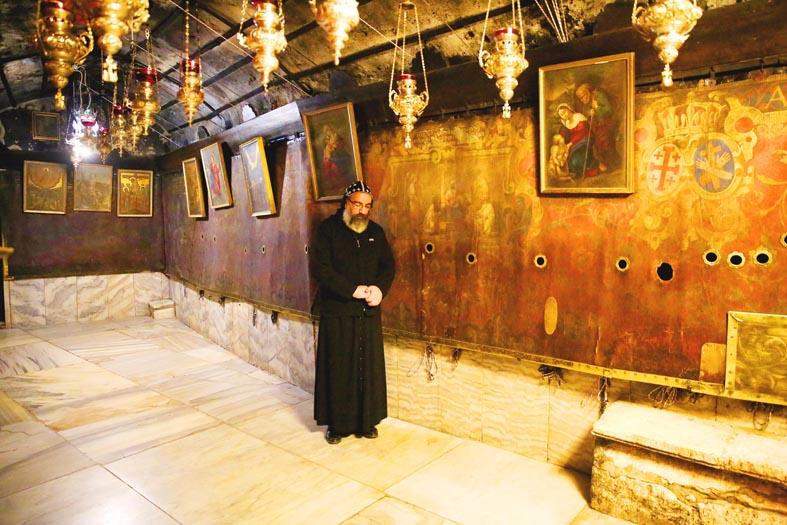
Photo: EPA-EFE
While the lack of visitors has been devastating for business owners, it has also offered a rare opportunity for solemn worship, said Father Rami Asakrieh, Bethlehem’s parish priest.
“Sometimes there are more than half million people who arrive in this period to visit the Nativity Church,” he said.
However, with COVID-19 restrictions making travel to Bethlehem all but impossible for foreign worshipers, the Church of the Nativity has been eerily calm in the days before Christmas.
Under the Grotto of the Nativity, the recitation of Armenian prayers by four monks echoed clearly through the basilica deserted of its typical throngs of visitors. The Christmas Eve Mass tomorrow, regarded as the most important annual event at the church, would be closed to the public.
Not even representatives of the Palestinian Authority are coming to Bethlehem tomorrow, Asakrieh said.
“It has never happened before,” he said, citing only past restrictions during the Palestinian intifadas, or uprisings, against Israel’s occupation.
“I think that this Christmas is different because people are not busy with the external manifestations of the feast,” the priest said, referring to the gift-buying that has, for many, become synonymous with Christmas.
“Now [people] have the time, and they are obligated, to concentrate on the essential... the theological spirit of Christmas,” he said.
“Less business, but more religion,” he said.
In the lead-up to Christmas, the small Chapel of Saint Catherine, adjacent to the Church of the Nativity, was opened to the local Palestinian population. Many turned out in their Sunday best, including Nicolas al-Zoghbi, who said that this year the joyfulnesses of Christmas had been replaced by “depression.”
He recounted the “heartache and pain” felt by those like his son who have lost their jobs due to the pandemic.
“We hope the Lord will destroy corona, just get rid of it so we can return to our previous life,” said al-Zoghbi, who is in his 70s.
Bethlehem’s economy is driven partly by an annual Christmas rush that benefits small shops selling postcards, rosaries carved from olive tree wood and other Nativity-related souvenirs.
Sitting outside his Bethlehem store on a plastic chair, Georges Baaboul said he “hadn’t sold anything for nine months.”
“In the last few days I sold about 170 shekels [US$52]” worth of goods, he said.
Sixty-year-old trader Saif said he had never seen things this bad through his 60 years in business, including during the intifadas.
This year, West Bank tradesmen cannot even count on Christian customers from Gaza, the coastal Palestinian enclave controlled by the Islamist group Hamas that is under Israeli blockade.
Gazan Christians generally receive special permission to cross to Bethlehem for Christmas, but this year those permits have not been issued, Father Youssef Asaad of the Latin monastery in Gaza said.
Hamas has imposed strict measures to limit the spread of the virus in the strip, including the closure of mosques and the Latin Church, but masses are being broadcast online.
Christian Gaza resident Issa Abou George said he could not buy gifts for his children this year, but would participate in services online.
“My family and I will pray to God for the pandemic to end as well as for peace, in the Holy Land and the world,” he said.

‘CROSSING THE LINE’: China’s embassy in Seoul criticized US Forces Korea Commander General Xavier Brunson, asking if his ‘hostile’ remarks were authorized by Washington South Korea and the US are in talks over recent public remarks by the commander of US Forces Korea, Seoul’s presidential office said yesterday, after the comments drew sharp criticism from China. In a recent podcast interview, US Forces Korea Commander General Xavier Brunson described South Korea as “the dagger in the heart of Asia” from China’s east coast, prompting the Chinese embassy in Seoul to say that he had “truly crossed the line.” The interview came amid growing speculation that Washington might seek to expand the role of US Forces Korea in countering the growing regional influence of China, a key

SEEKING ORDER: Rodrigo Paz said that ‘anyone who wants to destroy the nation will have to deal with this president and the full force of the constitution’ Bolivian President Rodrigo Paz on Wednesday said that the nation was at a “breaking point” after nearly a month of protests that have caused shortages of food, fuel and medicine. Paz, who took office six months ago amid the worst economic crisis there in four decades, is battling a groundswell of fury over his policies. The political capital, La Paz, has been besieged by low-income workers and members of the indigenous majority calling for his resignation. “The country needs order and is reaching breaking point,” the 58-year-old said at a public event in La Paz, renewing his appeal for dialogue. On Tuesday, the Bolivian

Through the noise of rushing papers and whirring belts at a print factory in Kyoto, two creators watch their photo essay come to life in broadsheet form — part of an effort to win new audiences in the age of artificial intelligence (AI). Despite the decline of the publishing industry, self-publication and handmade “zine” magazines are growing in popularity in Japan, reflecting the nation’s enduring love of paper in the digital era. While speaking to Agence France-Presse at the plant, his hands black with ink, one of the creators, Kazuma Obara, said: “I think [paper] is a medium that engages all five

Australian researchers have trained lab-grown brain cells on a silicon computer chip to play the 1990s shooter game Doom and said they are just scratching the surface of what the neurons could be capable of doing. It is the science-fiction work of biotech boffins at Cortical Labs, who researched and developed the technology that harnesses the workings of the brain’s networking system. Each so-called “biological computer” contains about 200,000 living human brain cells, grown from stem cells that were harvested from blood donations. Having mastered the simple computer game Pong, where a paddle is moved up and down to send a ball


 RSS
RSS