

Entering a Gaza City restaurant, customers are welcomed by a multitasking disinfection machine designed by a Palestinian businesswoman to curb the spread of COVID-19 in the crisis-hit enclave.
Spraying hand sanitiser while taking the person’s temperature, the 2m-high device offers an all-in-one disinfection experience.
If the body temperature is too high, a red signal would light up. Otherwise, the restaurant door opens automatically to allow the customer in.
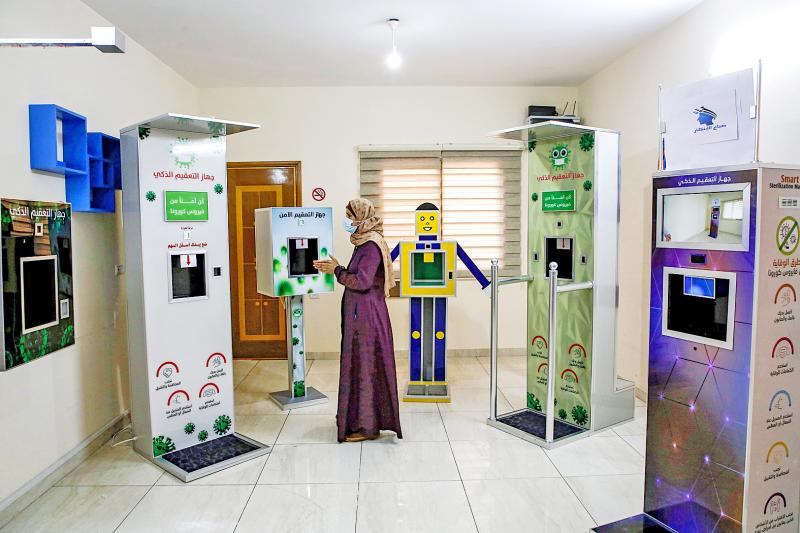
Photo: AFP
“In Gaza, we have basic devices imported from abroad to measure temperatures, and others to disinfect, but our devices combine multiple technologies in one,” creator Heba al-Hindi said.
The densely populated Palestinian coastal enclave, under an Israeli-enforced blockade since 2007, was initially largely spared by COVID-19 when the pandemic broke out.
However, dire economic conditions, a poor healthcare system and chronic electricity shortages, partly caused by the blockade, made Gaza especially vulnerable to the virus.
Confirmed infections in the enclave have topped 5,440, with 31 deaths.
“When COVID-19 reached the Gaza Strip, I told myself I had to find a way to fight its spread,” al-Hindi said. “Then came the idea of creating a sanitizer and I designed these smart machines.”
The 37-year-old mathematics graduate heads Innovation Makers, a company that has created eight anti-COVID-19 products, including a blue-and-yellow robot-like machine to appeal to children.
She said the project makes money, but that “our focus is not on the profit.”
“We’re focusing on a Palestinian product and a Palestinian invention from within the siege in the Gaza Strip, to show this invention to the world,” she said.
Innovation Makers has sold dozens of machines to supermarkets, bakeries and restaurants, for between US$550 and US$1,500 depending on the technology used.
The products have been patented by the Ramallah-based Palestinian Ministry of National Economy in the Israeli-occupied West Bank.
The company finds spare parts for the devices on the local market, but is barred by Israel from exporting the “Made in Gaza” creations, slowing down al-Hindi’s ambitions.
Management at the Taboun restaurant is delighted with the disinfecting machines they bought.
“The device is remarkable,” said Matar Matar, hospitality manager at the Gaza eatery, adding that he found out about it on social media.
Customers are happy to see that “something new is being developed in Gaza,” he said.
Computer engineer Mohammad Natat, 23, said he was proud to be part of the team that created the machine.
“I had the opportunity to take part in this work and be creative in my field,” he said. “It was a huge chance to have some work.”
About half of Gaza’s population is out of work, two-thirds of them young people, according to the World Bank, and more than two-thirds of residents depend on humanitarian aid.

Former British prime minister Rishi Sunak on Wednesday urged so-called middle powers to become a “poisonous shrimp” to carve out strategic economic leverage in a more turbulent global environment. Sunak drew from a metaphor by former Singaporean prime minister Lee Kuan Yew (李光耀): A big fish will eat a smaller fish, and the smaller fish will eat the shrimp. Lee made the point a year after the Asian nation’s independence in 1966 that the city-state needed to build up its defense mechanisms — like a shrimp that stings — so it would be left alone by predators. “He was thinking about what Singapore’s

POLL POSITION: Democrats criticized the timing of the raid, saying that the US justice department historically avoids public investigations within 60 days of an election Federal agents on Monday searched the home of Democratic US Representative Ilhan Omar, a startling escalation in a criminal investigation that brings renewed focus to the frequent target of White House derision in the final weeks of her re-election bid. The search of the Minnesota congresswoman’s home so close to next month’s midterm contests that would determine control of the US House and the Senate was swiftly condemned by top Democrats in Congress, who raised questions about the timing given longstanding US Department of Justice (DOJ) protocol to avoid overt investigative steps involving political candidates in the direct run-up to an

A Rhode Island pumpkin grower appears to have broken the world record for the heaviest pumpkin, with his giant squash topping the record by nearly 136kg. Ron Wallace of Greene, Rhode Island, weighed his pumpkin on Saturday at a contest in New England and is waiting for the Guinness World Records to confirm he smashed the record, set about a week earlier by a grower in England. Wallace said he has been in contact with Guinness officials who say his record is on track to be verified. “It’s truly massive, it was a pleasure to grow,” Wallace said on Monday. Guinness World Records lists

BUILDUP: The report comes as Japanese Prime Minister Sanae Takaichi boosts defense spending in the face of China’s military expansion and the North Korean threat French defence contractor Thales will establish a maintenance and operational support base in Japan in what is seen as the first such move by a foreign firm in the country, a report said yesterday. Thales chairman and CEO Patrice Caine told the Nikkei business daily that the base “will mark a milestone toward Thales’ long-term engagement in Japan.” It is believed to be the first time a foreign defense company has established a dedicated base in Japan for the maintenance and operation of Japanese defense equipment, the Nikkei said. It added that Thales might also expand its Japan-based business to


 RSS
RSS