


Spread out at the foot of a vast plateau in the desert in Sinai, hundreds of excited Bedouins gathered to race their camels after a six-month break due to the COVID-19 pandemic.
Shrouded in a vast sand cloud kicked up by the hump-backed beasts, more than 500 camels were loudly cheered on by their owners dressed in traditional jalabiyas and headdresses.
Camel racing is a popular traditional sport in many Arab countries, most notably in the Gulf region. In Egypt, Bedouins of the South Sinai desert have kept up the tradition.
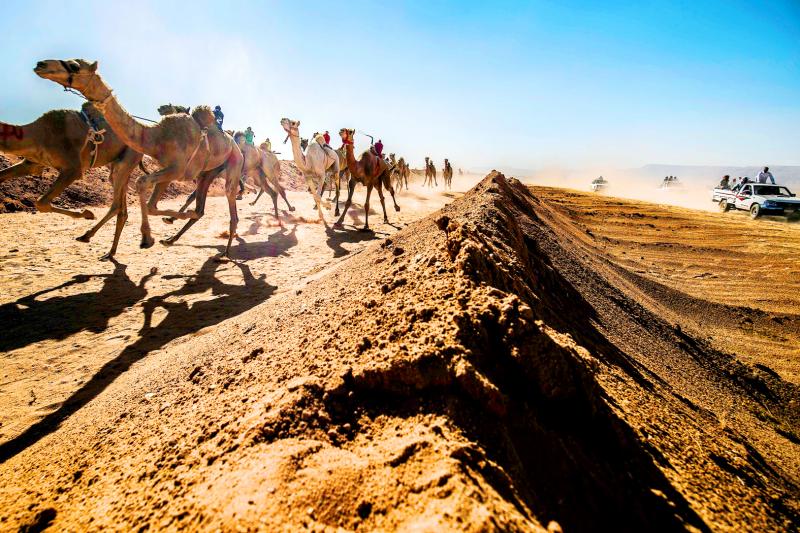
Photo: AFP
However, race events have been suspended since March following a COVID-19 outbreak and orders only came down at the beginning of the month that they could resume last weekend.
The camels ran around a 2km track in the Tih Plateau, completing it in a matter of minutes as they were followed by spectators and owners riding in SUVs to get a close-up glimpse of the action.
The competition “is a training for the international race, which should take place in October in Sharm el-Sheikh,” Nuweiba Camel Club head Saleh al-Muzaini told reporters.
One group of camels after another, placed in different categories according to age and sex, made their debut on the dirt track lined by sand embankments on each side.
On their backs sat mechanical jockeys, which are lighter than human riders, wearing racing jerseys and brandishing whips.
In a different race, young boys mount the camels to complete a 10km course.
Among the audience was 32-year-old Mostapha Abu al-Fadl, a geologist at an oil company in Cairo, who came especially to watch.
“When I heard they were organizing the race again, I told my friends how crazy, how wonderful it is... We had to come and see,” he said.
To the Bedouins, the race is a way of keeping a traditional heritage alive.
“There was camel racing in the past, but we revived it” in recent years, said Sheikh Hassan of the Alegat tribe, which organizes the event. “Camels will not disappear for us. We can use them for centuries. If the camel goes away, the Bedouins will also go away.”
Camel races — held every two or three months — often attract large audiences of tourists, visitors and Bedouins to the middle of the desert.
Suspending the races caused heavy losses for the camel owners, who still had to pay for their animals’ training, food and health checkups.
Over the six months alone, the owners lost 10 million to 15 million Egyptian pounds (US$635,000 to US$952,000), Sheikh Hassan said.
For owner Soleiman Hamad, Saturday’s race ended on a high note as his animal came first in its category.
There is no prize money, but the winners carry off a prestigious trophy, which also helps boost their animal’s value.
For Hamad and others, camel racing represents a source of additional income, provided that they also have the means to train, feed and care for the animal.
“It’s costly, but it’s our passion,” he said.
Each camel costs up to 2,000 Egyptian pounds per month to feed.
A well-trained camel can sell for up to 2 million Egyptian pounds, Sheikh Hassan said.
Bedouin of South Sinai usually eye Gulf countries, where camel racing is a popular and lucrative activity.
Now they are hoping for precious support with a visit to the peninsula due next month by Egyptian President Abdel-Fattah al-Sisi, which could boost their business.
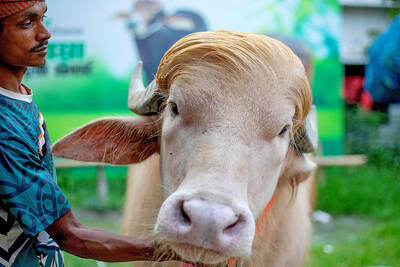
Crowds in Bangladesh are flocking to snap photographs with an unlikely social media star — an albino buffalo with flowing blond hair nicknamed “Donald Trump” that is due to be sacrificed within days. Owner Zia Uddin Mridha, 38, said his brother named the 700kg bull over its flowing helmet of hair resembling the signature look of the US president. “My younger brother picked this name because of the buffalo’s extraordinary hair,” he said at his farm in Narayanganj, just outside the capital, Dhaka. Mridha said that a constant stream of curious visitors — social media fans, onlookers and children — have come throughout

It began as a satirical online project. Now millions of young people in India are flocking to it as an outlet for their frustration. A parody political party called the Cockroach Janta Party, with the insect as its symbol, has exploded across India’s social media by turning absurdist humor into protest. Memes and short videos mocking corruption, joblessness and political dysfunction have flooded social media sites, where millions of users are embracing the cockroach — known for its ability to survive harsh conditions — as a tongue-in-cheek symbol of endurance. The online movement’s rise has been unusually rapid. The Cockroach Janta Party (CJP)
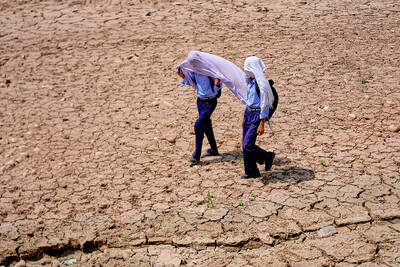
HOTTER: While Indians are accustomed to summer heat, climate change has caused northwestern India to warm faster than other parts of the country, an academic said Roads and markets have emptied during afternoons and some farmers have switched to nighttime work to avoid scorching temperatures as a heat wave grips large parts of India. The India Meteorological Department forecast maximum temperatures for yesterday of about 45°C in the capital, New Delhi, where authorities have opened temporary “cooling zones” to help people cope. The weather department warned that conditions would likely persist across several northern regions in the coming days, with temperatures staying well above seasonal averages. Authorities urged people to stay indoors during the hottest hours and take precautions against heat-related illnesses. India declares a heat wave whenever maximum temperatures
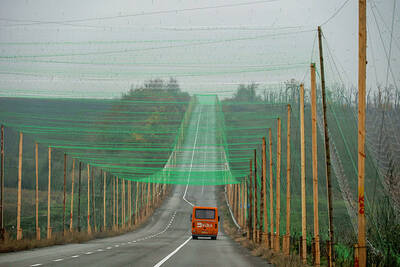
BIGGER ROLE: Beijing has said it maintains an impartial stance on the war in Ukraine, but by training Russian troops, China is far more involved than previously known China’s armed forces secretly trained about 200 Russian military personnel in China late last year, and some have since returned to fight in Ukraine, according to three European intelligence agencies and documents seen by Reuters. While China and Russia have held a number of joint military exercises since Moscow’s full-scale invasion of Ukraine in 2022, Beijing has repeatedly said that it is neutral in the conflict and presents itself as a peace mediator. The covert training sessions, which predominantly focused on the use of drones, were outlined in a dual-language Russian-Chinese agreement signed by senior Russian and Chinese officers in Beijing on


 RSS
RSS