


Turkish President Recep Tayyip Erdogan on Friday announced that the Hagia Sophia, a UNESCO World Heritage site, would be reopened for Muslim worship as a mosque, sparking fury in the Christian communities, in neighboring Greece and beyond.
Erdogan’s declaration came after a top Turkish court revoked the sixth-century Byzantine monument’s status as a museum, clearing the way for it to be repurposed.
In an address to the nation, Erdogan said the first Muslim prayers at the Hagia Sophia would be performed on July 24.
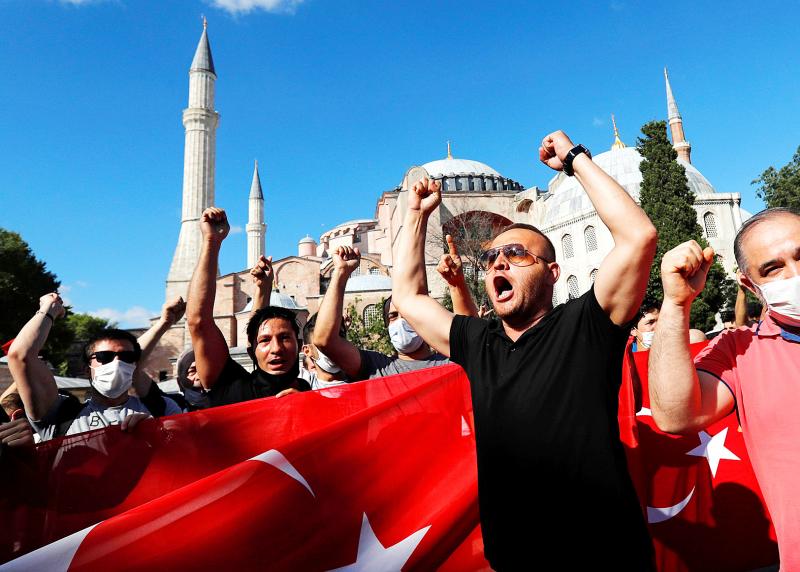
Photo: Reuters
“God willing, we will perform Friday prayers all together on July 24 and reopen Hagia Sophia to worshiping,” Erdogan said, assuring that it would open its door to all, including non-Muslims.
“Like all our mosques, the doors of Hagia Sophia will be wide open to locals and foreigners, Muslims and non-Muslims,” he said
The Hagia Sophia was constructed as a cathedral in the Christian Byzantine Empire, but was converted into a mosque after the Ottoman conquest of Constantinople in 1453.
The Turkish Council of State, the nation’s highest administrative court, unanimously canceled a 1934 decision to turn it into a museum and said it was registered as a mosque in its property deeds.
The nation’s historic foe Greece swiftly condemned the move by Muslim-majority Turkey.
“Greece condemns most firmly” the decision, said Greek Prime Minister Kyriakos Mitsotakis, adding that it “does not only impact relations between Greece and Turkey, but also the latter’s relations with the EU, UNESCO and the global community as a whole.”
The Russian Orthodox Church was equally scathing.
“The concerns of millions of Christians were not heard,” church spokesman Vladimir Legoida said.
The decision “shows that all pleas regarding the need to handle the situation extremely delicately were ignored,” Legoida added.
UNESCO Director-General Audrey Azoulay said she “deeply regrets” the decision made without prior dialogue with the UN’s cultural agency.
US Department of State spokeswoman Morgan Ortagus said: “We are disappointed by the decision by the government of Turkey to change the status of the Hagia Sophia.”
Meanwhile, Erdogan urged everyone to respect Turkey’s decision and said the issue of what purposes Hagia Sophia would serve “concerns Turkey’s sovereign rights.”
Shortly after the court decision, Erdogan signed a presidential decree handing over the administration of “Hagia Sophia Mosque” to the Turkish Directorate of Religious Affairs.
Erdogan has increasingly emphasized on the battles which resulted in the defeat of the Byzantine Empire by the Ottomans, with lavish celebrations held every year to mark the conquest.
Muslim clerics have occasionally recited prayers in the museum on key anniversaries or religious holidays. In 2018, Erdogan himself recited a verse from the Koran at Hagia Sophia.
“The decision is intended to score points with Erdogan’s pious and nationalist constituents,” Anthony Skinner of the risk assessment firm Verisk Maplecroft said.
After the decision was made public, worshipers performed evening prayers at the Hagia Sophia, while hundreds of people with Turkish flags shouted “Chains broken, Hagia Sophia reopened.”
“It’s been a dream since we were kids. [Hagia Sophia] finds its true purpose again. We are very excited, proud and hopeful that there will be beautiful services here,” Istanbul resident Erdal Gencler said.
The Turkish Council of State on Thursday last week started hearing the case brought by the Association for the Protection of Historic Monuments and the Environment, a religious advocacy group, which promoted Hagia Sophia to be reopened for Muslim prayers.
Since 2005, there have been several attempts to change the building’s status. In 2018, the Constitutional Court rejected one application.
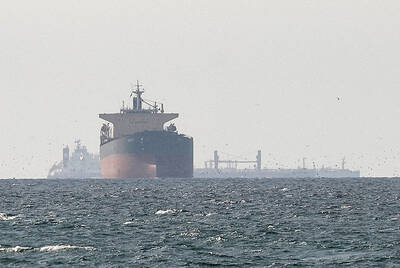
A ship that appears to be taking on the identity of a scrapped gas carrier exited the Strait of Hormuz on Friday, showing how strategies to get through the waterway are evolving as the Middle East war progresses. The vessel identifying as liquefied natural gas (LNG) carrier Jamal left the Strait on Friday morning, ship-tracking data show. However, the same tanker was also recorded as having beached at an Indian demolition yard in October last year, where it is being broken up, according to market participants and port agent’s reports. The ship claiming to be Jamal is likely a zombie vessel that

Cannabis-based medicines have shown little evidence of effectiveness for treating most mental health and substance-use disorders, according to a large review of past studies published in a major medical journal on Monday. Medical use of cannabinoids has been expanding, including in the US, Canada and Australia, where many patients report using cannabis products to manage conditions such as anxiety, post-traumatic stress disorder and sleep problems. Researchers reviewed data from 54 randomized clinical trials conducted between 1980 and May last year involving 2,477 participants for their analysis published in The Lancet. The studies assessed cannabinoids as a primary treatment for mental disorders or substance-use
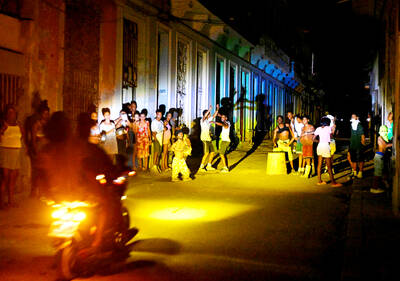
NATIONWIDE BLACKOUT: US President Donald Trump cut off Venezuelan oil shipments to Cuba, strangling the Caribbean island’s already antiquated grid Cuba’s national electric grid collapsed on Monday, the nation’s grid operator said, leaving about 10 million people without power amid a US-imposed oil blockade that has crippled the already obsolete generation system. Grid operator UNE on social media said that it is investigating the causes of the blackout, the latest in a series of widespread outages that last for hours or days and that this weekend sparked a rare violent protest in the communist-run nation. Officials ruled out a major power plant failure, but had still not pinpointed the root cause of the grid collapse, suggesting a problem with transmission. Officials said that

‘HEALTH ISSUE’: More than 250 women are hospitalized every day due to complications from unsafe abortions, and about three die, a study showed Jane had been bleeding heavily for days before finally seeking help, not from a hospital, but from the man who sold her the pills meant to end her six-week pregnancy. Abortions are strictly outlawed in the mainly Catholic Philippines, forcing women to turn to a patchwork of providers operating in the online shadows. While rare in practice, Philippine law allows for prison terms of up to six years for abortion patients and providers, leaving thousands of Filipinas to search for solutions in online forums where unlicensed sellers promote abortifacients. “It was very painful, as if my abdomen was being twisted,” said Jane, whose


 RSS
RSS