


Chinese agents have been pursuing hundreds of Chinese nationals living in the US in an effort to force their return, as part of a global campaign against the country’s diaspora, known as Operation Fox Hunt, FBI Director Christopher Wray said on Tuesday.
In a speech about the security threat posed by China, during which he said Beijing’s counterintelligence work was the “greatest long-term threat to our nation’s information and intellectual property, and to our economic vitality,” Wray gave the example of one Fox Hunt target who was given a choice of going back to China or killing themselves.
Fox Hunt was launched six years ago by Chinese President Xi Jinping (習近平), ostensibly to pursue corrupt officials and business executives who had fled abroad.

Photo: AFP
Beijing has celebrated its claimed successes, publicizing the return of hundreds of economic fugitives and issuing wanted lists of those still at large.
The administration of former US president Barack Obama complained about the activities of undercover agents in 2015.
Wray said the operation’s principal aim now was to suppress dissent among the diaspora.
“China describes Fox Hunt as some kind of international anti-corruption campaign. It is not,” he told the Hudson Institute in Washington.
Instead, Fox Hunt is a sweeping bid by Xi to target Chinese nationals who he sees as threats and who live outside of China, across the world, he said.
“We’re talking about political rivals, dissidents and critics seeking to expose China’s extensive human rights violations,” he said.
“Hundreds of these Fox Hunt victims that they target live right here in the United States, and many are American citizens or green card holders. The Chinese government wants to force them to return to China, and China’s tactics to accomplish that are shocking,” he said.
“For example, when it couldn’t locate one Fox Hunt target, the Chinese government sent an emissary to visit the target’s family here in the US. The message they said to pass on: the target had two options, return to China promptly or commit suicide,” he said.
Fox Hunt operations, directed by the Chinese Ministry of Public Security, are also under way in other countries, Wray said, adding that the FBI had been cooperating with its partners to foil Chinese efforts at intimidation.
He said that Chinese nationals in the US were often coerced by thinly veiled threats against their families back in China.
Asked about other coercive tactics used, he replied: “Use your imagination. You’re not going to be far off.”
He appealed to anyone in the US who thought they were a Fox Hunt target to “please reach out to your local FBI field office.”
Wray portrayed China as an aggressive rival with little or no regard for international or national laws.
He said that nearly half the FBI’s 5,000 active counterintelligence cases were China-related.
Beijing was using leverage, pressure or persuasion through intermediaries on federal, state and local officials, as well as US corporations and media, to win support for Chinese foreign policy positions.
Wray said such efforts had been stepped up during the COVID-19 pandemic, aimed at generating praise for Beijing’s handling of the pandemic.
Although he did not say whether China backed either US President Donald Trump or his presumptive Democratic rival, former US vice president Joe Biden, he claimed that Beijing was pushing its preferences for the outcome of this year’s US presidential election.
“China’s malign foreign influence campaign targets our policies, our positions, 24/7, 365 days a year,” he said. “So it’s not an election-specific threat; it’s really more of an all-year, all-the-time threat. But certainly that has implications for elections and they certainly have preferences that go along with that.”
He said that China was also involved in mass hacking, identity theft and intellectual property espionage, and there are 1,000 investigations into “China’s actual and attempted theft of technology” in all the bureau’s 56 field offices.
“The people of the United States are the victims of what amounts to Chinese theft on a scale so massive that it represents one of the largest transfers of wealth in human history,” Wray said.

Crowds in Bangladesh are flocking to snap photographs with an unlikely social media star — an albino buffalo with flowing blond hair nicknamed “Donald Trump” that is due to be sacrificed within days. Owner Zia Uddin Mridha, 38, said his brother named the 700kg bull over its flowing helmet of hair resembling the signature look of the US president. “My younger brother picked this name because of the buffalo’s extraordinary hair,” he said at his farm in Narayanganj, just outside the capital, Dhaka. Mridha said that a constant stream of curious visitors — social media fans, onlookers and children — have come throughout

The Bolivian government on Friday struck a deal with protesting miners, but was still grappling with blockades and demonstrations by other workers across La Paz. Other groups are still blocking access roads into the city, which is also the seat of the government. Police on Thursday prevented the miners from entering the main square by using tear gas, while the demonstrators hurled stones and explosives with slingshots. Protests against the policies of Bolivian President Rodrigo Paz have convulsed the Andean nation since early this month, and roadblocks were choking routes into La Paz throughout Friday, the national road authority said. Miners demanded that Paz
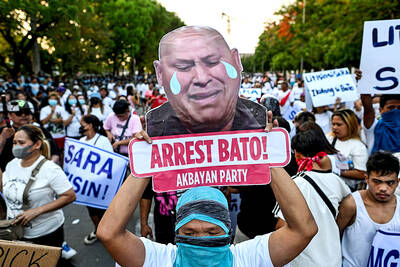
The Philippines said it has asked the country’s Supreme Court to allow it to arrest former Philippine president Rodrigo Duterte’s chief drug war enforcer to stand trial in an international tribunal. The International Criminal Court (ICC) last week unsealed an arrest warrant against Philippine Senator Ronald dela Rosa, accusing him along with Duterte and other “coperpetrators” of the “crime against humanity of murder.” Dela Rosa briefly sought refuge in the Philippine Senate last week while asking the Philippine Supreme Court to stop an ongoing attempt by government agents to arrest him. “By his own conduct, he has placed himself outside the protection of

The researchers in Ireland looked at their computer screen, marveling at a medieval book tracked down in a Roman library. They flipped through its digitized pages and found their sought-after treasure: the oldest surviving English poem. “We were extremely surprised. We were speechless. We couldn’t believe our eyes when we first saw that,” said Elisabetta Magnanti, a visiting research fellow at Trinity College Dublin’s school of English. The poem was also within the main body of Latin text, she said, calling it “extraordinary.” Composed in Old English by a Northumbrian agricultural worker in the 7th century, Caedmon’s Hymn appears within some copies of


 RSS
RSS