


Protests over a new citizenship law based on religion spread to student campuses across India yesterday as critics said Indian Prime Minister Narendra Modi’s government was pushing a partisan agenda in conflict with India’s founding as a secular republic.
Anger with Modi’s Hindu nationalist government was further fueled by allegations of police brutality at Jamia Millia Islamia University on Sunday, when officers entered the campus in New Delhi and fired tear gas to break up a protest. At least 100 people were injured in the clashes there.
There were similar scenes at the Aligarh Muslim University in the northern state of Uttar Pradesh, where police also clashed with protesters on the campus.
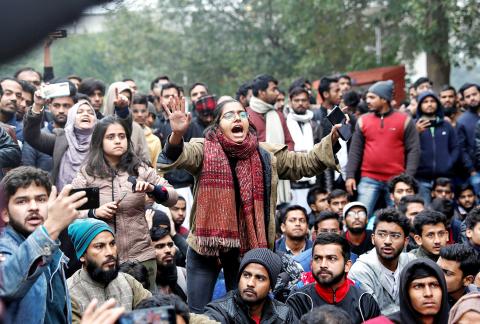
Photo: Reuters
Hundreds of activists gathered outside the New Delhi police headquarters on Sunday night to protest alleged police brutality and the detention of students.
The most violent protests during the past few days took place in the northeastern state of Assam, where mobs torched buildings and train stations, angry that the law would help thousands of immigrants from Bangladesh become lawful citizens. At least two people were killed in the violent clashes with police.
Under the law passed by parliament last week, religious minorities such as Hindus and Christians in neighboring Bangladesh, Pakistan and Afghanistan who have settled in India prior to 2015 are to have a path to Indian citizenship on the grounds that they faced persecution in those countries.
Critics say the law, which does not make the same provision for Muslims, weakens India’s secular foundations.
Protests were held at Mumbai’s Indian Institute of Technology and Tata Institute of Social Sciences.
“The country is burning, the government has made a mockery of the constitution,” Communist Party of India Secretary-General D. Raja said.
Some Bollywood celebrities like actress Konkona Sen Sharma, and directors Mahesh Bhatt and Anubhav Sinha, also criticized the police action on Twitter, and called on others to speak up.
“We are with the students! Shame on you @DelhiPolice,” Sen Sharma tweeted.
Anger with Modi’s Hindu nationalist government over the citizenship act has erupted for two reasons. In Assam, and other northeastern states bordering Bangladesh, people are upset over the impact that a large influx of migrants is having on society and the pressure it places on their land.
In the capital, New Delhi, and other urban centers, opposition political activists and student leaders are angry over a law that they say erodes India’s secular foundations.
Modi’s ruling Bharatiya Janata Party denies any religious bias, but says it is opposed to the appeasement of one community. It says the new law is meant to help minority groups facing persecution in the three nearby Muslim countries.
Modi has said the law has been passed by parliament and that there is no going back on it. He told a rally on Sunday the decision was “1,000 percent correct.”

School bullies in Singapore are to face caning under new guidelines, but the education minister on Tuesday said it would be meted out only as a last resort with strict safeguards. Human rights groups regularly criticize Singapore for the use of corporal punishment, which remains part of the school and criminal justice systems, but authorities have defended it as a deterrent to crime and serious misconduct. Caning was discussed in the parliament after legislators asked how it would be used in relation to bullying in schools. The debate followed stricter guidelines on serious student misconduct, including bullying, unveiled by the Singaporean Ministry of

As evening falls in Fiji’s capital, a steady stream of people approaches a makeshift clinic that is a first line of defense against one of the world’s fastest-growing HIV epidemics. In the South Pacific nation — a popular tourist destination of just under a million people — more than 2,000 new HIV cases were recorded last year, a 26 percent increase from 2024. The government has declared an HIV outbreak and described it as a national crisis. “It’s spreading like wildfire,” said Siteri Dinawai, 46, who came to be tested. The Moonlight Clinic, a converted minibus parked in a suburban cul-de-sac in Suva, is
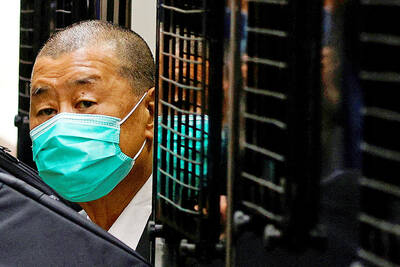
Jailed media entrepreneur Jimmy Lai (黎智英) has been awarded Deutsche Welle’s (DW) freedom of speech award for his contribution to Hong Kong’s pro-democracy movement. The German public broadcaster on Thursday said Lai would be presented in absentia with the 12th iteration of the award on June 23 at the DW Global Media Forum in Bonn. Deutsche Welle director-general Barbara Massing praised the 78-year-old founder of the now-shuttered news outlet Apple Daily for standing “unwaveringly for press freedom in Hong Kong at great personal risk.” “With Apple Daily, he gave journalists a platform for free reporting and a voice to the democracy movement in

A MESSAGE: Japan’s participation in the Balikatan drills is a clear deterrence signal to China not to attack Taiwan while the US is busy in the Middle East, an analyst said The Japan Self-Defense Forces yesterday fired a Type 88 anti-ship missile during a joint maritime exercise with US, Australian and Philippine forces, hitting a decommissioned Philippine Navy ship in waters facing the disputed South China Sea, in drills that underscore Tokyo’s rising willingness to project military power on China’s doorstep. The drill took place as Manila and Tokyo began talks on a potential defense equipment transfer, made possible by Japan’s decision to scrap restrictions on military exports. The discussions include the possible early transfer of Abukuma-class destroyers and TC-90 aircraft to the Philippines, Japanese Minister of Defense Shinjiro Koizumi said. Philippine Secretary of


 RSS
RSS