


The battlefields of Guadalcanal, in the Solomon Islands, draw visitors from the US and its war allies, as well as those from Japan, decades after the bloody campaign in the South Pacific ended.
However, in recent weeks, some visitors say they have been prevented from accessing one of Guadalcanal’s most significant World War II sites, which includes a Japanese war monument, after a deal handed control of the land to a company controlled by a Chinese businessman.
Tour operators and the Japanese ambassador to the Solomons say it appears to be a case of a lack of understanding of the significance of the Alligator Creek site by the new owner.
The issue has stirred up debate in the Solomons concerning its new relationship with China, which was formalized in September following the nation’s decision to sever its diplomatic ties with Taiwan.
That decision has frustrated the US and Japan, with US officials expressing concern about China’s “use of economic and military levers” to increase its influence in the South Pacific.
“I would like the problem settled in a peaceful way,” Japanese Ambassador to the Solomons Shigeru Toyama said by telephone from the capital, Honiara.
Toyama said he hoped to meet with the new owners, JQY Ltd, in the coming days.
“I hope they will pay much attention to the monument and will reconcile how to preserve it,” Toyama said.
The new owner has built a fence around part of the Alligator Creek site that takes in the Japanese monument, tour operator Francis Deve said, and access is dependent on whether security guards at the locked gate were present to take visitors in.
“There used to be local people sitting next to the site who put flowers around the monument; they were chased out and they put up a fence,” Deve said by phone from Guadalcanal.
A JQY representative in Honiara did not respond to repeated requests for comment.
The Solomon Islands Ministry of Culture and Tourism was liaising with the owner to discuss potential heritage plans for the area around the monument, the government said in a statement.
Tourism is an important income-earner for the Solomons, with most visitors drawn by the country’s diving spots and war relics, which are generally accessible to the public, tour operators said.
The archipelago is also heavily reliant on logging and fisheries.
JQY is registered to Yang Jiangqing, who was part of a delegation that accompanied Solomon Islands Prime Minister Manasseh Sogavare to Beijing last month where the two countries signed several commercial agreements.
Yang did not respond to interview requests.
The bloody battles that occurred near Alligator Creek — sometimes referred to as the Battle of the Tenaru or Battle for Hell’s Point — were part of a major US-led offensive in 1942 to take control of the island and its strategic airfield.
A counter-offensive proved disastrous for Japanese forces, and generations of relatives of the hundreds of fallen soldiers now regularly visit the battleground to pay their respects.
Solomons Acting Commissioner of Lands Alan McNeil said the department had consented to the transfer of the land to JQY in January from Levers Solomon, a local company historically involved in the timber industry.
“These land transfers are lawful and an everyday occurrence,” McNeil said in a statement. “Neither the national government nor the Guadalcanal provincial government sold this land — rather, it has been in private hands for many decades.”
Levers did not respond to requests for comment.
The government has since said a deal signed by one of its provinces to lease the entire island of Tulagi to a Chinese company was unlawful and should be terminated, however details of a contract awarded to state-owned China State Railway Group to develop a gold project on Guadalcanal have not been released.
Deve said negotiations with the new owners to freely access the site were advancing slowly.
“We must protect and preserve it,” Deve said. “It should be a heritage site.”
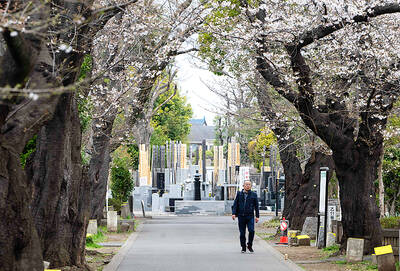
ROCKY RELATIONS: The figures on residents come as Chinese tourist numbers drop following Beijing’s warnings to avoid traveling to Japan The number of Chinese residents in Japan has continued to rise, even as ties between the two countries have become increasingly fractious, data released on Friday showed. As of the end of December last year, the number of Chinese residents had increased by 6.5 percent from the previous year to 930,428. Chinese people accounted for 22.6 percent of all foreign residents in Japan, making them by far the largest group, Japanese Ministry of Justice data showed. Beijing has criticized Tokyo in increasingly strident terms since Japanese Prime Minister Sanae Takaichi last year suggested that a military conflict around Taiwan could

A retired US colonel behind a privately financed rocket launch site in the Dominican Republic sees the project as a response to China’s dominance of the space race in Latin America. Florida-based Launch on Demand is slated to begin building a US$600 million facility in a remote region near the border with Haiti late this year. The project is designed to meet surging demand for the heavy-lift rockets needed to put clusters of satellites into orbit. It is also an answer to China’s growing presence in the region, said CEO Burton Catledge, a former commander of the US Air Force’s 45th Operations

Germany is considering Australia’s Ghost Bat robot fighter as it looks to select a combat drone to modernize its air force, German Minister of Defense Boris Pistorius said yesterday. Germany has said it wants to field hundreds of uncrewed fighter jets by 2029, and would make a decision soon as it considers a range of German, European and US projects developing so-called “collaborative combat aircraft.” Australia has said it will integrate the Ghost Bat, jointly developed by Boeing Australia and the Royal Australian Air Force, into its military after a successful weapons test last year. After inspecting the Ghost Bat in Queensland yesterday,
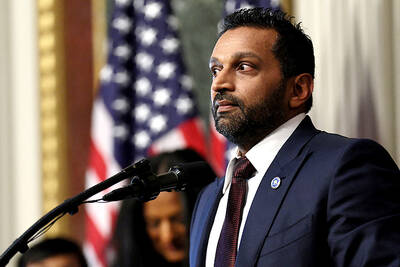
A pro-Iran hacking group claimed to breach FBI Director Kash Patel’s personal e-mail inbox and posted some of the contents online. The e-mails provided by the hacking group include travel details, correspondence with leasing agents in Washington and global entry, and loyalty account numbers. The e-mail address the hackers claim to have compromised has been previously tied to Patel’s personal details, and the leaked e-mails contain photos of Patel and others, in addition to correspondence with family members and colleagues. “The FBI is aware of malicious actors targeting Director Patel’s personal email information,” the agency said in a statement on


 RSS
RSS