


For decades, there was not a coffee shop anywhere in Indonesia’s Toraja region, even as its high-quality beans grabbed top dollar on the international market.
Locals in the lush, mountainous area on the island of Sulawesi used the bitter beverage in traditional ceremonies, gave away their extra beans to neighbors for free or traded them for a sack of rice and livestock.
However, Toraja is experiencing a mini-explosion in cafes, with dozens of shops sprouting up in the region courtesy of entrepreneurs such as Suleiman Mitting.
Coffee was introduced to the region by Muslim traders in about the 18th century, but for most Trojans paying to drink it in a store was an alien idea.
“If I ran out of coffee, I’d just go to my neighbor’s place,” Mitting said from his 16-seat shop in North Toraja. “Us Torajans are not used to drinking coffee at a cafe.”
When world coffee prices dropped several years ago, putting pressure on local farmers, Miting said it opened a window for a new business in the area that squeezed out middlemen who largely controlled prices.
The situation in Toraja mirrors a coffee culture explosion across Indonesia, particularly among young people living in cities. The region mostly produces arabica beans, which have a milder taste and lower caffeine concentration than robusta beans.
Its unique coffee has won devotees abroad — particularly in Japan. The Toarco Toraja brand is well known in Tokyo and exports are mostly run by a Japanese firm that takes its beans from a 500 hectare plantation that is almost 2,000m above sea level.
However, Indonesia’s army of small-scale coffee farmers, who have little marketing experience and can have low yields, are still struggling in a competitive global market.
In recent years it has been knocked back to become the world’s fourth-largest coffee exporter, behind Brazil, Vietnam and Colombia. It was third globally until it was overtaken by Vietnam in the late 1990s.
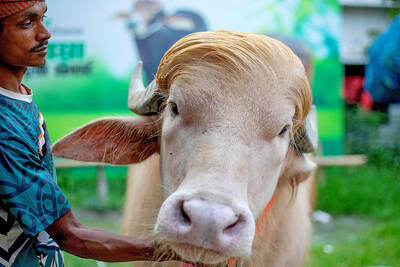
Crowds in Bangladesh are flocking to snap photographs with an unlikely social media star — an albino buffalo with flowing blond hair nicknamed “Donald Trump” that is due to be sacrificed within days. Owner Zia Uddin Mridha, 38, said his brother named the 700kg bull over its flowing helmet of hair resembling the signature look of the US president. “My younger brother picked this name because of the buffalo’s extraordinary hair,” he said at his farm in Narayanganj, just outside the capital, Dhaka. Mridha said that a constant stream of curious visitors — social media fans, onlookers and children — have come throughout

It began as a satirical online project. Now millions of young people in India are flocking to it as an outlet for their frustration. A parody political party called the Cockroach Janta Party, with the insect as its symbol, has exploded across India’s social media by turning absurdist humor into protest. Memes and short videos mocking corruption, joblessness and political dysfunction have flooded social media sites, where millions of users are embracing the cockroach — known for its ability to survive harsh conditions — as a tongue-in-cheek symbol of endurance. The online movement’s rise has been unusually rapid. The Cockroach Janta Party (CJP)
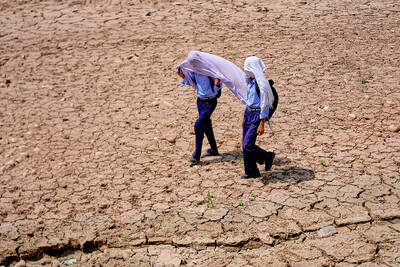
HOTTER: While Indians are accustomed to summer heat, climate change has caused northwestern India to warm faster than other parts of the country, an academic said Roads and markets have emptied during afternoons and some farmers have switched to nighttime work to avoid scorching temperatures as a heat wave grips large parts of India. The India Meteorological Department forecast maximum temperatures for yesterday of about 45°C in the capital, New Delhi, where authorities have opened temporary “cooling zones” to help people cope. The weather department warned that conditions would likely persist across several northern regions in the coming days, with temperatures staying well above seasonal averages. Authorities urged people to stay indoors during the hottest hours and take precautions against heat-related illnesses. India declares a heat wave whenever maximum temperatures

BIGGER ROLE: Beijing has said it maintains an impartial stance on the war in Ukraine, but by training Russian troops, China is far more involved than previously known China’s armed forces secretly trained about 200 Russian military personnel in China late last year, and some have since returned to fight in Ukraine, according to three European intelligence agencies and documents seen by Reuters. While China and Russia have held a number of joint military exercises since Moscow’s full-scale invasion of Ukraine in 2022, Beijing has repeatedly said that it is neutral in the conflict and presents itself as a peace mediator. The covert training sessions, which predominantly focused on the use of drones, were outlined in a dual-language Russian-Chinese agreement signed by senior Russian and Chinese officers in Beijing on


 RSS
RSS