


China is to keep hitting back at Washington as more US trade tariffs are imposed, but its counterstrikes would remain as targeted as possible to avoid harming businesses in China — whether Chinese or foreign, Chinese Minister of Finance Liu Kun (劉昆) said on Thursday.
The impact of the China-US “trade frictions” on the Chinese economy has been small so far, but he is concerned about job losses and lost livelihoods, Liu said in an interview, his first with the media since taking the position in March.
Beijing would increase its spending to support workers and the unemployed who are hurt by the trade conflict, he said, adding that bond issuance by local governments to support infrastructure investment this year would likely pick up and exceed 1 trillion yuan (US$145.35 billion) by the end of the current quarter.
“China doesn’t wish to engage in a trade war, but we will resolutely respond to the unreasonable measures taken by the United States,” Liu said. “If the United States persists with these measures, we will correspondingly take action to protect our interests.”
So far, China has imposed or proposed tariffs on US$110 billion of US goods, representing most of its imports of US products. Crude oil and large aircraft are key US goods that are still not targeted.
Trade talks between mid-level US and Chinese officials ended on Thursday without any sign of major progress.
Asked if China would consider increasing tariffs on US goods that are already facing higher taxes, Liu said that China would respond with precision.
“We’re responding in a precise way. Of course, the value of US imports of Chinese goods isn’t the same as the value of Chinese imports of US goods. We’ll take tariff measures in accordance to this situation,” he said without elaborating.
However, China is conscious of the potential for bystanders to be caught in the line of fire, he added.
“When we take measures, we try our hardest not to harm the interests of foreign businesses in China. That’s why our tariff measures are targeted to avoid affecting them as much as we can,” Liu said.
Some US firms and industry lobbies, including the US Chamber of Commerce, have criticized US President Donald Trump’s tariffs, saying the Chinese retaliation it is triggering would hurt businesses that already face greater competition from local rivals in China.
US fast food and beverage chains are ubiquitous in Chinese cities. US-branded infant formula, apparel, cars and phones are also popular.
The US tariffs have affected China’s economic growth — albeit modestly — and their impact is to become even more pronounced if the trade frictions persist, Liu said, adding that he is concerned about the Chinese jobs that could be lost.
“From my perspective, I’d pay more attention to the impact that the China-US trade frictions has on jobs in China. After all, some firms will be affected, exports will be reduced and production will be cut,” he said.
China’s urban survey-based jobless rate rose to 5.1 percent from 4.8 percent in June. The government aims to keep the rate below 5.5 percent this year.
China plans to increase its fiscal spending to support those hurt as higher tariffs kick in.
“We will make adequate preparations in terms of fiscal policy, and help unemployed workers find new jobs and ensure their basic social security,” Liu said.
Liu is optimistic about government revenues this year, saying they might even exceed expectations.
Beijing is expediting plans to invest billions of US dollars in infrastructure projects as its economy shows signs of cooling further.
Earlier this month, the Chinese Ministry of Finance told local governments to speed up issuance of special bonds used to fund infrastructure projects.
Issuance could pick up and exceed 1 trillion yuan in the first three quarters of the year, Liu said.
There are three things China needs to do well: lowering taxes and cutting fees, preserving the intensity of its fiscal spending so that its effect can be better felt and supporting the real economy and lightening the burdens of companies, he said.
The cuts in taxes and fees would be more than 1.1 trillion yuan this year, beating government forecasts, Liu said.
On May 1, China cut the value-added tax in the manufacturing, transportation, construction, telecom and agricultural sectors, but it does not mean China will unleash massive stimulus or go back on its campaign to reduce leverage in the economy.
“When we’re talking about a more proactive fiscal policy, we aren’t talking about massive stimulus, nor do we want to incur financial risks, let alone getting the government to take care of everything,” Liu said.
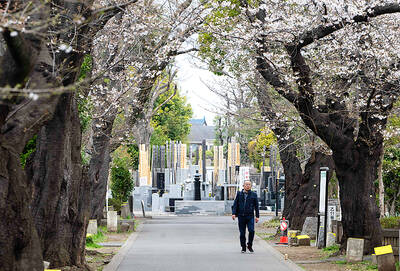
ROCKY RELATIONS: The figures on residents come as Chinese tourist numbers drop following Beijing’s warnings to avoid traveling to Japan The number of Chinese residents in Japan has continued to rise, even as ties between the two countries have become increasingly fractious, data released on Friday showed. As of the end of December last year, the number of Chinese residents had increased by 6.5 percent from the previous year to 930,428. Chinese people accounted for 22.6 percent of all foreign residents in Japan, making them by far the largest group, Japanese Ministry of Justice data showed. Beijing has criticized Tokyo in increasingly strident terms since Japanese Prime Minister Sanae Takaichi last year suggested that a military conflict around Taiwan could

A retired US colonel behind a privately financed rocket launch site in the Dominican Republic sees the project as a response to China’s dominance of the space race in Latin America. Florida-based Launch on Demand is slated to begin building a US$600 million facility in a remote region near the border with Haiti late this year. The project is designed to meet surging demand for the heavy-lift rockets needed to put clusters of satellites into orbit. It is also an answer to China’s growing presence in the region, said CEO Burton Catledge, a former commander of the US Air Force’s 45th Operations
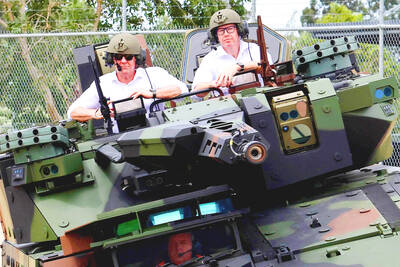
Germany is considering Australia’s Ghost Bat robot fighter as it looks to select a combat drone to modernize its air force, German Minister of Defense Boris Pistorius said yesterday. Germany has said it wants to field hundreds of uncrewed fighter jets by 2029, and would make a decision soon as it considers a range of German, European and US projects developing so-called “collaborative combat aircraft.” Australia has said it will integrate the Ghost Bat, jointly developed by Boeing Australia and the Royal Australian Air Force, into its military after a successful weapons test last year. After inspecting the Ghost Bat in Queensland yesterday,
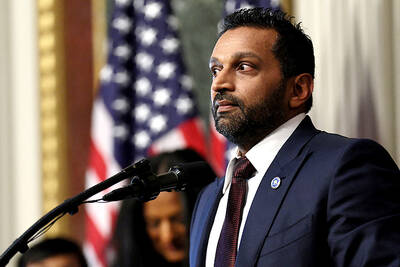
A pro-Iran hacking group claimed to breach FBI Director Kash Patel’s personal e-mail inbox and posted some of the contents online. The e-mails provided by the hacking group include travel details, correspondence with leasing agents in Washington and global entry, and loyalty account numbers. The e-mail address the hackers claim to have compromised has been previously tied to Patel’s personal details, and the leaked e-mails contain photos of Patel and others, in addition to correspondence with family members and colleagues. “The FBI is aware of malicious actors targeting Director Patel’s personal email information,” the agency said in a statement on


 RSS
RSS