


As countries around Southeast Asia struggle to cope with growing piles of plastic and other waste on land and in their waters, Singapore is one country in the region that appears to have things figured out.
Singapore’s streets are glistening clean, its parks and beaches mostly free from the trash that plagues neighboring countries like Malaysia and Indonesia.
Almost all of Singapore’s nonrecyclable waste is incinerated, with the ash and some solid waste shipped to an artificial island nearby that doubles as a nature reserve.
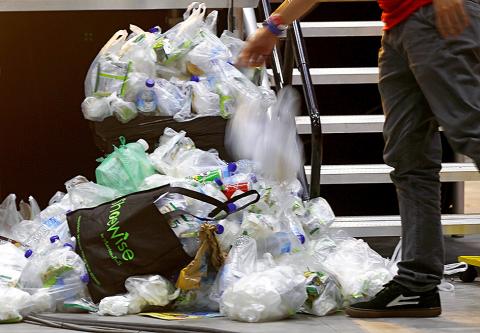
Photo: Reuters
However, that solution looks as if it is running short on time.
The tip of Semakau Island was supposed to meet Singapore’s dumping needs until as late as 2045, Singaporean Ministry of the Environment and Water Resources documents showed.
However, with the use of disposable products growing at a rapid rate, the ministry’s most recent estimates showed that Semakau could be full a decade earlier.
Plastics was the largest category of waste disposed of in Singapore last year — 763,400 tonnes — Singaporean National Environment Agency data showed. Only 6 percent of the 815,200 of plastic waste generated was recycled.
Analysis of the agency’s data showed that plastic waste per capita has increased nearly 20 percent over the past 15 years.
A report by the local Straits Times newspaper in March said each person in Singapore threw away an average of 13 bags per day in 2016.
So far, the government has not adopted any bans or charges on plastic bags or single-use plastic items such as straws and plates. It has also not disclosed any plans to replace the Semakau dump.
“More needs to be done to prolong the life of Semakau landfill beyond 2035,” the agency said in an e-mail, when asked about plans for the dump.
Recycling initiatives had helped stabilize the amount of trash sent for incineration, despite increases in waste generation caused by population and economic growth, it added.
Southeast Asia is home to four of the world’s top marine plastic polluters, a trend some think will be exacerbated by last year’s waste import ban in China, which used to be the world’s top destination for recyclable trash.
Singapore, which plays host to the 10-member ASEAN this year, is planning a special ministerial meeting on climate action next month.
However, climate groups have urged the government of the wealthy city-state, which enjoys broad support from its electorate, to spend more political capital on tackling waste in a convenience culture where deliveries and take-out meals are common.
Singapore has said it aims to become a “zero waste” nation, meaning it would eventually not send any waste to landfills.
However, it has yet to set a date for achieving that goal.
The agency said it was implementing initiatives aimed at increasing recycling rates and reducing waste at the source.
These have included increasing the number of recycling bins and awareness campaigns.
Singapore has offered research grants for companies and organizations to develop sustainable waste management technologies, and plans to make it mandatory for large generators of packaging waste to report the types and quantities they use and their reduction plans by 2021, the agency said.
The local recycling industry has yet to feel the pinch of China’s waste ban, the agency said, adding that for now it was still able to find overseas markets for recyclables.
WWF Singapore chief communications officer Kim Stengert said the group would like to see Singapore adopt measures like mandatory charges for plastic bags, or requiring firms to either pay for or participate in the collection and recycling of plastics.
Singaporean Senior Minister of State for the Environment and Water Resources Amy Khor (許連?) in March said that unlike other countries with mandatory plastic bag charges, Singapore incinerates plastic waste before putting it in landfills.
“We do not face the land and water pollution issues that plague those countries,” Khor said.
Plastic bags were “necessary for responsible and hygienic bagging of waste” in Singapore’s hot and humid climate, she said.
Malaysia has said it aims to introduce a nationwide ban on plastic bags within a year, while some local authorities in the Philippines already regulate their use.
“There is no rubbish piling up in the streets, so Singaporeans don’t perceive a waste problem or feel personally responsible to reduce waste,” said Sonny Ben Rosenthal, an academic who specializes in environmental issues at Singapore’s Nanyang Technological University.
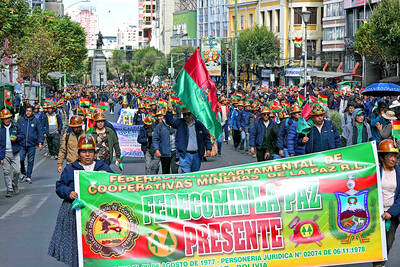
The Bolivian government on Friday struck a deal with protesting miners, but was still grappling with blockades and demonstrations by other workers across La Paz. Other groups are still blocking access roads into the city, which is also the seat of the government. Police on Thursday prevented the miners from entering the main square by using tear gas, while the demonstrators hurled stones and explosives with slingshots. Protests against the policies of Bolivian President Rodrigo Paz have convulsed the Andean nation since early this month, and roadblocks were choking routes into La Paz throughout Friday, the national road authority said. Miners demanded that Paz
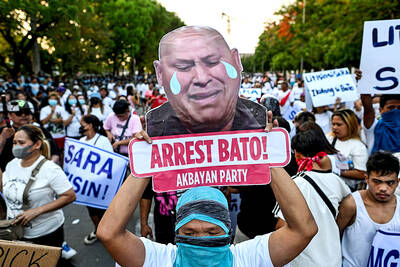
The Philippines said it has asked the country’s Supreme Court to allow it to arrest former Philippine president Rodrigo Duterte’s chief drug war enforcer to stand trial in an international tribunal. The International Criminal Court (ICC) last week unsealed an arrest warrant against Philippine Senator Ronald dela Rosa, accusing him along with Duterte and other “coperpetrators” of the “crime against humanity of murder.” Dela Rosa briefly sought refuge in the Philippine Senate last week while asking the Philippine Supreme Court to stop an ongoing attempt by government agents to arrest him. “By his own conduct, he has placed himself outside the protection of

A ship anchored off the United Arab Emirates (UAE) was seized and taken toward Iran and another — a cargo ship near Oman — sank after being attacked, authorities said on Thursday, as tensions escalated near the Strait of Hormuz. It was not immediately clear who was behind these incidents, but they happened as a senior Iranian official reiterated his country’s claim of control over the waterway and another said it had a right to seize oil tankers connected to the US. The turmoil in the strait has been a sticking point for weeks in talks between the US and Iran to

The researchers in Ireland looked at their computer screen, marveling at a medieval book tracked down in a Roman library. They flipped through its digitized pages and found their sought-after treasure: the oldest surviving English poem. “We were extremely surprised. We were speechless. We couldn’t believe our eyes when we first saw that,” said Elisabetta Magnanti, a visiting research fellow at Trinity College Dublin’s school of English. The poem was also within the main body of Latin text, she said, calling it “extraordinary.” Composed in Old English by a Northumbrian agricultural worker in the 7th century, Caedmon’s Hymn appears within some copies of


 RSS
RSS