


Gina Haspel’s long spy career is so shrouded in mystery that US senators want documents declassified so they can decide if her role at a CIA black site should prevent her from directing the agency.
It is a deep dive into Haspel’s past that reflects key questions about her future: Would she support US President Donald Trump if he tried to reinstate waterboarding and, in his words: “A lot worse”? Is Haspel the right person to lead the CIA at a time of escalating Russian aggression and ongoing extremist threats?
Haspel’s upcoming confirmation hearing is to focus on the time she spent supervising a secret prison in Thailand.
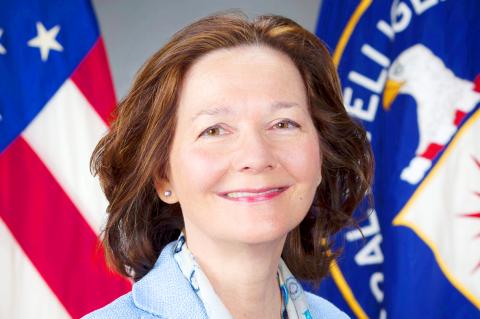
Photo: AFP / Central Intelligence Agency handout
The CIA would not say when in 2002 Haspel was there, but at various times that year interrogators at the site sought to make terror suspects talk by slamming them against walls, keeping them from sleeping, holding them in coffin-sized boxes and forcing water down their throats — a technique called waterboarding.
Haspel is also accused of drafting a memo calling for the destruction of 92 videotapes of interrogation sessions. Their destruction in 2005 prompted a lengthy US Department of Justice investigation that ended without charges.
“We should not be asked to confirm a nominee whose background cannot be publicly discussed and who cannot then be held accountable for her actions,” said US Senator Martin Heinrich, who joined other Democrats on the US Senate Intelligence Committee in asking the CIA to declassify more details about Haspel. “The American public deserves to know who its leaders are.”
Court filings, declassified documents and books written by those involved in the CIA’s now-defunct interrogation program suggest Haspel did not arrive at the secret prison in Thailand until after a detainee, Abu Zubaydah, was waterboarded 83 times in August 2002.
However, they indicate she arrived before another detainee, Abd al Rahim al-Nashiri, was waterboarded at least three times in November 2002.
Details about the two detainees’ treatment were disclosed in a 2014 Senate report.
It said the prison was shut down in December 2002.
Even if Haspel was at the prison site for just a few months, Steven Watt, an American Civil Liberties Union attorney, said she was deeply involved in the interrogation program.
For much of its existence, Haspel was deputy director of the CIA’s counterterrorism center that ran the program using “enhanced interrogation techniques.”
At least 119 men were detained and interrogated as part of the program, said Watt, who represented two detainees and the family of another in a 2015 lawsuit against a pair of CIA-hired psychologists.
It is unknown if Haspel ever was or is a proponent of brutal methods, or if she was only implementing orders from CIA headquarters.
Several colleagues and former intelligence officials have come to her defense.
Mike Morell, who was an acting director of the CIA, worked closely with Haspel from 2006 until he retired in 2013.
Morell has described her as a “warm and engaging” colleague with a “self-deprecating” sense of humor.
She is a “simply exceptional” person who gets things done in a “quiet, yet effective way” and is “calm under fire,” he wrote in the Cipher Brief, an online newsletter on intelligence issues.
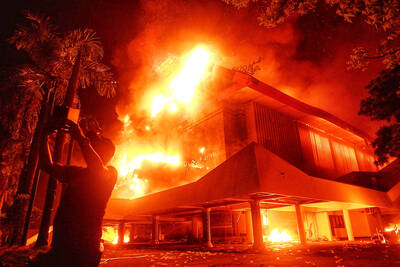
ANGER: Unrest worsened after a taxi driver was killed by a police vehicle on Thursday, as protesters set alight government buildings across the nation Protests worsened overnight across major cities of Indonesia, far beyond the capital, Jakarta, as demonstrators defied Indonesian President Prabowo Subianto’s call for calm. The most serious unrest was seen in the eastern city of Makassar, while protests also unfolded in Bandung, Surabaya, Solo and Yogyakarta. By yesterday morning, crowds had dispersed in Jakarta. Troops patrolled the streets with tactical vehicles and helped civilians clear trash, although smoke was still rising in various protest sites. Three people died and five were injured in Makassar when protesters set fire to the regional parliament building during a plenary session on Friday evening, according to
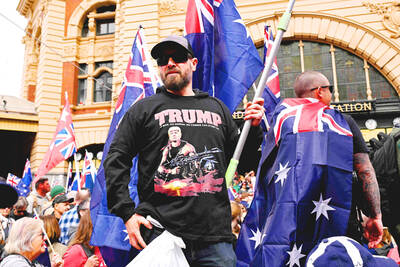
‘NEO-NAZIS’: A minister described the rally as ‘spreading hate’ and ‘dividing our communities,’ adding that it had been organized and promoted by far-right groups Thousands of Australians joined anti-immigration rallies across the country yesterday that the center-left government condemned, saying they sought to spread hate and were linked to neo-Nazis. “March for Australia” rallies against immigration were held in Sydney, and other state capitals and regional centers, according to the group’s Web site. “Mass migration has torn at the bonds that held our communities together,” the Web site said. The group posted on X on Saturday that the rallies aimed to do “what the mainstream politicians never have the courage to do: demand an end to mass immigration.” The group also said it was concerned about culture,
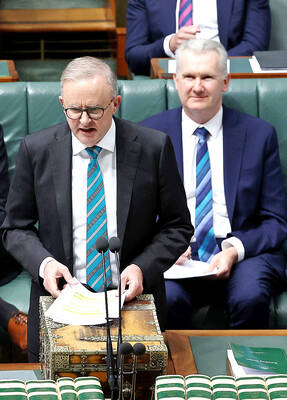
Australia has announced an agreement with the tiny Pacific nation Nauru enabling it to send hundreds of immigrants to the barren island. The deal affects more than 220 immigrants in Australia, including some convicted of serious crimes. Australian Minister of Home Affairs Tony Burke signed the memorandum of understanding on a visit to Nauru, the government said in a statement on Friday. “It contains undertakings for the proper treatment and long-term residence of people who have no legal right to stay in Australia, to be received in Nauru,” it said. “Australia will provide funding to underpin this arrangement and support Nauru’s long-term economic
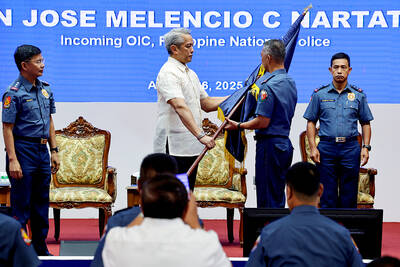
Philippine President Ferdinand Marcos Jr has fired his national police chief, who gained attention for leading the separate arrests of former Philippine president Rodrigo Duterte on orders of the International Criminal Court and televangelist Apollo Carreon Quiboloy, who is on the FBI’s most-wanted list for alleged child sex trafficking. Philippine Executive Secretary Lucas Bersamin did not cite a reason for the removal of General Nicolas Torre as head of the 232,000-member national police force, a position he was appointed to by Marcos in May and which he would have held until 2027. He was replaced by another senior police general, Jose


 RSS
RSS