


Chinese President Xi Jinping (習近平) yesterday called for all sides to exercise restraint in a telephone call about North Korea with US President Donald Trump, as Japan conducted joint drills with a US aircraft carrier strike group headed for Korean waters.
The carrier group was sent by Trump for exercises in waters off the Korean Peninsula as a warning, amid growing fears North Korea could conduct another nuclear test soon in defiance of UN sanctions.
Angered by the approach of the US carrier group, a defiant North Korea yesterday said the deployment of the USS Carl Vinson was “an extremely dangerous act by those who plan a nuclear war to invade the North.”
“The United States should not run amok and should consider carefully any catastrophic consequence from its foolish military provocative act,” the Rodong Sinmun, the official newspaper of the North’s ruling Workers’ Party, said in a commentary.
“What’s only laid for aggressors is dead bodies and deaths,” the newspaper said.
Two Japanese destroyers have already joined the carrier group for drills in the western Pacific, and South Korea yesterday said it was also in talks about holding joint naval exercises.
China is increasingly worried the situation could spin out of control, leading to war and a chaotic collapse of its neighbor.
Xi told Trump that China resolutely opposes any actions that run counter to UN Security Council resolutions, a Chinese Ministry of Foreign Affairs statement said.
China “hopes that all relevant sides exercise restraint, and avoid doing anything to worsen the tense situation on the peninsula,” the statement paraphrased Xi as saying.
The nuclear issue can only be resolved quickly with all relevant countries pulling in the same direction, and China is willing to work with all parties, including the US, to ensure peace, Xi said.
The issue has gained added urgency as North Korea prepares to celebrate the 85th anniversary of the foundation of its Korean People’s Army today. It has marked similar events in the past with nuclear tests or missile launches.
Earlier, Japanese Prime Minister Shinzo Abe described his conversation with Trump as a “thorough exchange of views.”
“We agreed to strongly demand that North Korea, which is repeating its provocation, show restraint,” Abe told reporters.
“We will maintain close contact with the United States, keep a high level of vigilance and respond firmly,” he said.
Abe also said he and Trump agreed that China should play a large role in dealing with Pyongyang.
A Japanese official said the phone call between Trump and Abe was not prompted by any specific change in the situation.
The US government has not specified where the carrier strike group is, but US Vice President Mike Pence on Saturday said that it would arrive “within days.”
South Korean Ministry of National Defense spokesman Moon Sang-gyun gave no further details about the South’s plans, other than saying Seoul was holding discussions with the US Navy.
“I can say the South Korean and US militaries are fully ready for North Korea’s nuclear test,” Moon said.
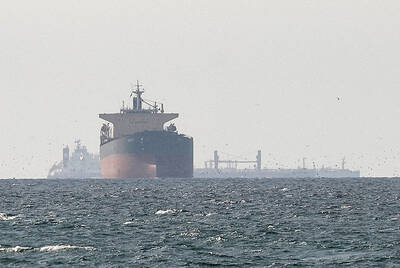
A ship that appears to be taking on the identity of a scrapped gas carrier exited the Strait of Hormuz on Friday, showing how strategies to get through the waterway are evolving as the Middle East war progresses. The vessel identifying as liquefied natural gas (LNG) carrier Jamal left the Strait on Friday morning, ship-tracking data show. However, the same tanker was also recorded as having beached at an Indian demolition yard in October last year, where it is being broken up, according to market participants and port agent’s reports. The ship claiming to be Jamal is likely a zombie vessel that
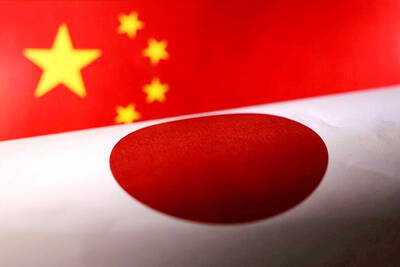
Japan is to downgrade its description of ties with China from “one of its most important” in an annual diplomatic report, according to a draft reviewed by Reuters, as relations with Beijing worsen. This year’s Diplomatic Bluebook, which Japanese Prime Minister Sanae Takaichi’s government is expected to approve next month, would instead describe China as an important neighbor and the relationship as “strategic” and “mutually beneficial.” The draft cites a series of confrontations with Beijing over the past year, including export controls on rare earths, radar lock-ons targeting Japanese military aircraft and increased pressure around Taiwan. The shift in tone underscores a deterioration
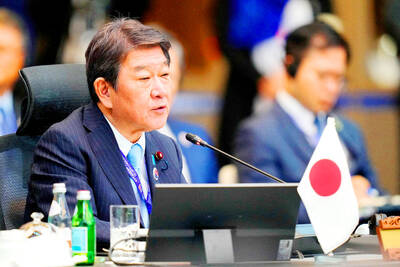
LAW CONSTRAINTS: The US has been pressing allies to send warships to open the Strait, but Tokyo’s military actions are limited under its postwar pacifist constitution Japan could consider deploying its military for minesweeping in the Strait of Hormuz if a ceasefire is reached in the war on Iran, Japanese Minister of Foreign Affairs Toshimitsu Motegi said yesterday. “If there were to be a complete ceasefire, hypothetically speaking, then things like minesweeping could come up,” Motegi said. “This is purely hypothetical, but if a ceasefire were established and naval mines were creating an obstacle, then I think that would be something to consider.” Japan’s military actions are limited under its postwar pacifist constitution, but 2015 security legislation allows Tokyo to use its Self-Defense Forces overseas if an attack,

German Chancellor Friedrich Merz’s conservative Christian Democratic Union (CDU) yesterday faced a regional election battle in Rhineland-Palatinate, now held by the center-left Social Democratic Party (SPD). Merz’s CDU has enjoyed a narrow poll lead over the SPD — their coalition partners at the national level — who have ruled the mid-sized state for 35 years. Polling third is the far-right Alternative for Germany (AfD), which spells a greater threat to the two centrist parties in several state elections in September in the country’s ex-communist east. The picturesque state of Rhineland-Palatinate, bordering France, Belgium and Luxembourg and with a population of about 4 million,


 RSS
RSS