


With only a skimpy loincloth to protect their modesty, thousands of men brave freezing temperatures to fight for lucky charms thrown by a priest at Japan’s annual Naked Man Festival.
A writhing mass of sweaty worshipers wrestled for elbow-room inside Saidai Temple in Okayama late on Saturday night in the hope of catching the sacred batons.
About 10,000 hardy souls celebrating the religious festival stepped under ice-cold fountains to purify their bodies before risking life and limb in a mysterious ceremony dating back 500 years.

Photo: AFP
“It can get very rough,” 62-year-old auto mechanic Kazuhiko Nishigami told a reporter, bare-chested and ready to rumble. “You have to write down your blood type on a form and tuck it into your loincloth in case you get seriously hurt.”
Most who took on the Hadaka Matsuri (Naked Festival), suffered no more than a few bumps and bruises after scrapping over a pair of wooden sticks, measuring 4cm in diameter and 20cm in length, believed to bring good fortune to whoever catches them.
However, revelers have been crushed to death in the past in a melee that makes Tokyo’s infamous rush-hour trains look like a walk in the park.
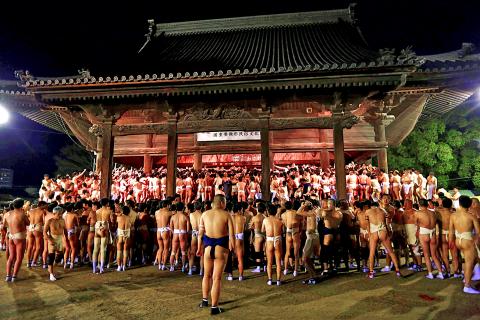
Photo: AFP
It is easy to see how fatalities could occur when the lights suddenly go off and priests cast the mystical charms from the temple’s rafters into the heaving crowd below.
As holy water was splashed from above, camera flashes illuminated the sea of bodies like disco lights at a rave — before all hell broke loose.
In a scene reminiscent of Dante’s Inferno, steam rises as thousands of groaning men, faces contorted with pain, thrust their arms upwards from the suffocating pit below, as if begging for forgiveness — or if not a pair of trousers and a shirt to keep warm.
Those who snaffle one of the holy talismans tossed from above have to fight tooth and nail to keep hold of it as they come under attack by rivals desperate for the fortune it bestows.
Fueled by beer and sake, many festivalgoers came to blows.
“I was lucky to escape,” said firefighter Kosuke Yasuhara, clutching one of the talismans.
“It dropped right in the middle of our group,” the 38-year-old added. “I had to quickly slip it into my loincloth to hide it and then force my way out.”
High priest Zenko Tsuboi said the festival was not an orgy of violence, even if wailing ambulance sirens have provided an unwanted soundtrack in previous years.
“Those who catch the charms will prosper and receive a bumper harvest,” he said. “We want to remind people this is a religious festival so we have become much stricter these days about alcohol and rough behavior.”
As revelers and the hundreds of police and firemen on call made their way back through the rice fields to the city, father-to-be Yasuhara broke into a wide grin.
“This charm is a gift from the gods,” he said. “I believe it will deliver us a bouncing baby when it’s born in April.”

When a hiker fell from a 55m waterfall in wild New Zealand bush, rescuers were forced to evacuate the badly hurt woman without her dog, which could not be found. After strangers raised thousands of dollars for a search, border collie Molly was flown to safety by a helicopter pilot who was determined to reunite the pet and the owner. A week earlier, an emergency rescue helicopter found the woman with bruises and lacerations after a fall at a rocky spot at the waterfall on the South Island’s West Coast. She was airlifted on March 24, but they were forced to

HIGH HOPES: The power source is expected to have a future, as it is not dependent on the weather or light, and could be useful for places with large desalination facilities A Japanese water plant is harnessing the natural process of osmosis to generate renewable energy that could one day become a common power source. The possibility of generating power from osmosis — when water molecules pass from a less salty solution to a more salty one — has long been known. However, actually generating energy from that has proved more complicated, in part due the difficulty of designing the membrane through which the molecules pass. Engineers in Fukuoka, Japan, and their private partners think they might have cracked it, and have opened what is only the world’s second osmotic power plant. It generates

Hundreds of Filipinos and tourists flocked to a sun-bleached field north of Manila yesterday, on Good Friday, to witness one of the country’s most blood-soaked displays of religious fervor, undeterred by rising fuel prices. Scores of bare-chested flagellants with covered faces walked barefoot through the dusty streets of Pampanga Province’s San Fernando as they flogged their backs with bamboo whips in the scorching heat. Agence France-Presse (AFP) journalists said they saw devotees deliberately puncturing their skin with glass shards attached to a small wooden paddle to ensure their bleeding during the ritual, a way to atone for sins and seek miracles from
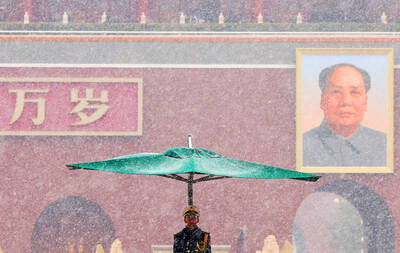
Chinese dissident artist Gao Zhen (高兟), famous for making provocative satirical sculptures of former Chinese leader Mao Zedong (毛澤東), was tried on Monday over accusations of “defaming national heroes and martyrs,” his wife and a rights group said. Gao, 69, who was detained in 2024 during a visit from the US, faces a maximum three-year prison sentence, said his wife, Zhao Yaliang (趙雅良), and Shane Yi, a researcher at the Chinese Human Rights Defenders group which operates outside the nation. The closed-door, one-day trial took place at Sanhe City People’s Court in Hebei Province neighboring the capital, Beijing, and ended without a


 RSS
RSS