


Ali Hribish stands by the Arch of Septimius Severus, which dominates Libya’s ancient city of Leptis Magna, brandishing letters of thanks for his efforts to protect the site.
The former electricity company employee in his 50s has become the Roman city’s unlikely savior, protecting it from looting and vandalism as chaos rocks the country following the 2011 downfall of former Libyan leader Muammar Qaddafi.
Despite having no background in archaeology, Hribish gathered a band of fighters who dedicated themselves to preserving the ancient Roman city, a UNESCO World Heritage site.
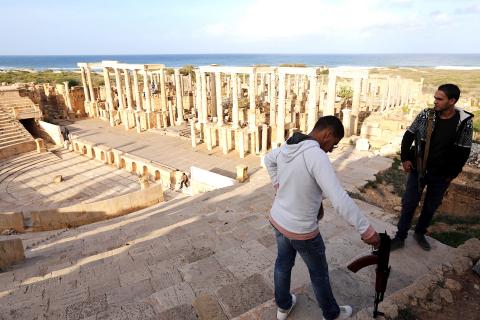
Photo: AFP
While others set up armed groups to protect banks and public buildings, “we immediately thought of Leptis Magna,” said Ashraf Mohammed, 33, one of the first fighters to join Hribish’s group.
“A bank can be rebuilt, but our monuments and our history are things we can’t replace,” he said.
The group of 20 young men, Kalashnikov rifles in hand, go on a routine patrol around the 50 hectare site.
They inspect the hippodrome, the basilica and the open-air theater that used to host about 15,000 spectators on its terraces, with a sublime view of the Mediterranean. Roman Emperor Septimius Severus, who was born in Leptis Magna and ruled Rome from 193 to 211 AD, favored his home town and turned it into one of the most beautiful cities in the empire.
He endowed it with splendid monuments, including a vast basilica more than 30m high, and renovated the thermal baths built during the reign of Hadrian (76-138 AD). The open-air pool is still intact to this day.
Hribish, who is from the nearby city of Khoms, fears for the site’s safety.
The Islamic State (IS) group, which destroyed priceless artifacts in Syria and Iraq, is still active in Libya, despite having been ousted from Sirte, their North African bastion.
However, “we are much more worried about looting and acts of vandalism,” Hribish told reporters, adding that he knows “every stone of the site.”
Hribish said he was “appalled” when the Islamic State group blew up UNESCO-listed Roman-era temples and looted ancient relics in Syria’s Palmyra.
However, he said that unlike the country’s other historical sites, “Leptis Magna has been protected from acts of looting and we are continuing to monitor it.”
“We will not allow IS or anyone else to touch it,” he said.
Last year his men discovered and defused a bomb weighing several kilograms in a cafe close to the site.
However, he said he doubts it was put there by the Islamic State, in a nation where multiple armed groups are struggling for power.
Muslim ideologues are not the only threat to the site, he said, with developer destroying part of the city of Cyrene, an ancient Greek and Roman city in eastern Libya, to build houses there.
“We have prevented acts like that here,” he said.
He said that he has blocked plans to build an unlicensed row of shops immediately next to the remains.
“At the start, we thought our mission would be a short-term thing. We expected a state would be built that could guarantee that the country’s archaeological sites would be protected,” he said.
Libya remains divided between rival governments and militias waging a bitter struggle for power.
Other inhabitants of the nearby town of Khoms have also mobilized to protect administrative buildings and banks from vandalism and looting.
Hribish said he supports the restoration of Libya’s monarchy, which was overthrown in the coup that brought Qaddafi to power in 1969.
“We will continue with our mission until a real state is built,” Hribish said.
His colleagues complain they are defending the site with the most basic means.
“There are no surveillance cameras, no fence, not even fire extinguishers,” Ali Ghazi, 26, told reporters.
Ghazi, who is unemployed, tells of the “nightmare” of putting out grass fires in the summer.
“Some people tried putting them out by beating them with sticks, while others brought in buckets of sea water,” he said.
Walid Abu Hamid, 33, says the city needs restoration work to tackle the effects of erosion.
“We have told the Department of Antiquities, but in vain,” he said. “Qaddafi marginalized our history and our heritage for more than 40 years. It’s time for us to look after it and show it to the world.”

School bullies in Singapore are to face caning under new guidelines, but the education minister on Tuesday said it would be meted out only as a last resort with strict safeguards. Human rights groups regularly criticize Singapore for the use of corporal punishment, which remains part of the school and criminal justice systems, but authorities have defended it as a deterrent to crime and serious misconduct. Caning was discussed in the parliament after legislators asked how it would be used in relation to bullying in schools. The debate followed stricter guidelines on serious student misconduct, including bullying, unveiled by the Singaporean Ministry of

As evening falls in Fiji’s capital, a steady stream of people approaches a makeshift clinic that is a first line of defense against one of the world’s fastest-growing HIV epidemics. In the South Pacific nation — a popular tourist destination of just under a million people — more than 2,000 new HIV cases were recorded last year, a 26 percent increase from 2024. The government has declared an HIV outbreak and described it as a national crisis. “It’s spreading like wildfire,” said Siteri Dinawai, 46, who came to be tested. The Moonlight Clinic, a converted minibus parked in a suburban cul-de-sac in Suva, is
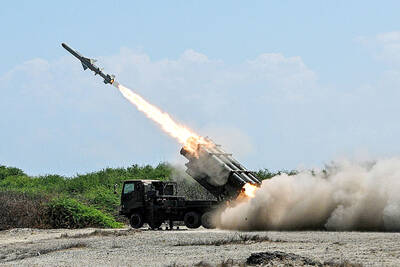
A MESSAGE: Japan’s participation in the Balikatan drills is a clear deterrence signal to China not to attack Taiwan while the US is busy in the Middle East, an analyst said The Japan Self-Defense Forces yesterday fired a Type 88 anti-ship missile during a joint maritime exercise with US, Australian and Philippine forces, hitting a decommissioned Philippine Navy ship in waters facing the disputed South China Sea, in drills that underscore Tokyo’s rising willingness to project military power on China’s doorstep. The drill took place as Manila and Tokyo began talks on a potential defense equipment transfer, made possible by Japan’s decision to scrap restrictions on military exports. The discussions include the possible early transfer of Abukuma-class destroyers and TC-90 aircraft to the Philippines, Japanese Minister of Defense Shinjiro Koizumi said. Philippine Secretary of
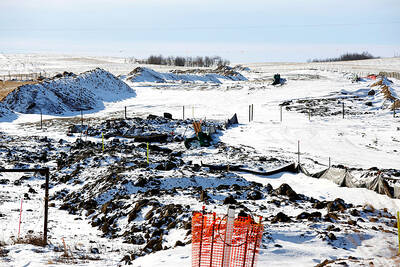
Separatists in Alberta are preparing to submit a petition tomorrow that they said has enough signatures to force a referendum on independence for the oil-rich Canadian province. Polls indicate the pro-independence camp remains a minority among Alberta’s 5 million people, but has hit a historic high of roughly 30 percent. Alberta separatists are also closer than ever to forcing a referendum, riding momentum fueled by intensifying grievances over Ottawa’s control of the provincial oil industry. They have also undeniably gotten a boost from the return to power of US President Donald Trump. After launching a petition in January, Stay Free Alberta, the group


 RSS
RSS