


An increasing number of Indonesians are taking a stand against digital games like Pokemon Go that they say erode values, and are encouraging children to play with traditional toys like wooden spinning tops and bamboo pinwheels.
Tens of thousands of Indonesians were hooked on Nintendo’s augmented reality app, in which players hunt virtual characters in real-life places, months before the smash-hit game was officially launched in the Southeast Asian nation.
However, parents and teachers worry that children get too caught up in the virtual world and are missing out on interacting with each other.
Some parents are nostalgic about the games they used to play and want to introduce their children to them.
Hundreds of parents and children attended a traditional games festival on a recent weekend at the Pilar Bangsa, or “pillar of the nation,” school in West Jakarta.
A gaggle of children huddled around a wooden board, taking turns shooting marbles at goal posts made of rubber bands in a version of table soccer.
Others were tying strings around tops and spinning them on a circular platform.
“Traditional games involve more activities, whereas electronic games only require kids to use their thumbs,” said Januar Surjadi, who was teaching his three-year-old boy to play with a bamboo toy that made a clicking sound when spun.
Some games like wayang, or traditional puppets, and congklak, which requires players to collect as many “seeds” as possible in the holes of a wooden set, have been passed down through generations.
Pilar Bangsa principal Agustinus, who goes by one name, said his school would organize more events to introduce kids to traditional games.
“We want to show the unique features of Indonesia, that it has a rich culture,” Agustinus said.
His school is not the only one.
Indonesian Ministry of Education official Essi Hermaliza said authorities aimed to instill old values in students through traditional games across the nation.
The mayor of the city of Bogor has renovated a park and equipped it with wooden stilts and other toys to “help children avoid Pokemon Go,” media reported recently.
Traditional toys are often cheap — some sell for US$1 or less — but even so present an opportunity for businessmen like Fahrudin, who gets toys made in villages and sells them online.
“The response from consumers has been positive and there’s still a lot of demand,” he said at his warehouse near Jakarta, where workers were packaging toys for delivery.
For children like Michelle Miranda, 13, traditional toys do not replace her electronic gadget, but they are still fun.
“I am getting a little bored of Pokemon Go because it is harder to find the rarer Pokemons,” she said. “I play congklak at home with my friends. It is fun and it helps to teach mental arithmetic.”

School bullies in Singapore are to face caning under new guidelines, but the education minister on Tuesday said it would be meted out only as a last resort with strict safeguards. Human rights groups regularly criticize Singapore for the use of corporal punishment, which remains part of the school and criminal justice systems, but authorities have defended it as a deterrent to crime and serious misconduct. Caning was discussed in the parliament after legislators asked how it would be used in relation to bullying in schools. The debate followed stricter guidelines on serious student misconduct, including bullying, unveiled by the Singaporean Ministry of
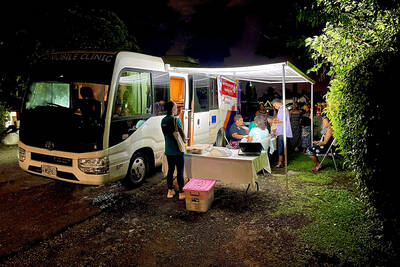
As evening falls in Fiji’s capital, a steady stream of people approaches a makeshift clinic that is a first line of defense against one of the world’s fastest-growing HIV epidemics. In the South Pacific nation — a popular tourist destination of just under a million people — more than 2,000 new HIV cases were recorded last year, a 26 percent increase from 2024. The government has declared an HIV outbreak and described it as a national crisis. “It’s spreading like wildfire,” said Siteri Dinawai, 46, who came to be tested. The Moonlight Clinic, a converted minibus parked in a suburban cul-de-sac in Suva, is

A MESSAGE: Japan’s participation in the Balikatan drills is a clear deterrence signal to China not to attack Taiwan while the US is busy in the Middle East, an analyst said The Japan Self-Defense Forces yesterday fired a Type 88 anti-ship missile during a joint maritime exercise with US, Australian and Philippine forces, hitting a decommissioned Philippine Navy ship in waters facing the disputed South China Sea, in drills that underscore Tokyo’s rising willingness to project military power on China’s doorstep. The drill took place as Manila and Tokyo began talks on a potential defense equipment transfer, made possible by Japan’s decision to scrap restrictions on military exports. The discussions include the possible early transfer of Abukuma-class destroyers and TC-90 aircraft to the Philippines, Japanese Minister of Defense Shinjiro Koizumi said. Philippine Secretary of

Separatists in Alberta are preparing to submit a petition tomorrow that they said has enough signatures to force a referendum on independence for the oil-rich Canadian province. Polls indicate the pro-independence camp remains a minority among Alberta’s 5 million people, but has hit a historic high of roughly 30 percent. Alberta separatists are also closer than ever to forcing a referendum, riding momentum fueled by intensifying grievances over Ottawa’s control of the provincial oil industry. They have also undeniably gotten a boost from the return to power of US President Donald Trump. After launching a petition in January, Stay Free Alberta, the group


 RSS
RSS