


There are two versions of how Manila pedicab driver Neptali Celestino died.
According to Philippine police, he shot at plainclothes officers during a sting operation on Sept. 12, and they returned fire. His family says police burst into their ramshackle home, cornered an unarmed Celestino and shot him in front of his teenage sons.
Whatever the case, Celestino’s days seem to have been numbered. His name had appeared on a police “watch list” of drug suspects drawn up with the help of community leaders and other people who lived alongside him in Palatiw, a frenetic, traffic-choked area on the eastern side of the nation’s capital.
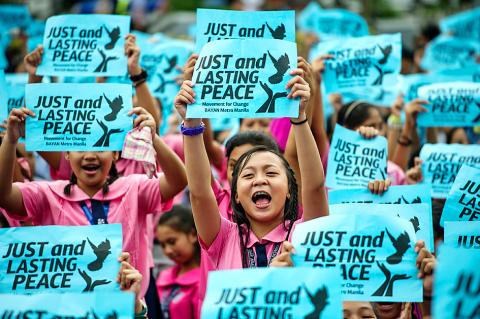
Photo: AFP
The local officials who help police draw up these lists are foot soldiers in a war on drugs that has led to the killing of more than 3,600 people since Philippine President Rodrigo Duterte took office on June 30.
Most of the 1,377 people shot by the police had appeared on the lists, Philippine Police Chief Ronald Dela Rosa said.
It was unclear how many of the remaining 2,275 victims, who human rights activists suspect were mostly killed by vigilantes, were on the lists.
The campaign draws its momentum from Duterte: On Sept. 23, he seemed to compare himself to Hitler and said he would be “happy to slaughter” 3 million drug addicts in the Philippines, but the campaign’s efficiency depends on the lowliest officials in the country’s barangays — its districts and villages.
“They are on the forefront of this fight,” Dela Rosa said. “They can identify the drug users and pushers in their barangays. They know everyone.”
Interviews with local police, residents and barangay officials reveal the mechanics of a crusade against drugs that the popular Duterte has vowed to wage until June next year in the face of global condemnation.
Barangay leaders, known as “captains,” have been instrumental in drawing up the lists, police said.
Maricar Asilo Vivero is the captain of Pinagbuhatan, a Manila barangay with about 145,000 people, and says she is an enthusiastic supporter of Duterte’s campaign.
“The war on drugs is good,” she said. “It lowers crime. It identifies those who want to change.”
The night before, Vivero said, motorbike-riding assassins killed two men who had been named as pushers on the barangay’s watch list.
Vivero said she sympathized with the victims’ families but did not feel responsible for the deaths.
People were not included on the watch list with “the objective of killing them, or asking the police or authorities to kill them,” she said. “Our objective is to guide them, to direct their lives to the better — not to kill.”
Asked if people named on the watch list were more likely to get killed, Vivero replied: “No, I don’t think so.”
There were 323 suspected users and dealers on Pinagbuhatan’s watch list, according to a computer print-out seen by reporters. It had been swelled by people who had gone to the barangay office to admit to police they were users, a process known as “surrendering.”
The origins of the barangay system predate the arrival of Spanish colonizers in the 16th century. In Manila, a barangay can consist of just two densely populated streets; in the countryside, it can sprawl for kilometers.
Each has a barangay captain and six kagawad, or councilors, who are elected in polls often dogged by allegations of corruption. And, as with more senior posts in the Philippines, the barangay captaincy often passes between members of the same family.
The barangay office sits at the heart of the community and, on any given day, its hallways are clogged with people seeking so-called “clearances.” These are certificates, signed by the captain, for people needing to establish residency, set up a business, apply for a job or enroll a child at a local school.
Barangay captains routinely attend the weddings, baptisms and funerals of constituents, and even victims of serious crimes will sometimes report to them first rather than the police.
“They trust us more and get an immediate response,” said Eriberto Guevarra, who for 11 years was captain of Palatiw.
His wife, Dinah, now occupies the position, while Eriberto works at her side as a self-styled “peace and order czar.”
The Barangay Anti-Drug Action Committees (BADACs) play a key role in helping the police identify alleged drug dealers and users in each district.
Each BADAC’s six to 10 members are chosen by the barangay captain, who also chairs the committee.
Each BADAC provides the names of what police term “drug personalities,” meaning suspected users or dealers, most of them small-time.
Police say they then “validate” these names in consultation with national anti-narcotics and intelligence officials. They also add names of their own.
First created by the government in 1998, BADACs were meant to convene every month, but for years many did little or existed only on paper.
Duterte not only revived the BADACs, he made them the lynchpin of his war on drugs.
Duterte pioneered the nationwide campaign in the southern city of Davao, where he was mayor for 22 years.
There, barangay leaders and police compiled similar lists that were used by death squads to assassinate hundreds of alleged drug dealers, petty criminals and street children, said Human Rights Watch in a 2009 report.
Duterte denied any involvement in the killings.
Officials say the watch lists are not arbitrary hit lists.
Metro Manila’s list of 11,700 users and dealers has been “validated and revalidated by intelligence,” said Kimberley Molitas, police spokeswoman for a region that has seen more than a quarter of the drug-war deaths.
Human rights monitors and some officials counter that the process is open to abuse.

School bullies in Singapore are to face caning under new guidelines, but the education minister on Tuesday said it would be meted out only as a last resort with strict safeguards. Human rights groups regularly criticize Singapore for the use of corporal punishment, which remains part of the school and criminal justice systems, but authorities have defended it as a deterrent to crime and serious misconduct. Caning was discussed in the parliament after legislators asked how it would be used in relation to bullying in schools. The debate followed stricter guidelines on serious student misconduct, including bullying, unveiled by the Singaporean Ministry of

As evening falls in Fiji’s capital, a steady stream of people approaches a makeshift clinic that is a first line of defense against one of the world’s fastest-growing HIV epidemics. In the South Pacific nation — a popular tourist destination of just under a million people — more than 2,000 new HIV cases were recorded last year, a 26 percent increase from 2024. The government has declared an HIV outbreak and described it as a national crisis. “It’s spreading like wildfire,” said Siteri Dinawai, 46, who came to be tested. The Moonlight Clinic, a converted minibus parked in a suburban cul-de-sac in Suva, is
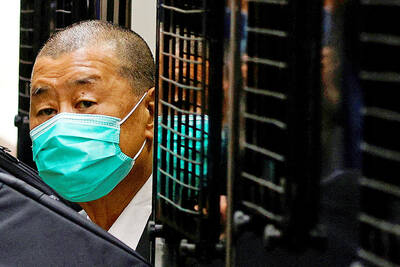
Jailed media entrepreneur Jimmy Lai (黎智英) has been awarded Deutsche Welle’s (DW) freedom of speech award for his contribution to Hong Kong’s pro-democracy movement. The German public broadcaster on Thursday said Lai would be presented in absentia with the 12th iteration of the award on June 23 at the DW Global Media Forum in Bonn. Deutsche Welle director-general Barbara Massing praised the 78-year-old founder of the now-shuttered news outlet Apple Daily for standing “unwaveringly for press freedom in Hong Kong at great personal risk.” “With Apple Daily, he gave journalists a platform for free reporting and a voice to the democracy movement in
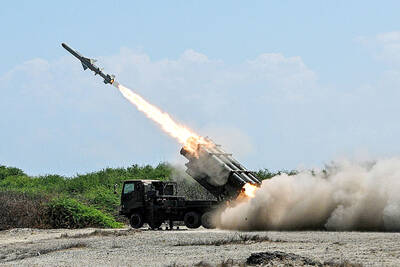
A MESSAGE: Japan’s participation in the Balikatan drills is a clear deterrence signal to China not to attack Taiwan while the US is busy in the Middle East, an analyst said The Japan Self-Defense Forces yesterday fired a Type 88 anti-ship missile during a joint maritime exercise with US, Australian and Philippine forces, hitting a decommissioned Philippine Navy ship in waters facing the disputed South China Sea, in drills that underscore Tokyo’s rising willingness to project military power on China’s doorstep. The drill took place as Manila and Tokyo began talks on a potential defense equipment transfer, made possible by Japan’s decision to scrap restrictions on military exports. The discussions include the possible early transfer of Abukuma-class destroyers and TC-90 aircraft to the Philippines, Japanese Minister of Defense Shinjiro Koizumi said. Philippine Secretary of


 RSS
RSS