


Balinese women dressed in gold bodices dance to rhythmic drumming while waving fans as men in purple outfits sit cross-legged around them, jiggling their arms and chanting.
It appears to be just another show on the Indonesian island of Bali, known for its ancient culture and rituals, but there is a key difference — the dancers are all deaf and cannot hear the beat. They perform the moves, learned over months of hard training, from memory.
The village of Bengkala has been home to an unusually large number of deaf people for generations and nowadays about 40 out of approximately 3,000 residents have severe hearing loss, but unlike in other parts of Indonesia where they could face mistreatment, local people have taken the deaf residents to their hearts.
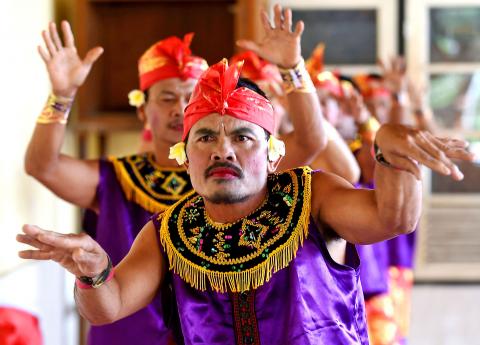
Photo: AFP
In many ways, life in the small hamlet has come to revolve around them. As well as the dance project, a unique sign language called Kata Kolok has been developed in the isolated village, which has been mastered by those with hearing impairment, as well as many of those who can hear, prompting interest from scientists around the world.
In addition, deaf villagers are trained in skills such as making handicrafts that can be sold in the heaving tourist resorts of the island and they work side by side with other villagers in the rice fields.
“Human rights are the same everywhere. So I thought, why should the deaf be ostracized?” said Ketut Kanta, who heads a community group for the village’s deaf residents.
The approach is relatively unique in Indonesia, where disabled people often suffer harsh discrimination.
Bengkala, in northern Bali, has existed for about eight centuries. Residents often scrape a living tending to the surrounding rice fields and education levels are generally low.
In the past, villagers thought the high incidence of deafness was due to a curse, but those superstitions — and the prejudices they created — have largely been abandoned after experts concluded it was due to a recessive gene common among the local population.
It was not until the 1960s that the village began to make efforts to better integrate its deaf residents and nowadays everyone is treated equally, village head I Made Arpana said.
“We don’t differentiate between deaf villagers and non-deaf villagers,” he said, adding that the community did not want the hard-of-hearing residents to feel “inferior.”
A key factor in creating this peaceful coexistence has been Kata Kolok, which literally translates as “talk of the deaf,” and it is used to varying degrees by about 80 percent of the villagers.
It is different to international and Indonesian sign language. It has grown organically over the decades and has its own unique signs created by villagers to reflect how they see the world.
Attempts to ensure harmony in the village start at a young age, with the Bengkala elementary school teaching all children side by side. The 77 students are all given lessons in the local sign language, and are introduced to elements of Indonesian and international signing.
Made Budiasih, whose seven-year-old son goes to the school, said she was worried for his future when they discovered he was deaf at birth, but said the inclusive school had made all the difference.
“I was despairing, but then I found out about this school,” she said.
Still, it is not always easy teaching deaf students, as they often become frustrated and act out, said teacher I Made Wisnu, who has been working at the school for a decade. There are no junior high schools equipped to teach deaf students, so most have to drop out of the system once they have graduated from elementary classes.
Despite the challenges, Arpana is determined to safeguard the unique culture of the hamlet’s deaf community, saying he would be a “sinner” if he did not.
The clearest expression of the village’s warm embrace of its hard-of-hearing population is the unique project “dance of the deaf,” which has started to draw a trickle of foreign visitors to the out-of-the-way village, giving residents hope for a brighter future.
“Tourists from China and Europe are coming to watch us and they really enjoy it,” tambourine player I Wayan Getar said in sign language through an interpreter.

Crowds in Bangladesh are flocking to snap photographs with an unlikely social media star — an albino buffalo with flowing blond hair nicknamed “Donald Trump” that is due to be sacrificed within days. Owner Zia Uddin Mridha, 38, said his brother named the 700kg bull over its flowing helmet of hair resembling the signature look of the US president. “My younger brother picked this name because of the buffalo’s extraordinary hair,” he said at his farm in Narayanganj, just outside the capital, Dhaka. Mridha said that a constant stream of curious visitors — social media fans, onlookers and children — have come throughout

It began as a satirical online project. Now millions of young people in India are flocking to it as an outlet for their frustration. A parody political party called the Cockroach Janta Party, with the insect as its symbol, has exploded across India’s social media by turning absurdist humor into protest. Memes and short videos mocking corruption, joblessness and political dysfunction have flooded social media sites, where millions of users are embracing the cockroach — known for its ability to survive harsh conditions — as a tongue-in-cheek symbol of endurance. The online movement’s rise has been unusually rapid. The Cockroach Janta Party (CJP)

HOTTER: While Indians are accustomed to summer heat, climate change has caused northwestern India to warm faster than other parts of the country, an academic said Roads and markets have emptied during afternoons and some farmers have switched to nighttime work to avoid scorching temperatures as a heat wave grips large parts of India. The India Meteorological Department forecast maximum temperatures for yesterday of about 45°C in the capital, New Delhi, where authorities have opened temporary “cooling zones” to help people cope. The weather department warned that conditions would likely persist across several northern regions in the coming days, with temperatures staying well above seasonal averages. Authorities urged people to stay indoors during the hottest hours and take precautions against heat-related illnesses. India declares a heat wave whenever maximum temperatures

BIGGER ROLE: Beijing has said it maintains an impartial stance on the war in Ukraine, but by training Russian troops, China is far more involved than previously known China’s armed forces secretly trained about 200 Russian military personnel in China late last year, and some have since returned to fight in Ukraine, according to three European intelligence agencies and documents seen by Reuters. While China and Russia have held a number of joint military exercises since Moscow’s full-scale invasion of Ukraine in 2022, Beijing has repeatedly said that it is neutral in the conflict and presents itself as a peace mediator. The covert training sessions, which predominantly focused on the use of drones, were outlined in a dual-language Russian-Chinese agreement signed by senior Russian and Chinese officers in Beijing on


 RSS
RSS