


The story of the thief who walked out of an expensive Manhattan cigar store with four boxes of medium-blend Dominicans last month actually begins decades earlier, before he was born. It starts in the 1960s, with an encounter between two men that would change both their lives. One of those men was Avo Uvezian, an Armenian jazz musician living in New York. The other was also a musician, from New Jersey, named Frank Sinatra.
Uvezian was born in 1926 in Beirut. He became an accomplished musician who traveled the Middle East, speaking multiple languages along the way.
“I usually count in Armenian in my head,” he told Cigar Journal in an interview this year. “I find the best language to swear in is Turkish, and when dreaming of pretty women, French is the best language.”
Playing piano, he led a jazz combo that performed in Lebanon, Iraq and Iran. In 1947, he moved to New York and entered the Juilliard School of Music.
Years passed and by the 1960s he had written his own music. One melody stood out.
“The song itself is a very simple song,” Uvezian, 89, said this month by telephone from his home in Orlando, Florida. “You take the thing and you repeat it. ‘Dah-dah-dah-dah-daaaah.’ It’s the same line repeated throughout.”
He had a friend who knew Sinatra. The friend set up a meeting and told Uvezian to bring along his music. Someone else had put lyrics to the melody and called it Broken Guitar.
Sinatra gave it a listen.
“He said: ‘I love the melody, but change the lyrics,’” Uvezian said.
The task was given to studio songwriter and they came back with new words. Sinatra, legend has it, hated it.
The title was new, too — Strangers in the Night.
However, Uvezian did not receive credit for the song. Before Sinatra ever heard the music, Uvezian, a novice, had sent it to a friend, Bert Kaempfert, an established German composer, to be published there, he said.
Kaempfert claimed credit for the song, and the experience soured Uvezian on the music business and on New York, he said.
He moved to Puerto Rico and started over. He played piano at a resort. He had smoked a pipe in the past, but he was introduced to good cigars on the occasion of his daughter’s christening in 1982, he said.
He saw an opportunity that would lead to a flourishing second career.
He traveled to the Dominican Republic and visited a cigar manufacturer. He met a master blender named Hendrik Kelner.
“He made 10 or 12 different blends,” Uvezian said.
Uvezian sampled them over a month or so and came back with his favorite. It would become a brand called the Avo Classic.
“The beginner or longtime smoker, he could find satisfaction in that Classic,” Uvezian said.
He sent samples to Davidoff of Geneva, a worldwide distributor. Davidoff bought the Avo line of cigars in 1995 and now sells some 2 million per year, brand manager Scott Kolesaire said.
“The construction, balance and palate stimulation were just top notch,” Kolesaire said of the Avo Classic.
Another blend, stronger in taste, was created, the Avo XO. The Davidoff store on Avenue of the Americas in New York, keeps its Avo line in the climate-controlled, walk-in humidor it installed in January. It was into this humidor that an unidentified man in his 30s walked, alone and unnoticed, on Nov. 23 at 4:20pm. He scooped four boxes of cigars into a big Bed Bath & Beyond bag and left. They were Avo XOs, each box worth US$261.22.
Uvezian, informed of the theft by a reporter’s call, was unfazed. He has had bigger headaches than 80 of his 2 million cigars going missing.
“It can happen,” he said.

ROCKY RELATIONS: The figures on residents come as Chinese tourist numbers drop following Beijing’s warnings to avoid traveling to Japan The number of Chinese residents in Japan has continued to rise, even as ties between the two countries have become increasingly fractious, data released on Friday showed. As of the end of December last year, the number of Chinese residents had increased by 6.5 percent from the previous year to 930,428. Chinese people accounted for 22.6 percent of all foreign residents in Japan, making them by far the largest group, Japanese Ministry of Justice data showed. Beijing has criticized Tokyo in increasingly strident terms since Japanese Prime Minister Sanae Takaichi last year suggested that a military conflict around Taiwan could

A retired US colonel behind a privately financed rocket launch site in the Dominican Republic sees the project as a response to China’s dominance of the space race in Latin America. Florida-based Launch on Demand is slated to begin building a US$600 million facility in a remote region near the border with Haiti late this year. The project is designed to meet surging demand for the heavy-lift rockets needed to put clusters of satellites into orbit. It is also an answer to China’s growing presence in the region, said CEO Burton Catledge, a former commander of the US Air Force’s 45th Operations

Germany is considering Australia’s Ghost Bat robot fighter as it looks to select a combat drone to modernize its air force, German Minister of Defense Boris Pistorius said yesterday. Germany has said it wants to field hundreds of uncrewed fighter jets by 2029, and would make a decision soon as it considers a range of German, European and US projects developing so-called “collaborative combat aircraft.” Australia has said it will integrate the Ghost Bat, jointly developed by Boeing Australia and the Royal Australian Air Force, into its military after a successful weapons test last year. After inspecting the Ghost Bat in Queensland yesterday,
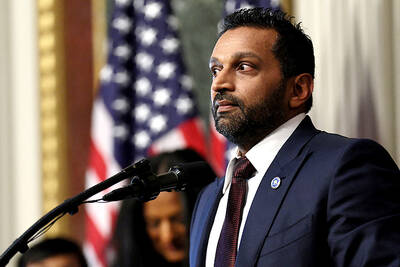
A pro-Iran hacking group claimed to breach FBI Director Kash Patel’s personal e-mail inbox and posted some of the contents online. The e-mails provided by the hacking group include travel details, correspondence with leasing agents in Washington and global entry, and loyalty account numbers. The e-mail address the hackers claim to have compromised has been previously tied to Patel’s personal details, and the leaked e-mails contain photos of Patel and others, in addition to correspondence with family members and colleagues. “The FBI is aware of malicious actors targeting Director Patel’s personal email information,” the agency said in a statement on


 RSS
RSS