


Authorities have begun handing blue police uniforms and assault rifles to vigilantes in western Mexico, legalizing a movement that formed last year to combat a vicious drug cartel.
Scores of farmers lined up on Saturday at a cattle ranch to receive uniforms of the newly created rural state police force in Tepalcatepec, a founding town of the self-defense militias in the fertile agricultural state of Michoacan.
The units were also making their debut in the neighboring town of Buenavista, which revolted in February last year against the cult-like Knights Templars gang because local police failed to protect them.
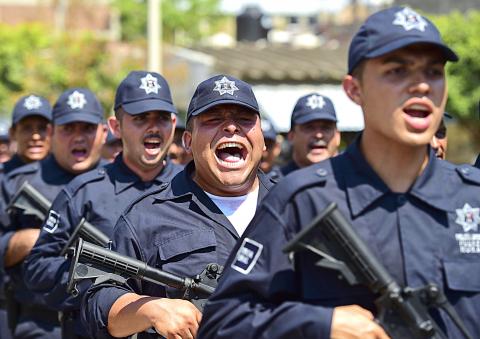
Photo: AFP
“With this, we become legal,” said white-bearded vigilante leader Estanislao Beltran, nicknamed “Papa Smurf,” after slipping into his blue uniform.
“We are part of the government,” he said.
About 100 new rural police officers then sang the national anthem at a formal swearing-in ceremony in the town square. The Mexican government later said 450 officers were sworn in.
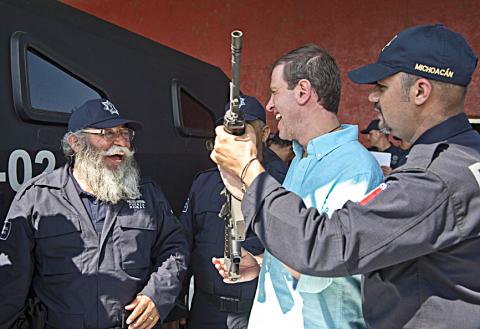
Photo: AFP
“From now on, you are in charge of defending your brothers, your families, your neighbors and anybody who can be harmed by organized crime,” said Alfredo Castillo, the special federal security envoy to Michoacan.
The federal government, which had previously only tolerated the vigilante group, has warned that anybody found carrying weapons illegally after Saturday’s deadline to join the police force will be arrested.
After authorities took down three of the four main Knights Templar leaders, the vigilantes signed an agreement last month to register their guns and keep them stored in their homes or join the rural force.
Vigilante leaders said they still had to hash out details like salaries and who would be in command, though they would work alongside the regular state police.
The militia has faced divisions among its leadership, but more than 3,300 out of an estimated 20,000 vigilantes have signed up to join the police force, officials said.
Despite the deadline, Castillo said the vigilantes could be granted a few more days to be deputized in other towns because of an unexpected high demand to join the force.
“I am proud of wearing this uniform,” said Arturo Barragan, a 35-year-old truck driver. “We are in a struggle that at some point must have a beginning and an end.”
The growth of the vigilante movement, which spread to about 30 towns and chased out many cartel members, brought with it fears that it could turn into a dangerous paramilitary force in Michoacan’s tierra caliente (hot land in Spanish).
The violence in Michoacan turned into one of the biggest security challenges to Mexican President Enrique Pena Nieto, who deployed thousands of troops to restore order last year and named Castillo as his special security envoy this year.
The transition comes amid deep divisions within the militia, accusations that it is infiltrated by cartels and the recent arrest of one of its founders.
Authorities have also found several cases of criminals posing as vigilantes.
Castillo said federal and state security forces, backed by the newly formed militia, captured 155 suspects dressed like vigilantes on Friday.
The movement’s leadership has faced turmoil, too.
On Thursday, the council of self-defense forces in more than 30 towns announced the dismissal of its chief spokesman, Jose Manuel Mireles, who was absent from Saturday’s registrations and ceremonies.
The council accused him of making public statements without clearance that undermined the movement.
The council also said “recent actions” by Mireles had cost the lives of five civilians, but it did not elaborate.
Authorities said they are investigating whether Mireles had a role in the deaths.
Mireles could not be reached for comment on Saturday.
Another founder of the movement, Hipolito Mora, was arrested in March on charges that he masterminded the murders of two fellow vigilantes. He denies the charges.
Mireles, a tall, mustachioed doctor, told a radio station this week that the vigilante movement was divided and infiltrated by criminals.
Security forces are still hunting for the Knights Templar cartel’s last top leader, Servando Gomez, alias La Tuta.

When a hiker fell from a 55m waterfall in wild New Zealand bush, rescuers were forced to evacuate the badly hurt woman without her dog, which could not be found. After strangers raised thousands of dollars for a search, border collie Molly was flown to safety by a helicopter pilot who was determined to reunite the pet and the owner. A week earlier, an emergency rescue helicopter found the woman with bruises and lacerations after a fall at a rocky spot at the waterfall on the South Island’s West Coast. She was airlifted on March 24, but they were forced to

HIGH HOPES: The power source is expected to have a future, as it is not dependent on the weather or light, and could be useful for places with large desalination facilities A Japanese water plant is harnessing the natural process of osmosis to generate renewable energy that could one day become a common power source. The possibility of generating power from osmosis — when water molecules pass from a less salty solution to a more salty one — has long been known. However, actually generating energy from that has proved more complicated, in part due the difficulty of designing the membrane through which the molecules pass. Engineers in Fukuoka, Japan, and their private partners think they might have cracked it, and have opened what is only the world’s second osmotic power plant. It generates

Hundreds of Filipinos and tourists flocked to a sun-bleached field north of Manila yesterday, on Good Friday, to witness one of the country’s most blood-soaked displays of religious fervor, undeterred by rising fuel prices. Scores of bare-chested flagellants with covered faces walked barefoot through the dusty streets of Pampanga Province’s San Fernando as they flogged their backs with bamboo whips in the scorching heat. Agence France-Presse (AFP) journalists said they saw devotees deliberately puncturing their skin with glass shards attached to a small wooden paddle to ensure their bleeding during the ritual, a way to atone for sins and seek miracles from

Chinese dissident artist Gao Zhen (高兟), famous for making provocative satirical sculptures of former Chinese leader Mao Zedong (毛澤東), was tried on Monday over accusations of “defaming national heroes and martyrs,” his wife and a rights group said. Gao, 69, who was detained in 2024 during a visit from the US, faces a maximum three-year prison sentence, said his wife, Zhao Yaliang (趙雅良), and Shane Yi, a researcher at the Chinese Human Rights Defenders group which operates outside the nation. The closed-door, one-day trial took place at Sanhe City People’s Court in Hebei Province neighboring the capital, Beijing, and ended without a


 RSS
RSS