


A New York Police Department (NYPD) campaign to burnish its image via social media instead produced a flood of pictures of apparent police brutality and tweets critical of the force being shared at a rate of thousands an hour.
NYPD Commissioner Bill Bratton on Wednesday said he would continue and expand the Twitter campaign a day after it backfired, triggering an outpouring of negative images, including police violence at New York’s Occupy Wall Street demonstrations, an officer pointing a gun at a dog and an officer asleep in a subway car.
“The reality of policing is that oftentimes our actions are lawful, but they look awful,” Bratton told a news briefing at New York City Hall.
“Most of those photos that I looked at are old news,” said Bratton, appointed by New York Mayor Bill de Blasio to take over from Ray Kelly, who served for 12 years under de Blasio’s predecessor, Michael Bloomberg.
The department on Tuesday afternoon invited Twitter users to submit pictures of themselves with NYPD officers using the hashtag #mynypd, promising some would be posted to the NYPD Facebook page.
Within hours, a torrent of images depicting police brutality, violence and controversial tactics, most of which occurred under Kelly, deluged Twitter.
Some of the images and tweets referred to the fatal, controversial New York police shootings of Sean Bell in 2006 and Amadou Diallo in 1999, each of which led to criminal trials in which all the officers were acquitted.
By Wednesday morning, the #mynypd hashtag had been tweeted more than 94,000 times.
By afternoon, the viral campaign had spread across the country, sparking similarly critical images and tweets around hashtags aimed at police departments in Miami, Detroit, Los Angeles, Oakland and Chicago.
Saying he would continue and expand the Twitter campaign, Bratton said that earlier this month, someone had captured a picture of a New York transit police officer guiding a blind woman to the subway, and posted it online.
“Within about three hours, almost half a million people had basically seen that photo. What is wrong with that? We’re going to continue that. Send us your photos, good or bad,” he said.
Other high-profile Twitter campaigns that went awry include one launched by Comedy Central’s satirical Colbert Report that last month took down a tweet that many considered racist.
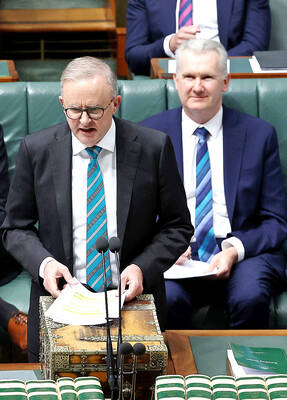
Australia has announced an agreement with the tiny Pacific nation Nauru enabling it to send hundreds of immigrants to the barren island. The deal affects more than 220 immigrants in Australia, including some convicted of serious crimes. Australian Minister of Home Affairs Tony Burke signed the memorandum of understanding on a visit to Nauru, the government said in a statement on Friday. “It contains undertakings for the proper treatment and long-term residence of people who have no legal right to stay in Australia, to be received in Nauru,” it said. “Australia will provide funding to underpin this arrangement and support Nauru’s long-term economic
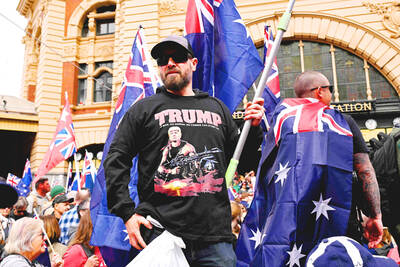
‘NEO-NAZIS’: A minister described the rally as ‘spreading hate’ and ‘dividing our communities,’ adding that it had been organized and promoted by far-right groups Thousands of Australians joined anti-immigration rallies across the country yesterday that the center-left government condemned, saying they sought to spread hate and were linked to neo-Nazis. “March for Australia” rallies against immigration were held in Sydney, and other state capitals and regional centers, according to the group’s Web site. “Mass migration has torn at the bonds that held our communities together,” the Web site said. The group posted on X on Saturday that the rallies aimed to do “what the mainstream politicians never have the courage to do: demand an end to mass immigration.” The group also said it was concerned about culture,
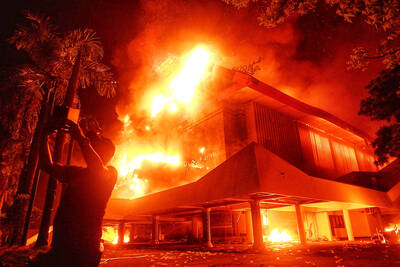
ANGER: Unrest worsened after a taxi driver was killed by a police vehicle on Thursday, as protesters set alight government buildings across the nation Protests worsened overnight across major cities of Indonesia, far beyond the capital, Jakarta, as demonstrators defied Indonesian President Prabowo Subianto’s call for calm. The most serious unrest was seen in the eastern city of Makassar, while protests also unfolded in Bandung, Surabaya, Solo and Yogyakarta. By yesterday morning, crowds had dispersed in Jakarta. Troops patrolled the streets with tactical vehicles and helped civilians clear trash, although smoke was still rising in various protest sites. Three people died and five were injured in Makassar when protesters set fire to the regional parliament building during a plenary session on Friday evening, according to
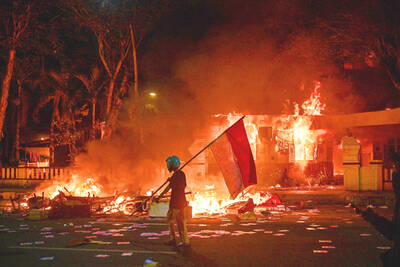
CRACKDOWN: The Indonesian president vowed to clamp down on ‘treason and terrorism,’ while acceding to some protest demands to revoke lawmaker benefits Protests in Indonesia over rising living costs and inequality intensified overnight, prompting Indonesian President Prabowo Subianto to cancel a planned trip to China, while demonstrators reportedly targeted the homes of the finance minister and several lawmakers. Rioters entered Indonesian Minister of Finance Sri Mulyani Indrawati’s residence near Jakarta early yesterday, but were repelled by armed forces personnel, Kompas reported. Items were taken from the homes of lawmaker Ahmad Sahroni and two others, according to Detik.com. The reports of looting could not be independently verified, and the finance ministry has not responded to requests for comment. The protests were sparked by outrage over


 RSS
RSS