


The death of wartime Vietnamese general Vo Nguyen Giap has triggered public mourning in Vietnam the likes of which have been unseen since former leader Ho Chi Minh passed away more than four decades ago. Given the current leaders, it may not be witnessed again, according to many of the 150,000 people who lined up to pay respects to the so-called “Red Napoleon.”
The Vietnamese Communist Party orchestrated the sendoff for Giap, emphasizing his leadership in the wars first against France and then the US. However, it ignored his later years, when the general’s popularity allowed him to air rare public criticism of the ruling elite.
Still, the death of the country’s last old guard revolutionary inevitably stirred reflection by some on the country’s current leaders, only one of whom fought against the US. Giap’s passing comes as the government is struggling against public dissatisfaction over corruption and a faltering economy.
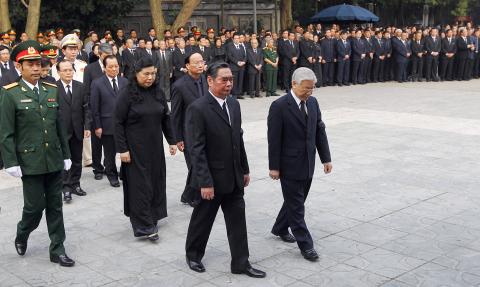
Photo: AFP
“I’m not sure we will have a third leader like Giap and Uncle Ho,” said Tran Thi Thien, who rose at 3am to pay tribute outside the Giap family home in Hanoi this past week. “I hope the current leadership would look at how people love and respect General Giap to improve themselves and better lead the country.”
Yesterday, Giap’s body was laid in state in Hanoi. The country’s top leaders, along with veterans, diplomats and ordinary people paid their final respects ahead of Giap’s funeral today in his home province. The country’s flag was flown at half-mast and unrelated public events were canceled.
The mourning period has gone smoothly in a nation where little happens in public without the blessing of the ruling party. State media coverage projects a united nation, bolstering a government whose legitimacy still rests in part on its history of expelling foreign invaders.
News of Giap’s death first spread over Facebook, which would have underlined to the old guard how information now flows beyond their control. The public mourning was also unscripted. About 150,000 people lined up over five days outside Giap’s house to pay their respects, an outpouring of emotion that surprised his family, according to Giap’s personal secretary, Colonel Trinh Nguyen Huan.
Giap is best remembered for leading Vietnamese forces to victory over the French at Dien Bien Phu in 1954.
His Chinese advisers told him to strike elite French forces fast and hard, but Giap changed the plans at the last minute and ordered his jungle troops, clad in sandals made of old car tires, to besiege the French army. The French were defeated after 56 days, and the unlikely victory led not only to Vietnam’s independence, but hastened the collapse of colonialism across Indochina and beyond.
“He was an outstanding general, but he was a very simple man,” said Nguyen Chan, a 78-year-old who fought in Dien Bien Phu in 1954 and yesterday was in a park watching the coverage of the mourning on a big screen. “For us, he was a commander in chief, a teacher and also a father.”
Throughout most of the war against the US, Giap served as defense minister and armed forces commander, but he was slowly pushed aside after Ho Chi Minh’s death in 1969. The glory for victory in 1975 did not go to Giap.
He stepped down from his last state post, as deputy prime minister, in 1991. Despite losing favor with the government, he became even more beloved by Vietnamese.
At age 97, Giap opposed the proposed expansion of a bauxite mine, in part because it was to be operated by a Chinese company. This angered the party because it helped legitimize charges by its critics that it is too close to its fellow Communists in China, the subject of popular nationalist anger in Vietnam.
“Giap was a critical figure in contemporary Vietnam history, however one part of his life will always be associated with his question of authority,” said Jonathan London, a Vietnam expert at the City University of Hong Kong. “His legacy will be used as badge of legitimacy for the Socialist Republic of Vietnam, but this is occurring at a time when Vietnamese are questioning the direction of their country.”

Kouri Richins, a Utah mother who published a children’s book about grief after the death of her husband is to serve a life sentence for his murder without the possibility of parole, a judge ruled on Wednesday. Richins was convicted in March of aggravated murder for lacing a cocktail given to her husband, Eric Richins, with five times the lethal dose of fentanyl at their home near Park City in 2022. A jury also found her guilty of four other felonies, including insurance fraud, forgery and attempted murder for trying to poison her husband weeks earlier on Feb. 14, 2022, with a

‘PERSONAL MISTAKES’: Eileen Wang has agreed to plead guilty to the felony, which comes with a maximum sentence of 10 years in federal prison A southern California mayor has agreed to plead guilty to acting as an illegal agent for the Chinese government and has resigned from her city position, officials said on Monday. Eileen Wang (王愛琳), mayor of Arcadia, was charged last month with one count of acting in the US as an illegal agent of a foreign government. She was accused of doing the bidding of Chinese officials, such as sharing articles favorable to Beijing, without prior notification to the US government as required by law. The 58-year-old was elected in November 2022 to a five-person city council, from which the mayor is selected

DELA ROSA CASE: The whereabouts of the senator, who is wanted by the ICC, was unclear, while President Marcos faces a political test over the senate situation Philippine authorities yesterday were seeking confirmation of reports that a top politician wanted by the International Criminal Court (ICC) had fled, a day after gunfire rang out at the Philippine Senate where he had taken refuge fearing his arrest. Senator Ronald “Bato” dela Rosa, the former national police chief and top enforcer of former Philippine president Rodrigo Duterte’s “war on drugs,” has been under Senate protection and is wanted for crimes against humanity, the same charges Duterte is accused of. “Several sources confirmed that the senator, Senator Bato, is no longer in the Senate premises, but we are still getting confirmation,” Presidential
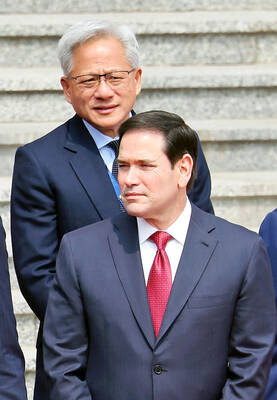
HELP DENIED? The US Department of State said that the Cuban leadership refuses to allow the US to provide aid to Cubans, ‘who are in desperate need of assistance’ US Secretary of State Marco Rubio on Wednesday said that Cuba’s leadership must change, as Washington renewed an offer of US$100 million in aid if the communist nation agrees to cooperate. Cuba has been suffering severe economic tumult led by an energy shortage that plunged 65 percent of the country into darkness on Tuesday. Cuba’s leaders have blamed US sanctions, but Rubio, a Cuban American and critic of the government established by Fidel Castro, said the system was to blame, including corruption by the military. “It’s a broken, nonfunctional economy, and it’s impossible to change it. I wish it were different,” he told


 RSS
RSS