


In a landmark decision, Hong Kong’s highest court yesterday ruled against granting residency to two Philippine domestic workers, dashing the hopes of several hundred thousand other domestic helpers from ever gaining permanent residency in the territory.
Five judges at the Court of Final Appeal ruled unanimously that Evangeline Banao Vallejos and Daniel Domingo would not be allowed to settle permanently in Hong Kong after residing there for more than seven years, a period that would ordinarily qualify foreigners to become permanent residents under the constitution.
The court ruled that domestic workers should not be treated as “ordinarily resident” in the financial hub given contracts that tied them to finite temporary employment.
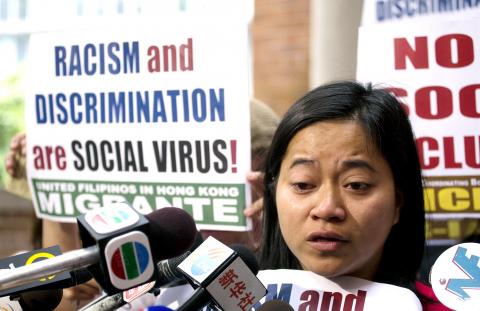
Photo: Reuters
“The nature of foreign domestic helpers’ residence in Hong Kong is highly restrictive,” the judgment said. “The foreign domestic helper is obliged to return to the country of origin at the end of the contract and is told from the outset that admission is not for the purposes of settlement.”
A lower court had previously ruled that the Philippine pair had the right to seek permanent residency in the territory.
Over the past few years, the controversial legal battle has divided Hong Kongers over whether 286,000 domestic helpers — largely from the Philippines and Indonesia, but also other countries like Nepal, India and Pakistan — should be entitled to residency on a par with other foreigners.
A small group of migrant workers protested the ruling outside the historic red-brick courthouse, denouncing it as institutionalized discrimination.
“Today is a very sad day for migrant workers in Hong Kong,” said Eman Villanueva, the head of Philippine advocacy group United Filipinos in Hong Kong. “It gave its judicial seal to unfair treatment and the social exclusion of foreign domestic helpers in Hong Kong.”
The ruling also bars dependents of domestic workers from seeking residency in Hong Kong.
Critics say that the economic burden that would be caused by such an influx could have been huge, given education, housing, healthcare and welfare costs. One political party estimated that it could cost taxpayers an extra HK$25 billion (US$3.2 billion) per year.
Many Hong Kong families and expatriates consider having a maid essential, with many employing a live-in helper who cooks, cleans and helps with childcare. However, maids are excluded from a minimum wage and other basic services.
Despite the government’s victory, lingering ambiguity over eligibility for permanent residency in Hong Kong as stipulated in the Basic Law, the territory’s mini-constitution, could trigger further legal battles in the future.
Hong Kong, a former British colony that returned to Chinese rule in 1997, has always had an uneasy relationship with immigration and right of residency issues that have sometimes strained its ties with Beijing.
A 1999 case which ruled that China-born children had a right of abode in Hong Kong sparked an outcry over Beijing’s perceived meddling in the territory’s judicial independence.
The government had asked Hong Kong’s highest court to seek Beijing’s clarification on precisely who qualifies for right of abode in a bid to resolve the issue, but the court of final appeal rejected this request.
ROCKY RELATIONS: The figures on residents come as Chinese tourist numbers drop following Beijing’s warnings to avoid traveling to Japan The number of Chinese residents in Japan has continued to rise, even as ties between the two countries have become increasingly fractious, data released on Friday showed. As of the end of December last year, the number of Chinese residents had increased by 6.5 percent from the previous year to 930,428. Chinese people accounted for 22.6 percent of all foreign residents in Japan, making them by far the largest group, Japanese Ministry of Justice data showed. Beijing has criticized Tokyo in increasingly strident terms since Japanese Prime Minister Sanae Takaichi last year suggested that a military conflict around Taiwan could

A retired US colonel behind a privately financed rocket launch site in the Dominican Republic sees the project as a response to China’s dominance of the space race in Latin America. Florida-based Launch on Demand is slated to begin building a US$600 million facility in a remote region near the border with Haiti late this year. The project is designed to meet surging demand for the heavy-lift rockets needed to put clusters of satellites into orbit. It is also an answer to China’s growing presence in the region, said CEO Burton Catledge, a former commander of the US Air Force’s 45th Operations

Germany is considering Australia’s Ghost Bat robot fighter as it looks to select a combat drone to modernize its air force, German Minister of Defense Boris Pistorius said yesterday. Germany has said it wants to field hundreds of uncrewed fighter jets by 2029, and would make a decision soon as it considers a range of German, European and US projects developing so-called “collaborative combat aircraft.” Australia has said it will integrate the Ghost Bat, jointly developed by Boeing Australia and the Royal Australian Air Force, into its military after a successful weapons test last year. After inspecting the Ghost Bat in Queensland yesterday,

A pro-Iran hacking group claimed to breach FBI Director Kash Patel’s personal e-mail inbox and posted some of the contents online. The e-mails provided by the hacking group include travel details, correspondence with leasing agents in Washington and global entry, and loyalty account numbers. The e-mail address the hackers claim to have compromised has been previously tied to Patel’s personal details, and the leaked e-mails contain photos of Patel and others, in addition to correspondence with family members and colleagues. “The FBI is aware of malicious actors targeting Director Patel’s personal email information,” the agency said in a statement on


 RSS
RSS