


A Turkish court sentenced more than 300 military officers to jail on Friday for plotting to overthrow Turkish Prime Minister Recep Tayyip Erdogan almost a decade ago, ending a trial that underscored civilian dominance over the once all-powerful military.
The court in Silivri, about 60km west of Istanbul, handed prison terms to 322 serving and retired army officers and acquitted 34, according to court documents seen by foreign media.
Two retired generals and a retired admiral considered the ringleaders of the so-called “Sledgehammer” plot to topple Erdogan in 2003 were given life terms. Their relatives collapsed in tears in the courtroom as the sentences were handed down.
The military has long been the guardian of Turkey’s secular establishment, launching three coups between 1960 and 1980 and pressuring an Islamist-led government to quit in 1997.
However, Erdogan’s Islamist-rooted Justice and Development Party (JDP), which came to power a decade ago, has tamed military influence over policymaking and ministerial appointments as part of efforts to strengthen democracy, while prosecutors have pursued suspected coup-makers in court.
“To comment without seeing the reasons for the verdict would be inappropriate. There is an appeals process. What is important for us is that the right decision emerges,” Erdogan told reporters in Ankara, as the sentences were being announced.
The ruling has the potential to undermine morale in Turkey’s military as it battles Kurdish militants in the southeast and faces a growing challenge maintaining security along its southern border with Syria.
“Turkish soldiers are not just being struck down in Diyarbakir, Sirnak and Bingol, it is actually here where they have been hit,” said Colonel Mustafa Onsel, one of the defendants, referring to three southeastern provinces which have seen clashes with Kurdish militants in recent months.
The court said the three sentenced to life would in fact only serve 20 years because they were unsuccessful in their bid to topple the government.
The “Sledgehammer” conspiracy is alleged to have included plans to bomb historic mosques in Istanbul and trigger conflict with Greece to pave the way for an army takeover.
Prosecutors had demanded 15 to 20-year jail sentences for the 365 defendants, 364 of who were serving or retired officers.
Those sentenced to life included retired generals Cetin Dogan and Halil Ibrahim Firtina, and retired admiral Ozden Ornek, considered the ringleaders of the plot.
Those sentenced to 18-year terms included Engin Alan, a retired general elected to the Turkish Parliament last year, and Bilgin Baranli, who had been in line to become the Turkish Air Force commander before his arrest last year.
“Sledgehammer” is one of a series of trials that has sparked criticism that the government is using the courts to silence opponents.
Others include the “Ergenekon” case, which involves a web of alleged plots against Turkey’s government.
Thousands of people, including journalists, lawyers and politicians, are in jail pending verdicts in trials that human rights groups say raise questions about Turkey’s commitment to democratic rights.
Dogan’s daughter, Pinar Dogan, a lecturer at Harvard University, said her family believed the case was aimed at settling old scores and pointed to reports by experts who said computer documents submitted as evidence appeared doctored.
“Going after those perceived as opposed to this government because of its Islamist leaning is motivated in part by revenge. My father was a retired man with no political clout left,” she said. “He had no sympathy for this government, but he would never have bombed mosques or shot down planes, never.”
The Turkish military is NATO’s second-biggest standing force after the US. Its main domestic challenge has been militants from the Kurdistan Workers’ Party (PKK), considered a terrorist group by Ankara, the US and the EU.
The past few months have seen some of the heaviest fighting since the PKK took up arms in 1984 to carve out a Kurdish state.

ROCKY RELATIONS: The figures on residents come as Chinese tourist numbers drop following Beijing’s warnings to avoid traveling to Japan The number of Chinese residents in Japan has continued to rise, even as ties between the two countries have become increasingly fractious, data released on Friday showed. As of the end of December last year, the number of Chinese residents had increased by 6.5 percent from the previous year to 930,428. Chinese people accounted for 22.6 percent of all foreign residents in Japan, making them by far the largest group, Japanese Ministry of Justice data showed. Beijing has criticized Tokyo in increasingly strident terms since Japanese Prime Minister Sanae Takaichi last year suggested that a military conflict around Taiwan could

A retired US colonel behind a privately financed rocket launch site in the Dominican Republic sees the project as a response to China’s dominance of the space race in Latin America. Florida-based Launch on Demand is slated to begin building a US$600 million facility in a remote region near the border with Haiti late this year. The project is designed to meet surging demand for the heavy-lift rockets needed to put clusters of satellites into orbit. It is also an answer to China’s growing presence in the region, said CEO Burton Catledge, a former commander of the US Air Force’s 45th Operations

Germany is considering Australia’s Ghost Bat robot fighter as it looks to select a combat drone to modernize its air force, German Minister of Defense Boris Pistorius said yesterday. Germany has said it wants to field hundreds of uncrewed fighter jets by 2029, and would make a decision soon as it considers a range of German, European and US projects developing so-called “collaborative combat aircraft.” Australia has said it will integrate the Ghost Bat, jointly developed by Boeing Australia and the Royal Australian Air Force, into its military after a successful weapons test last year. After inspecting the Ghost Bat in Queensland yesterday,
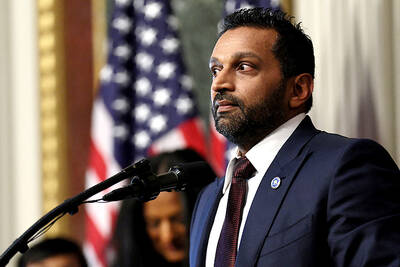
A pro-Iran hacking group claimed to breach FBI Director Kash Patel’s personal e-mail inbox and posted some of the contents online. The e-mails provided by the hacking group include travel details, correspondence with leasing agents in Washington and global entry, and loyalty account numbers. The e-mail address the hackers claim to have compromised has been previously tied to Patel’s personal details, and the leaked e-mails contain photos of Patel and others, in addition to correspondence with family members and colleagues. “The FBI is aware of malicious actors targeting Director Patel’s personal email information,” the agency said in a statement on


 RSS
RSS