


In a tribute to Holocaust victims, a Czech theater troupe is roaming the rails of central Europe this summer aboard a train converted into a stage for a play about Jews sent to Nazi death camps.
“I thought about this idea for a long time — to stage a play on a train, a symbol of Jewish transports during World War II,” said Pavel Chalupa, director of the Nine Gates festival of Jewish culture and mastermind of the project.
“The Nazi regime transported Jews to Auschwitz and other concentration and death camps on board cattle wagons,” said Chalupa, who has teamed up with Prague’s Pod Palmovkou theater.
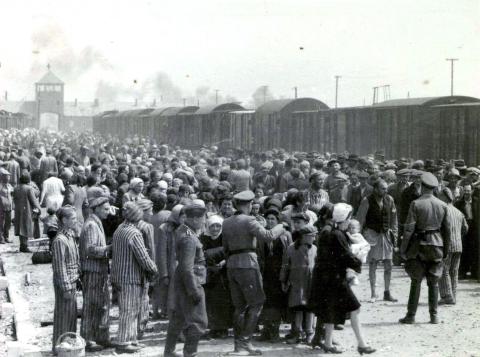
Photo: AFP
Traveling through the Czech Republic, Germany and Poland, the symbolic “Train of No Return” will present a theatrical adaptation of A Prayer for Katerina Horovitzova, a novel by Arnost Lustig (1926-2011), a Czech Jew who survived the Holocaust, also known as the Shoah.
The story takes place in 1943 on a train to the infamous Auschwitz death camp in Poland. The Nazis play a cynical game with a group of wealthy Jewish businessmen, promising them freedom in exchange for money, and a young Polish Jew, Katerina Horovitzova.
However, when she is asked to dance naked before a Nazi officer, she decides to take revenge for the humiliation.
Inspired by the true story of a Polish actress, Lustig wrote the novel in a single night in 1964.
“Women possess that little something that keeps poets alive,” he used to say.
“I am drawn to the Jewish theme ... I am very interested in the history of the Jews,” said Denisa Pfauserova, one of the two actresses who alternate playing Katerina, who with the businessmen in the end perishes at Auschwitz.
The theater-train of five wagons will start off next month with stops at 14 Czech railway stations before taking a highly symbolic tour of Wannsee, Prague, Krakow and Auschwitz in late August, Chalupa said.
In Wannsee, a suburb of Berlin, leaders of the Third Reich gathered on Jan. 20, 1942, to agree what they termed “the final solution of the Jewish question,” or Nazi Germany’s plan of genocide against European Jews.
In the Nazi-occupied Polish city of Krakow, the Germans liquidated a Jewish ghetto on March 13, 1943.
And at the nearby Auschwitz-Birkenau death camp, an estimated 1.1 million people, including about 1 million Jews from across Europe, were killed from 1940 to 1945 at Nazi Germany’s most infamous killing site.
An audience of about one hundred people will be able to watch the play on portable theater seats. The performance will take place on a stage measuring 8m by 4m inside one of the wagons, with subtitles for the Czech screened in Germany and Poland.
“A Prayer for Katerina Horovitzova is a great story. I don’t understand why it has never appealed to a big US movie studio,” said Petr Kracik, director of the Prague-based Pod Palmovkou theater — though it was made into a Czech film.
The theater-train will depart next month from the now derelict Prague-Bubny station, where during World War II Czech Jews boarded trains first to a ghetto in the northern town of Terezin and then to death camps.
The train includes two authentic cattle wagons used in the Nazi transports which will house a cinema hall and an exhibition on the events from 70 years ago. These include the Wannsee conference, the killing of one participant Reinhard Heydrich in Prague in 1942, and the story of Swedish diplomat Raoul Wallenberg who saved up to 100,000 Jews during the war.
Joining the actors and stage crew on board will be students from Berlin, Prague and Krakow on the journey between Wannsee and Auschwitz.
“Like the Jewish girl Anne Frank during the war, they will keep diaries to capture the atmosphere of the performances and discussions with the actors and spectators,” Chalupa said.
“We expect to publish the diaries. We want the young to become familiar with this topic. It’s important, especially with the current rise of neo-Nazism and racism,” he added.

Australia has announced an agreement with the tiny Pacific nation Nauru enabling it to send hundreds of immigrants to the barren island. The deal affects more than 220 immigrants in Australia, including some convicted of serious crimes. Australian Minister of Home Affairs Tony Burke signed the memorandum of understanding on a visit to Nauru, the government said in a statement on Friday. “It contains undertakings for the proper treatment and long-term residence of people who have no legal right to stay in Australia, to be received in Nauru,” it said. “Australia will provide funding to underpin this arrangement and support Nauru’s long-term economic

ANGER: Unrest worsened after a taxi driver was killed by a police vehicle on Thursday, as protesters set alight government buildings across the nation Protests worsened overnight across major cities of Indonesia, far beyond the capital, Jakarta, as demonstrators defied Indonesian President Prabowo Subianto’s call for calm. The most serious unrest was seen in the eastern city of Makassar, while protests also unfolded in Bandung, Surabaya, Solo and Yogyakarta. By yesterday morning, crowds had dispersed in Jakarta. Troops patrolled the streets with tactical vehicles and helped civilians clear trash, although smoke was still rising in various protest sites. Three people died and five were injured in Makassar when protesters set fire to the regional parliament building during a plenary session on Friday evening, according to

‘NEO-NAZIS’: A minister described the rally as ‘spreading hate’ and ‘dividing our communities,’ adding that it had been organized and promoted by far-right groups Thousands of Australians joined anti-immigration rallies across the country yesterday that the center-left government condemned, saying they sought to spread hate and were linked to neo-Nazis. “March for Australia” rallies against immigration were held in Sydney, and other state capitals and regional centers, according to the group’s Web site. “Mass migration has torn at the bonds that held our communities together,” the Web site said. The group posted on X on Saturday that the rallies aimed to do “what the mainstream politicians never have the courage to do: demand an end to mass immigration.” The group also said it was concerned about culture,

CRACKDOWN: The Indonesian president vowed to clamp down on ‘treason and terrorism,’ while acceding to some protest demands to revoke lawmaker benefits Protests in Indonesia over rising living costs and inequality intensified overnight, prompting Indonesian President Prabowo Subianto to cancel a planned trip to China, while demonstrators reportedly targeted the homes of the finance minister and several lawmakers. Rioters entered Indonesian Minister of Finance Sri Mulyani Indrawati’s residence near Jakarta early yesterday, but were repelled by armed forces personnel, Kompas reported. Items were taken from the homes of lawmaker Ahmad Sahroni and two others, according to Detik.com. The reports of looting could not be independently verified, and the finance ministry has not responded to requests for comment. The protests were sparked by outrage over


 RSS
RSS