


It has been sought for centuries, but remained a mystery. Now an expert has pinpointed a site that could be Atahualpa’s resting place: the last Inca emperor’s tomb.
“This is an absolutely important find for the history of Ecuador’s archeology and for the [Andean] region,” Ecuadoran Patrimony Minister Maria Fernanda Espinosa said, referring to the ruins found by historian Tamara Estupinan.
The Inca empire, in the 1400s and early 1500s, spanned much of South America’s Andean region — more than 1,600km — from modern-day Bolivia and Peru to Argentina, Chile, Ecuador and Colombia. It included dozens of ethnic groups with different languages, cities, temples, farming terraces and fortresses.
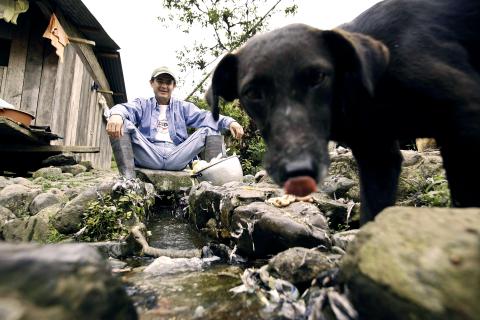
Photo: AFP
Atahualpa was the last of his dynasty. During the Spanish conquest he was taken captive in what is now Cajamarca, Peru.
He had been pressed to convert to Christianity and then the Spanish executed him by strangulation. After his death in 1533, the empire began to fall apart.
This year Ecuador’s state Cultural Patrimony Institute will start work on a promising archeological site and Estupinan will be front and center to raise the curtain on a massive complex sprawling over a ridge at 1,020m.
It was back in June 2010 that Estupinan, now a researcher with the French Institute for Andean Studies (IFEA), found what she describes as an “Inca archeological site” high on the Andes’ eastern flank amid plunging canyons. Nearby are a small local farm and a facility for raising fighting cocks.
However, in the area called Sigchos, about 72km south of Quito, up on a hill dotted with brush, there is more — much more: She found a complex of walls, aqueducts and stonework that lie inside the Machay rural retreat. Machay means burial in the Quechua language.
“This is a late imperial design Inca monument that leads to several rectangular rooms that were built with cut polished stone set around a trapezoidal plaza,” Estupinan said.
Archeologist Tamara Bray, of Wayne State University in Michigan and a colleague of Estupinan, confirmed that the site boasts “an Inca edifice that is phenomenally well preserved and quite important scientifically.”
Inside the facility, a walled walkway starts at the Machay River and one can see the shape of an ushno, essentially stairs that form a pyramid believed to be the emperor’s throne. Meanwhile, a tiny cut channel of water would spout out a small waterfall nicknamed “the Inca’s bath.”
Georges Lomne, the director at the Lima-based IFEA, said the find appears to confirm that the Incas were active and present in a lowland area well outside what their best-known area of operations were: Andean highlands.
“Malqui-Machay is part of a broader complex that also would have included the Quilotoa lagoon and the area called Pujili [Cotopaxi],” he said.
“All of this belonged to Atahualpa. It was his personal fiefdom in the way that French [and other] kings had royal domains,” he added.
Bray also said that “very few such Inca sites have been found in this type of tropical lowland. I think that the Incas used it as a sort of getaway.”
Estupinan has some more specific ideas.
She believes Malqui-Machay is Atahualpa’s final resting place. The tomb of the last capac of Tahuantinsuyo, the trans-Andean empire.
While many experts have other theories, Estupinan believes that when Atahualpa was killed, his remains could have been brought by his most loyal man, Ruminahui, to Sigchos for burial, to a place where Ruminahui based his fight for survival against the European intruders.

Kouri Richins, a Utah mother who published a children’s book about grief after the death of her husband is to serve a life sentence for his murder without the possibility of parole, a judge ruled on Wednesday. Richins was convicted in March of aggravated murder for lacing a cocktail given to her husband, Eric Richins, with five times the lethal dose of fentanyl at their home near Park City in 2022. A jury also found her guilty of four other felonies, including insurance fraud, forgery and attempted murder for trying to poison her husband weeks earlier on Feb. 14, 2022, with a
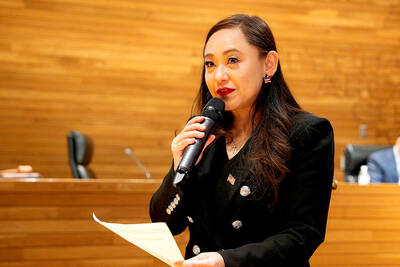
‘PERSONAL MISTAKES’: Eileen Wang has agreed to plead guilty to the felony, which comes with a maximum sentence of 10 years in federal prison A southern California mayor has agreed to plead guilty to acting as an illegal agent for the Chinese government and has resigned from her city position, officials said on Monday. Eileen Wang (王愛琳), mayor of Arcadia, was charged last month with one count of acting in the US as an illegal agent of a foreign government. She was accused of doing the bidding of Chinese officials, such as sharing articles favorable to Beijing, without prior notification to the US government as required by law. The 58-year-old was elected in November 2022 to a five-person city council, from which the mayor is selected
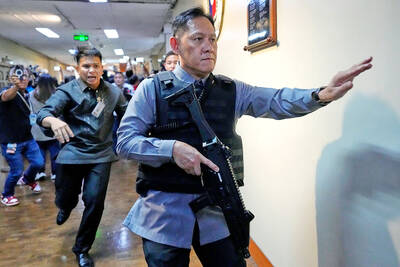
DELA ROSA CASE: The whereabouts of the senator, who is wanted by the ICC, was unclear, while President Marcos faces a political test over the senate situation Philippine authorities yesterday were seeking confirmation of reports that a top politician wanted by the International Criminal Court (ICC) had fled, a day after gunfire rang out at the Philippine Senate where he had taken refuge fearing his arrest. Senator Ronald “Bato” dela Rosa, the former national police chief and top enforcer of former Philippine president Rodrigo Duterte’s “war on drugs,” has been under Senate protection and is wanted for crimes against humanity, the same charges Duterte is accused of. “Several sources confirmed that the senator, Senator Bato, is no longer in the Senate premises, but we are still getting confirmation,” Presidential
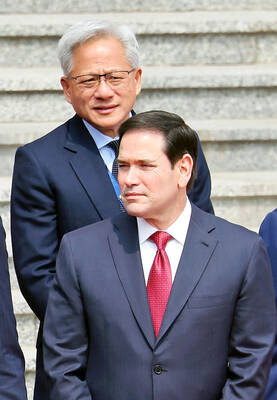
HELP DENIED? The US Department of State said that the Cuban leadership refuses to allow the US to provide aid to Cubans, ‘who are in desperate need of assistance’ US Secretary of State Marco Rubio on Wednesday said that Cuba’s leadership must change, as Washington renewed an offer of US$100 million in aid if the communist nation agrees to cooperate. Cuba has been suffering severe economic tumult led by an energy shortage that plunged 65 percent of the country into darkness on Tuesday. Cuba’s leaders have blamed US sanctions, but Rubio, a Cuban American and critic of the government established by Fidel Castro, said the system was to blame, including corruption by the military. “It’s a broken, nonfunctional economy, and it’s impossible to change it. I wish it were different,” he told


 RSS
RSS