


Stephen Hawking, the world’s most famous living scientist and a symbol of the triumph of willpower over adversity, celebrated his 70th birthday on Sunday, revealing he did not learn to read properly until he was eight years old and that his schoolmates had made a bet that he “would never come to anything.”
A public symposium in Cambridge was told that, far from being top of the class, he was never more than half-way up.
“My classwork was very untidy and my handwriting was the despair of my teachers, but my classmates gave me the nickname Einstein, so presumably they saw signs of something better,” he said. “When I was 12, one of my friends bet another friend a bag of sweets that I would never come to anything. I don’t know if this bet was ever settled and, if so, which way it was decided.”
Unable to attend the event in person because of ill health, Hawking sent a speech which marked the culmination of four days of birthday celebrations organized by his colleagues at Cambridge University. The festivities were attended by the world’s leading cosmologists, including Nobel laureates Frank Wilczek and Saul Perlmutter, as well as celebrities such as Richard Branson.
Hawking’s laidback approach to education continued during his years studying physics at the University of Oxford.
“I did one exam before I went up, then had three years at Oxford with just the final exams at the end,” he said. “I once calculated that I did about a thousand hours’ work in the three years I was there, an average of an hour a day. I’m not proud of this.”
In his half-century career as a researcher, Hawking has been at the forefront of the understanding of black holes and quantum cosmology. His fame has also brought his ideas to a vast audience outside academia. His first book, A Brief History of Time, has reportedly sold more than 10 million copies worldwide and he has made guest appearances on The Simpsons and Star Trek.
In the speech, Hawking spoke of his early life growing up in the town of St Albans, north of London, and gave the highlights of his scientific career, but his main message was to “be curious” and never give up, however difficult things might seem.
“Remember to look up at the stars and not down at your feet,” he said. “Try to make sense of what you see and about what makes the universe exist. Be curious, and however difficult life may seem, there is always something you can do and succeed at. It matters that you don’t just give up.”
At about the age of 21, as he started his doctorate in Cambridge, Hawking was diagnosed with motor neurone disease. The first signs that something was wrong came after he fell over while ice skating on a lake near his childhood home in St Albans.
“At first I became depressed. I seemed to be getting worse pretty rapidly. There didn’t seem any point in working on my PhD because I didn’t know I would live long enough to finish it,” he said.
After his expectations had been reduced to zero, he said, he was only emboldened when he met his future wife, Jane, at a party.
“Getting engaged lifted my spirits and I realized, if we were going to get married, I had to do a job and finish my PhD. I began to work hard and I enjoyed it,” he said.
Other speakers in the public seminar at Cambridge University included Lord Rees, the astronomer royal, and Perlmutter, who won the Nobel prize in physics last year for the co-discovery of dark energy, the mysterious substance said to drive the expansion of the universe.
Kip Thorne, formerly of the California Institute of Technology and a longtime collaborator of Hawking, spoke of a “new golden age” in the study of black holes.
Attending the birthday celebrations, Virgin chief executive Branson said it was “wonderful to be celebrating his 70th birthday, which in itself is remarkable. He should have won the Nobel prize many times.”
Hawking finished his statement, to a standing ovation, by saying that it had been a glorious time to be alive and be a researcher in theoretical physics.
“Our picture of the universe has changed a great deal in the past 40 years and I’m happy if I’ve made a small contribution. The fact that we humans — who are ourselves mere collections of fundamental particles of nature — have been able to come this close to an understanding of the laws governing us and our universe is a great triumph,” he said.

When a hiker fell from a 55m waterfall in wild New Zealand bush, rescuers were forced to evacuate the badly hurt woman without her dog, which could not be found. After strangers raised thousands of dollars for a search, border collie Molly was flown to safety by a helicopter pilot who was determined to reunite the pet and the owner. A week earlier, an emergency rescue helicopter found the woman with bruises and lacerations after a fall at a rocky spot at the waterfall on the South Island’s West Coast. She was airlifted on March 24, but they were forced to

HIGH HOPES: The power source is expected to have a future, as it is not dependent on the weather or light, and could be useful for places with large desalination facilities A Japanese water plant is harnessing the natural process of osmosis to generate renewable energy that could one day become a common power source. The possibility of generating power from osmosis — when water molecules pass from a less salty solution to a more salty one — has long been known. However, actually generating energy from that has proved more complicated, in part due the difficulty of designing the membrane through which the molecules pass. Engineers in Fukuoka, Japan, and their private partners think they might have cracked it, and have opened what is only the world’s second osmotic power plant. It generates

Hundreds of Filipinos and tourists flocked to a sun-bleached field north of Manila yesterday, on Good Friday, to witness one of the country’s most blood-soaked displays of religious fervor, undeterred by rising fuel prices. Scores of bare-chested flagellants with covered faces walked barefoot through the dusty streets of Pampanga Province’s San Fernando as they flogged their backs with bamboo whips in the scorching heat. Agence France-Presse (AFP) journalists said they saw devotees deliberately puncturing their skin with glass shards attached to a small wooden paddle to ensure their bleeding during the ritual, a way to atone for sins and seek miracles from
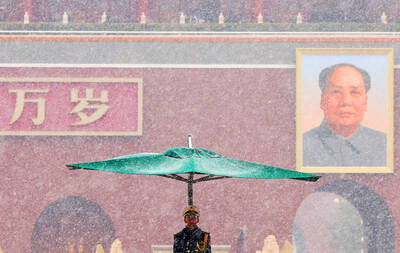
Chinese dissident artist Gao Zhen (高兟), famous for making provocative satirical sculptures of former Chinese leader Mao Zedong (毛澤東), was tried on Monday over accusations of “defaming national heroes and martyrs,” his wife and a rights group said. Gao, 69, who was detained in 2024 during a visit from the US, faces a maximum three-year prison sentence, said his wife, Zhao Yaliang (趙雅良), and Shane Yi, a researcher at the Chinese Human Rights Defenders group which operates outside the nation. The closed-door, one-day trial took place at Sanhe City People’s Court in Hebei Province neighboring the capital, Beijing, and ended without a


 RSS
RSS