


Former British prime minister Margaret Thatcher’s government considered arresting journalists covering riots in Britain in 1981 as it blamed the media for fomenting violence in inner-city areas, according to previously secret Cabinet papers.
Like British Prime Minister David Cameron’s Tory-led government amid riots this year, Thatcher’s Conservative Cabinet wrestled with the violence that spread across cities including London, Liverpool and Manchester in the summer of 1981.
While Cameron looked at shutting down social-media networks, Thatcher turned against television companies and considered a change in the law to allow reporters covering riots to be arrested, National Archives papers released yesterday after the statutory 30-year delay show.
“Reintroducing the Riot Act in a modernized form might be presentationally helpful and would have the additional advantage that anyone found on the streets once the statutory time from reading the proclamation expired, including press and radio and television reporters, would be guilty of an absolute offence,” then-home secretary Willie Whitelaw told the Cabinet on July 9.
He was referring to the 1714 law, since repealed, that gave rise to the phrase “read the Riot Act.”
HISTORY REPEATS
Thatcher’s Cabinet faced similar challenges to Cameron’s as it grappled with rising unemployment and young people with “no loyalty to society.”
Thatcher took a personal interest in ensuring how money was spent to improve conditions and job prospects in inner cities and her government decided the cash should be allocated to broader “travel-to-work” areas around cities so communities where there had been “well-organized rioting” were not seen as being rewarded.
Britain’s unemployment rate shot up from 5.3 percent when Thatcher’s government was elected in May 1979 to 9.4 percent two years later, as measured by International Labor Organization standards.
In the Brixton district of south London, riots broke out in April 1981 after police used new stop-and-search powers to detain disproportionate numbers of young black men.
The violence in Brixton, which inspired similar unrest across the country, left 299 police officers and 65 civilians injured and 28 buildings burned out, with another 117 damaged and looted, according to the Metropolitan Police.
It was the first time Molotov cocktails had been thrown in mainland Britain, the police said.
“The generation of young people now growing up were habituated to watching television for many hours every day, and there was good reason to fear that television had undermined the traditional disciplines of family life, and had given prominence to violence in both news and entertainment programs,” the record of the 1981 Cabinet discussion says.
‘SIDE EFFECTS’
“The home secretary should consider what more could be done to encourage the broadcasting authorities to pay greater attention to the possible side effects of the way in which they collected and broadcast news items about violent incidents,” it says.
Cameron told lawmakers in the House of Commons this year that his government was considering closing down social-media networks to stop them being used to encourage disorder. He mentioned Research In Motion Ltd’s BlackBerry Messenger service as one of the tools that were used by rioters.
“Everyone watching these horrific actions will be struck by how they were organized via social media,” Cameron said on Aug. 11. British Home Secretary Theresa May met police chiefs and social-media companies two weeks later to discuss how to “crack down on the networks being used for criminal behavior.”
On July 16, 1981, a week after discussing the arrest of journalists, Thatcher’s Cabinet agreed it would be a mistake to rush through new laws, even though they would be supported in Parliament. Ministers were told that Leslie Scarman, a judge who was leading an inquiry into the Brixton unrest, had said he would oppose a new version of the Riot Act.
Whitelaw met with the management of the BBC and the Independent Broadcasting Authority, which regulated commercial TV companies, and “impressed on them the great importance which the government attached to the responsible reporting of civil disturbances,” the record of the meeting says.
“He had also drawn their attention to the inflammatory effect which the showing of violent entertainment films could have during a period of heightened tension,” the notes of the July 16 meeting say. “They had promised to bear his points in mind, and there had in fact been a marked improvement in news reporting in the last few days.”
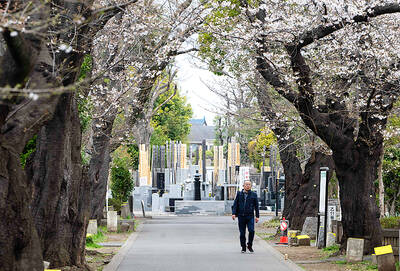
ROCKY RELATIONS: The figures on residents come as Chinese tourist numbers drop following Beijing’s warnings to avoid traveling to Japan The number of Chinese residents in Japan has continued to rise, even as ties between the two countries have become increasingly fractious, data released on Friday showed. As of the end of December last year, the number of Chinese residents had increased by 6.5 percent from the previous year to 930,428. Chinese people accounted for 22.6 percent of all foreign residents in Japan, making them by far the largest group, Japanese Ministry of Justice data showed. Beijing has criticized Tokyo in increasingly strident terms since Japanese Prime Minister Sanae Takaichi last year suggested that a military conflict around Taiwan could

A retired US colonel behind a privately financed rocket launch site in the Dominican Republic sees the project as a response to China’s dominance of the space race in Latin America. Florida-based Launch on Demand is slated to begin building a US$600 million facility in a remote region near the border with Haiti late this year. The project is designed to meet surging demand for the heavy-lift rockets needed to put clusters of satellites into orbit. It is also an answer to China’s growing presence in the region, said CEO Burton Catledge, a former commander of the US Air Force’s 45th Operations

Germany is considering Australia’s Ghost Bat robot fighter as it looks to select a combat drone to modernize its air force, German Minister of Defense Boris Pistorius said yesterday. Germany has said it wants to field hundreds of uncrewed fighter jets by 2029, and would make a decision soon as it considers a range of German, European and US projects developing so-called “collaborative combat aircraft.” Australia has said it will integrate the Ghost Bat, jointly developed by Boeing Australia and the Royal Australian Air Force, into its military after a successful weapons test last year. After inspecting the Ghost Bat in Queensland yesterday,
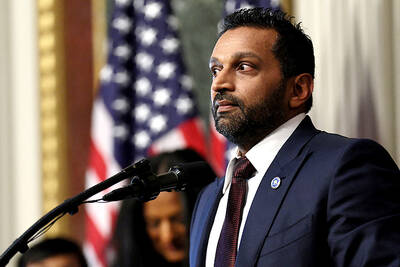
A pro-Iran hacking group claimed to breach FBI Director Kash Patel’s personal e-mail inbox and posted some of the contents online. The e-mails provided by the hacking group include travel details, correspondence with leasing agents in Washington and global entry, and loyalty account numbers. The e-mail address the hackers claim to have compromised has been previously tied to Patel’s personal details, and the leaked e-mails contain photos of Patel and others, in addition to correspondence with family members and colleagues. “The FBI is aware of malicious actors targeting Director Patel’s personal email information,” the agency said in a statement on


 RSS
RSS