


Japanese teenage pop sensation Miku Hatsune has millions of smitten fans, a string of top hits and an image entirely unblemished by drug use, scandals or celebrity meltdowns.
She doesn’t demand six-figure recording contracts, always shows up on time, never throws tantrums and won’t break a sweat during a two-hour live show in a concert hall packed with thousands of adoring followers.
Too good to be true? Yes and no.
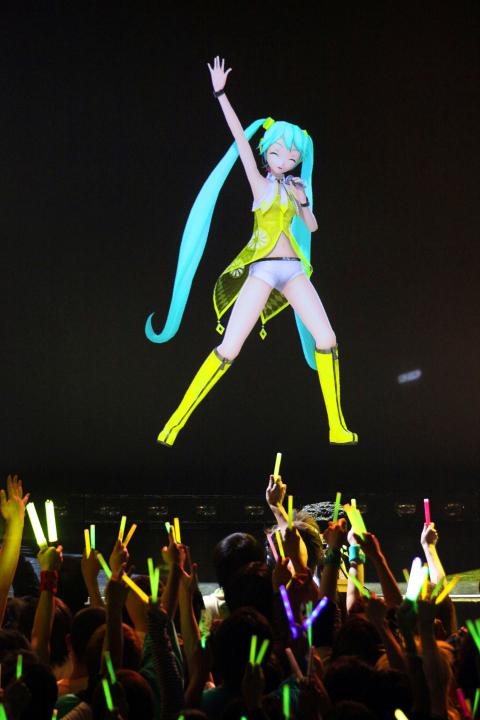
Photo: AFP
Miku Hatsune is a 3D computer animation.
The collaborative brainchild of software developers, a manga comic artist and a vast digital fan community, the virtual singer from outer space has become one of the hottest stars on the J-pop scene.
Next month she’s giving her debut US concert, the “Mikunopolis” show on July 2 at the Anime Expo in Los Angeles.
Miku may not, technically, be real, but that didn’t stop several thousand fans, most of them young men, from flocking to her latest live gig in Tokyo, where the android star enthralled her audience from an onstage screen.
“We can see her, but we can’t touch her. We think she is a true idol, the purest kind of idol,” said 21-year-old literature student Keisuke Umeda, decked out in a Miku T-shirt and a range of her merchandise.
“She’s so cute and she dances so well,” said his girlfriend, Azusa Fushimi, 20, a design student dressed in a self-made Miku outfit for the occasion, complete with body-length aquamarine pig-tails.
Below the strobe lights, TV cameras and disco balls, fans were jabbing the air with fluorescent glow-sticks even before Miku showed up and while her very human support band was still fidgeting with their instruments.
An excited roar rippled through the crowd when she burst onto the stage as a cloud of pixels that morphed into the shape of a petite galactic manga vixen with thigh-high boots and an impossibly short miniskirt.
The programmers who created Miku are vague about her persona, but very specific about her stats — the teenage pop queen is 158cm tall and weighs a dainty 42kg.
What followed was an energy-packed, pixel-perfect show with all the usual elements of a rock concert — light banter between star and audience, strobe lights, bursts of dry ice and a series of well-received encores.
Unlike her flesh-and-blood pop sisters, Miku changed costumes at the speed of a mouse-click — wearing a sailor-girl uniform one moment and a China-doll red silk number with a paper hand-fan the next.
To the casual observer, Miku’s strange show could easily appear like a glimpse into a dystopian future when humans will slavishly celebrate computer programs.
However, to insiders and fans, the phenomenon is a far more participatory, collaborative and interactive experience than a normal concert, because fans don’t just sing along with the hits — they create them.
The software engine behind Miku is Yamaha’s Vocaloid music program, which allows fans to literally put words in her mouth, by typing in lyrics and a melody that creates a synthetic voice track.
The company Crypton Future Media, based in Sapporo on the northern island of Hokkaido, created the Miku Hatsune character in 2007 with the help of a manga artist and voice samples from a real singer, Saki Fujita.
Fans were invited to breathe life into her and they have — posting more than 30,000 songs and films featuring the virtual star on video sharing Web sites, such as YouTube and Japan’s Nico Nico Douga.
The creative outpouring has spawned a number of real-world hits and a compilation of Vocaloid songs featuring Hatsune Miku in May last year hit No. 1 on one Japanese weekly’s album charts.
Amid her meteoric rise, the galactic vixen really has reached for the stars.
When Japan launched the its Venus Climate Orbiter Akatsuki in May last year, the spacecraft carried three aluminum plates depicting Miku, thanks to a fan petition with more than 10,000 signatures.

School bullies in Singapore are to face caning under new guidelines, but the education minister on Tuesday said it would be meted out only as a last resort with strict safeguards. Human rights groups regularly criticize Singapore for the use of corporal punishment, which remains part of the school and criminal justice systems, but authorities have defended it as a deterrent to crime and serious misconduct. Caning was discussed in the parliament after legislators asked how it would be used in relation to bullying in schools. The debate followed stricter guidelines on serious student misconduct, including bullying, unveiled by the Singaporean Ministry of
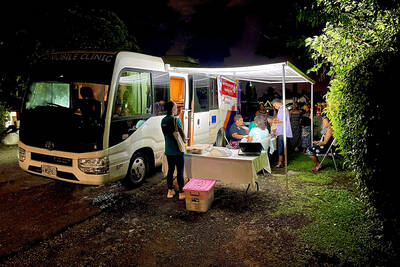
As evening falls in Fiji’s capital, a steady stream of people approaches a makeshift clinic that is a first line of defense against one of the world’s fastest-growing HIV epidemics. In the South Pacific nation — a popular tourist destination of just under a million people — more than 2,000 new HIV cases were recorded last year, a 26 percent increase from 2024. The government has declared an HIV outbreak and described it as a national crisis. “It’s spreading like wildfire,” said Siteri Dinawai, 46, who came to be tested. The Moonlight Clinic, a converted minibus parked in a suburban cul-de-sac in Suva, is

A MESSAGE: Japan’s participation in the Balikatan drills is a clear deterrence signal to China not to attack Taiwan while the US is busy in the Middle East, an analyst said The Japan Self-Defense Forces yesterday fired a Type 88 anti-ship missile during a joint maritime exercise with US, Australian and Philippine forces, hitting a decommissioned Philippine Navy ship in waters facing the disputed South China Sea, in drills that underscore Tokyo’s rising willingness to project military power on China’s doorstep. The drill took place as Manila and Tokyo began talks on a potential defense equipment transfer, made possible by Japan’s decision to scrap restrictions on military exports. The discussions include the possible early transfer of Abukuma-class destroyers and TC-90 aircraft to the Philippines, Japanese Minister of Defense Shinjiro Koizumi said. Philippine Secretary of

Separatists in Alberta are preparing to submit a petition tomorrow that they said has enough signatures to force a referendum on independence for the oil-rich Canadian province. Polls indicate the pro-independence camp remains a minority among Alberta’s 5 million people, but has hit a historic high of roughly 30 percent. Alberta separatists are also closer than ever to forcing a referendum, riding momentum fueled by intensifying grievances over Ottawa’s control of the provincial oil industry. They have also undeniably gotten a boost from the return to power of US President Donald Trump. After launching a petition in January, Stay Free Alberta, the group


 RSS
RSS