


“Palinism” and “Obama-mess” are likely to be among the top global words of next year, as the US gears up for its next presidential elections, according to a language monitoring group.
The coming year will also likely be commonly deemed “Twenty-Eleven” as the English-speaking world moves away from disagreement over how to pronounce the first years of the decade, the Global Language Monitor said on Monday.
However, the “great recession” is expected to hang around next year as a well-used term while the world economy struggles to right itself.
“Palinism” has been around for a couple of years, used mostly to coin malapropisms from Tea Party favorite Sarah Palin, including her conflation “refudiate.”
According to the UrbanDictionary.com, “Palinism” is also sometimes defined as “other illogical stream of conscious meanderings uttered by Sarah Palin.”
Palin, who ran unsuccessfully for vice president in 2008 as a Republican and is now a conservative political activist, best-selling author and TV star, is pondering whether to run for US -president against US President Barack Obama in 2012.
Global Language Monitor president Paul Payack said Americans were thus likely to see and hear more of Palin next year, adding that “the media needs an heir to ‘Bushisms’ and Sarah Palin is the candidate of choice here.”
Payack said that “Obama-mess” is expected to be big next year.
“If Obama regains his magic, he escaped his Obama-mess; if his rating sinks further, he continues to be engulfed by it,” Payack said.
The Texas-based Global Language Monitor has gathered the Top 10 words at the end of each year since 2000, according to citations in the media and on the Internet from throughout the -English-speaking world.
“To project possible top words for 2011, we analyzed the categories that we monitor and then chose words from each representative of various world trends,” Payack said.
The top words of next year are:
1) Twenty-Eleven
2) Obama-mess
3) Great Recession
4) Palinism
5) TwitFlocker
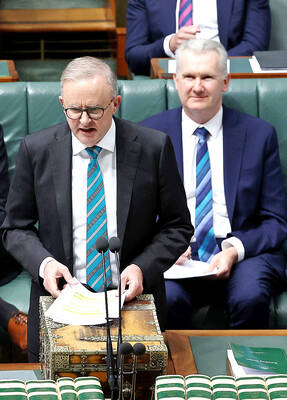
Australia has announced an agreement with the tiny Pacific nation Nauru enabling it to send hundreds of immigrants to the barren island. The deal affects more than 220 immigrants in Australia, including some convicted of serious crimes. Australian Minister of Home Affairs Tony Burke signed the memorandum of understanding on a visit to Nauru, the government said in a statement on Friday. “It contains undertakings for the proper treatment and long-term residence of people who have no legal right to stay in Australia, to be received in Nauru,” it said. “Australia will provide funding to underpin this arrangement and support Nauru’s long-term economic

ANGER: Unrest worsened after a taxi driver was killed by a police vehicle on Thursday, as protesters set alight government buildings across the nation Protests worsened overnight across major cities of Indonesia, far beyond the capital, Jakarta, as demonstrators defied Indonesian President Prabowo Subianto’s call for calm. The most serious unrest was seen in the eastern city of Makassar, while protests also unfolded in Bandung, Surabaya, Solo and Yogyakarta. By yesterday morning, crowds had dispersed in Jakarta. Troops patrolled the streets with tactical vehicles and helped civilians clear trash, although smoke was still rising in various protest sites. Three people died and five were injured in Makassar when protesters set fire to the regional parliament building during a plenary session on Friday evening, according to
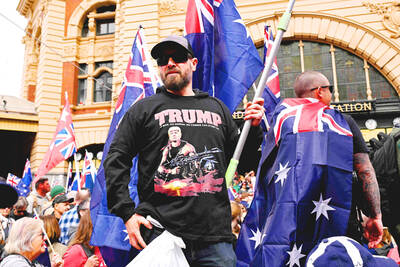
‘NEO-NAZIS’: A minister described the rally as ‘spreading hate’ and ‘dividing our communities,’ adding that it had been organized and promoted by far-right groups Thousands of Australians joined anti-immigration rallies across the country yesterday that the center-left government condemned, saying they sought to spread hate and were linked to neo-Nazis. “March for Australia” rallies against immigration were held in Sydney, and other state capitals and regional centers, according to the group’s Web site. “Mass migration has torn at the bonds that held our communities together,” the Web site said. The group posted on X on Saturday that the rallies aimed to do “what the mainstream politicians never have the courage to do: demand an end to mass immigration.” The group also said it was concerned about culture,

CRACKDOWN: The Indonesian president vowed to clamp down on ‘treason and terrorism,’ while acceding to some protest demands to revoke lawmaker benefits Protests in Indonesia over rising living costs and inequality intensified overnight, prompting Indonesian President Prabowo Subianto to cancel a planned trip to China, while demonstrators reportedly targeted the homes of the finance minister and several lawmakers. Rioters entered Indonesian Minister of Finance Sri Mulyani Indrawati’s residence near Jakarta early yesterday, but were repelled by armed forces personnel, Kompas reported. Items were taken from the homes of lawmaker Ahmad Sahroni and two others, according to Detik.com. The reports of looting could not be independently verified, and the finance ministry has not responded to requests for comment. The protests were sparked by outrage over


 RSS
RSS