


His name used to be poison in the Philippines, but Ferdinand Marcos Junior is now talking about becoming president after elections showed him to be one of the nation’s most popular politicians.
The dictator’s son also says his family has nothing to apologize for in regards to his father and namesake’s 20-year rule of the country that ended in 1986 with a “people power” revolution and a humiliating escape into exile.
“My father doesn’t need me to vindicate him,” a relaxed Marcos said on Wednesday in his first major interview since last week’s national elections that saw him secure more than 13 million votes and a seat in the Senate. “What will vindicate my father will be the academics and the historians, who will look back on his time in the cold light of day and see his administration for what it was.”
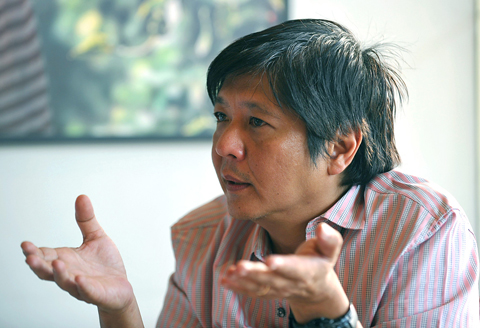
PHOTO: AFP
To many, Ferdinand Marcos Senior’s reign was dominated by widespread human rights abuses, the family stealing billions of dollars from state coffers and the wholesale slaughter of a fledgling democracy aimed at holding on to power.
But Marcos Junior said his father, who died in 1989 in US exile and now lies embalmed in the family home in the northern Philippines, committed no major crimes and was a superior president to those who succeeded him.
“To compare between him and the presidents since, he was a much better president than they have been,” the 53-year-old said as he sipped on a fruit juice in an upscale Manila cafe.
He dismissed charges that his father cheated to win the 1986 elections, one of the key moments in modern Philippine history as it triggered the so-called “people power” revolution led by the democracy heroine Corazon Aquino.
Marcos was similarly black-and-white when asked if the family stole even just one dollar while in power.
“Good Lord no, of course not,” he said, then emphasized that hundreds of cases had been lodged against the Marcos family in an attempt to recover alleged ill-gotten wealth, but none had succeeded.
On human rights abuses, Marcos initially said that some minor incidents — such as a drunken soldier beating someone up — may have occurred while his father was in power.
“But it was not part and parcel of government. It was not national policy to commit human rights abuses,” he said.
Pushed further, however, on issues such as the detention of journalists, newspapers being closed and the imposition of martial law, Marcos said such measures were needed to contain “wars” against Muslim and communist rebels.
“So the war rules applied, I suppose, in that regard,” he said.
Further boosting his confidence that his family will fall on the right side of history were parallel victories in the national elections by his famously flamboyant mother, Imelda, and sister Imee. With Imelda, 80, winning a seat in the nation’s lower house of parliament, and Imee the governorship of Ilocos Norte province that is their family stronghold, the clan is at its strongest politically since being overthrown.
“It’s a result that we all wanted. You can’t do better than that,” he said.
Marcos said the trio’s victories showed that ordinary Filipinos had never abandoned the family, and that its downfall was only because it fell victim to a plot by the US and powerful local oligarchs.
“The EDSA [people power] revolution was American-inspired,” Marcos said.
“It was a regime change ... and although they’ll deny it and swear on everything that’s holy that they weren’t involved, its very clear that they were,” he said of the US government. “In the family, we always knew that, but it’s very gratifying to see that other people have come around to that way of thinking.”
Marcos said he had decided to step up to the Senate — after serving for nine years as Ilocos Norte governor and three as a lower house member — purely to give ordinary Filipinos a voice on the national stage.
“I really felt that I could help, I really felt that I had learned very much and I could bring those lessons to a national stage,” he said.

School bullies in Singapore are to face caning under new guidelines, but the education minister on Tuesday said it would be meted out only as a last resort with strict safeguards. Human rights groups regularly criticize Singapore for the use of corporal punishment, which remains part of the school and criminal justice systems, but authorities have defended it as a deterrent to crime and serious misconduct. Caning was discussed in the parliament after legislators asked how it would be used in relation to bullying in schools. The debate followed stricter guidelines on serious student misconduct, including bullying, unveiled by the Singaporean Ministry of

As evening falls in Fiji’s capital, a steady stream of people approaches a makeshift clinic that is a first line of defense against one of the world’s fastest-growing HIV epidemics. In the South Pacific nation — a popular tourist destination of just under a million people — more than 2,000 new HIV cases were recorded last year, a 26 percent increase from 2024. The government has declared an HIV outbreak and described it as a national crisis. “It’s spreading like wildfire,” said Siteri Dinawai, 46, who came to be tested. The Moonlight Clinic, a converted minibus parked in a suburban cul-de-sac in Suva, is

A MESSAGE: Japan’s participation in the Balikatan drills is a clear deterrence signal to China not to attack Taiwan while the US is busy in the Middle East, an analyst said The Japan Self-Defense Forces yesterday fired a Type 88 anti-ship missile during a joint maritime exercise with US, Australian and Philippine forces, hitting a decommissioned Philippine Navy ship in waters facing the disputed South China Sea, in drills that underscore Tokyo’s rising willingness to project military power on China’s doorstep. The drill took place as Manila and Tokyo began talks on a potential defense equipment transfer, made possible by Japan’s decision to scrap restrictions on military exports. The discussions include the possible early transfer of Abukuma-class destroyers and TC-90 aircraft to the Philippines, Japanese Minister of Defense Shinjiro Koizumi said. Philippine Secretary of
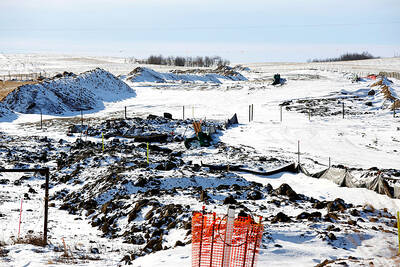
Separatists in Alberta are preparing to submit a petition tomorrow that they said has enough signatures to force a referendum on independence for the oil-rich Canadian province. Polls indicate the pro-independence camp remains a minority among Alberta’s 5 million people, but has hit a historic high of roughly 30 percent. Alberta separatists are also closer than ever to forcing a referendum, riding momentum fueled by intensifying grievances over Ottawa’s control of the provincial oil industry. They have also undeniably gotten a boost from the return to power of US President Donald Trump. After launching a petition in January, Stay Free Alberta, the group


 RSS
RSS