


A man accused of helping a Mexican drug kingpin dispose of hundreds of victims by dissolving their bodies in acid was arrested in the border city of Tijuana, authorities said on Friday.
A Mexican military statement said Santiago Meza Lopez confessed to disposing of at least 300 bodies over a decade, but authorities provided no further evidence to back the claim. Officials contend he dumped the bodies in graves, poured acid on them and let them dissolve underground.
The victims are believed to be rivals of Teodoro Garcia Simental, an alleged former lieutenant of the Tijuana-based Arellano Felix drug cartel, authorities said.
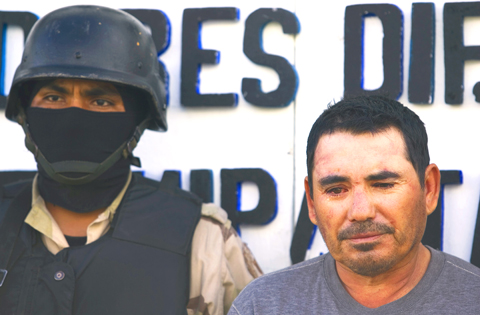
PHOTO: AP
Soldiers and police paraded Meza, 45, before reporters at a cement-block shack on the outskirts of Tijuana where he allegedly disposed of the bodies. Two grave-sized holes had been dug near the walls.
The security officers had Meza tell reporters how he allegedly got rid of the bodies, prodding him to speak up whenever he mumbled.
Meza, who has not yet been charged, was arrested along with three other people on Thursday at a Tijuana hotel. He told reporters on Friday that he got paid US$600 a week for his work and repeated his claim that he had disposed of 300 bodies.
This month, the US Drug Enforcement Administration (DEA) identified Garcia as one of 10 men it believed were battling for drug trafficking routes through Tijuana. The DEA said Garcia was the chief rival of alleged Arellano Felix cartel leader Fernando Sanchez Arrellano.
Mexican officials have blamed the power struggle for a surge in violence in Tijuana, the birthplace of the Arellano Felix cartel.
The two men split in April after a shootout between their followers in Tijuana left at least 14 people dead, Mexican and US officials said.
The Arellano Felix cartel rose to power in the 1980s. Since 2002, four brothers who led the cartel have been killed or arrested, most recently Eduardo Arellano Felix, who was captured in October in his Tijuana home.
Mexico’s drug violence has surged and grown more gruesome in recent years, particularly in northern border cities Tijuana and Ciudad Juarez. Drug violence claimed more than 5,300 lives last year.
In one case last year, authorities said they found human teeth and other remains inside barrels of acid left on a Tijuana street.

The Bolivian government on Friday struck a deal with protesting miners, but was still grappling with blockades and demonstrations by other workers across La Paz. Other groups are still blocking access roads into the city, which is also the seat of the government. Police on Thursday prevented the miners from entering the main square by using tear gas, while the demonstrators hurled stones and explosives with slingshots. Protests against the policies of Bolivian President Rodrigo Paz have convulsed the Andean nation since early this month, and roadblocks were choking routes into La Paz throughout Friday, the national road authority said. Miners demanded that Paz
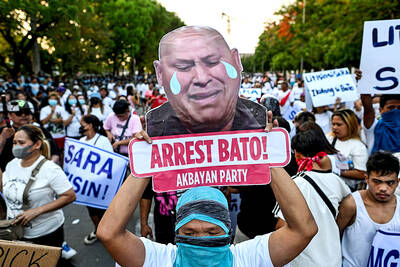
The Philippines said it has asked the country’s Supreme Court to allow it to arrest former Philippine president Rodrigo Duterte’s chief drug war enforcer to stand trial in an international tribunal. The International Criminal Court (ICC) last week unsealed an arrest warrant against Philippine Senator Ronald dela Rosa, accusing him along with Duterte and other “coperpetrators” of the “crime against humanity of murder.” Dela Rosa briefly sought refuge in the Philippine Senate last week while asking the Philippine Supreme Court to stop an ongoing attempt by government agents to arrest him. “By his own conduct, he has placed himself outside the protection of

A ship anchored off the United Arab Emirates (UAE) was seized and taken toward Iran and another — a cargo ship near Oman — sank after being attacked, authorities said on Thursday, as tensions escalated near the Strait of Hormuz. It was not immediately clear who was behind these incidents, but they happened as a senior Iranian official reiterated his country’s claim of control over the waterway and another said it had a right to seize oil tankers connected to the US. The turmoil in the strait has been a sticking point for weeks in talks between the US and Iran to

The researchers in Ireland looked at their computer screen, marveling at a medieval book tracked down in a Roman library. They flipped through its digitized pages and found their sought-after treasure: the oldest surviving English poem. “We were extremely surprised. We were speechless. We couldn’t believe our eyes when we first saw that,” said Elisabetta Magnanti, a visiting research fellow at Trinity College Dublin’s school of English. The poem was also within the main body of Latin text, she said, calling it “extraordinary.” Composed in Old English by a Northumbrian agricultural worker in the 7th century, Caedmon’s Hymn appears within some copies of


 RSS
RSS