


A crowd of angry protesters threw shoes and plastic bottles at Thai prime minister’s entourage after cornering him in an underground parking lot yesterday. He escaped unharmed.
Somchai Wongsawat’s security agents and police shielded him from the objects and huddled him into a waiting car, which sped off in a motorcade.
The protest was staged by more than 100 employees of the state-owned telecom operator TOT during a visit by Somchai to their headquarters outside Bangkok.
It marked the first time in Thailand’s months of political crisis that state employees have come into direct confrontation with the prime minister.
It was not, however, the first time that Somchai has had to make a quick getaway.
On Oct. 7, Somchai escaped a violent protest outside parliament by climbing over a back fence to safety. Riot police outside the building fired tear gas to disperse rowdy protesters, leaving hundreds injured and two dead.
Yesterday’s rally started outside the TOT headquarters, in the grounds of the Ministry of Information and Communications Technology. Somchai’s motorcade detoured into an underground parking lot to avoid the crowd shouting “Somchai, Murderer!” in reference to the two fatalities at the Oct. 7 protest.
Protesters swarmed around him in the parking lot, waving noisy plastic clappers shaped like giant hands.
After a meeting inside the building, Somchai exited through the main entrance, where more protesters had gathered. Some hurled clappers at his entourage and plastic water bottles and shoes.
Throwing shoes is particularly insulting in Thai culture, which considers feet the dirtiest part of the body.
Somchai, who took office last month, has come under growing pressure to step down to ease Thailand’s deepening political crisis. He is a brother-in-law of deposed prime minister Thaksin Shinawatra, around whom the crisis revolves.
Thaksin was convicted of corruption for helping his wife buy a piece of cut-price government land and sentenced to two years in prison in a landmark ruling on Tuesday. But he is currently living in self-imposed exile in London and most Thais doubt he will ever serve time behind bars.
Pprosecutors began gathering evidence yesterday to submit to Britain asking for Thaksin’s extradition.
“The special litigation department will copy the verdict and translate it into English, before we prepare case details,” said Sirisak Tiyapan, international affairs director at the attorney general’s office. “All documents must be translated into English before we can prepare the petition and that will take considerable time ... in our petition, we have to prove Thaksin committed a crime that is common between the two countries.”
Once all the paperwork is complete, the attorney general will forward a petition to the foreign ministry.

When a hiker fell from a 55m waterfall in wild New Zealand bush, rescuers were forced to evacuate the badly hurt woman without her dog, which could not be found. After strangers raised thousands of dollars for a search, border collie Molly was flown to safety by a helicopter pilot who was determined to reunite the pet and the owner. A week earlier, an emergency rescue helicopter found the woman with bruises and lacerations after a fall at a rocky spot at the waterfall on the South Island’s West Coast. She was airlifted on March 24, but they were forced to
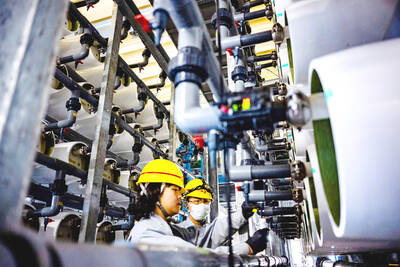
HIGH HOPES: The power source is expected to have a future, as it is not dependent on the weather or light, and could be useful for places with large desalination facilities A Japanese water plant is harnessing the natural process of osmosis to generate renewable energy that could one day become a common power source. The possibility of generating power from osmosis — when water molecules pass from a less salty solution to a more salty one — has long been known. However, actually generating energy from that has proved more complicated, in part due the difficulty of designing the membrane through which the molecules pass. Engineers in Fukuoka, Japan, and their private partners think they might have cracked it, and have opened what is only the world’s second osmotic power plant. It generates

Hundreds of Filipinos and tourists flocked to a sun-bleached field north of Manila yesterday, on Good Friday, to witness one of the country’s most blood-soaked displays of religious fervor, undeterred by rising fuel prices. Scores of bare-chested flagellants with covered faces walked barefoot through the dusty streets of Pampanga Province’s San Fernando as they flogged their backs with bamboo whips in the scorching heat. Agence France-Presse (AFP) journalists said they saw devotees deliberately puncturing their skin with glass shards attached to a small wooden paddle to ensure their bleeding during the ritual, a way to atone for sins and seek miracles from
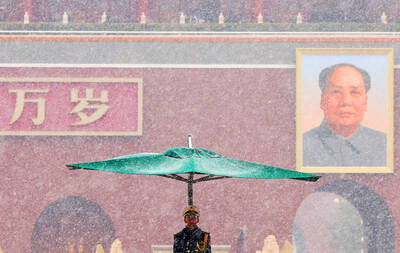
Chinese dissident artist Gao Zhen (高兟), famous for making provocative satirical sculptures of former Chinese leader Mao Zedong (毛澤東), was tried on Monday over accusations of “defaming national heroes and martyrs,” his wife and a rights group said. Gao, 69, who was detained in 2024 during a visit from the US, faces a maximum three-year prison sentence, said his wife, Zhao Yaliang (趙雅良), and Shane Yi, a researcher at the Chinese Human Rights Defenders group which operates outside the nation. The closed-door, one-day trial took place at Sanhe City People’s Court in Hebei Province neighboring the capital, Beijing, and ended without a


 RSS
RSS