


The authorities call it a Greek tragedy, but the graffiti artists who have increasingly left their mark on this ancient city and its monuments say they are simply responding to a different sort of muse.
Churches and archeological sites in Greece used to enjoy a certain immunity from graffiti and the stylized signatures known as tagging, but are now increasingly part of the action as the phenomenon takes off in Athens.
“There is an inability to distinguish what is a monument, and what is not,” said Zetta Antonopoulou, an architect who has conducted extensive research on Athens statues, many of which are routinely marked with spray paint.
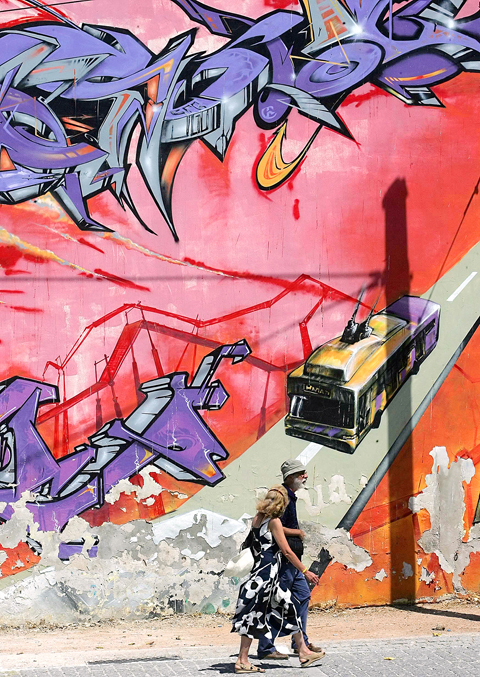
PHOTO: AFP
“It’s getting out of control and it’s not easy to explain why,” she said.
The “art form” has come a long way since 1810.
BLAME IT ON BYRON
It was then that a young tourist in Greece carved his name into the ancient temple of Poseidon at Cape Sounio south of Athens.
Little did he know that the scrawl would become a cherished part of modern Greek heritage.
The traveler was 22-year-old George Gordon, Lord Byron, the maverick English poet who died fighting alongside the Greeks in their war of liberation against the Ottoman Empire and who is considered a national hero here.
Two centuries later, Greek archeologists are proud of young Byron’s handiwork — but contemporary graffiti artists are not as welcome.
“The mark left by Byron is a historical document. Youths today write slogans, it’s not the same thing,” says Miranda Karatza, an archeologist who heads the Greek culture ministry’s sites and monuments office.
While other forms of graffiti related to sports or politics have been around for a long time in Greece, many Athenians remain unaccustomed to the latest phenomenon of street art and wall tagging by young “crews” marking territory.
“Graffiti is vandalism, it’s an element of conflict, and sometimes things that are nice are also ruined,” said Fotis, a 28-year-old street artist.
CONFLICT
Fotis, who paints lizards and dragons, said he turned to graffiti as a way out of hooliganism and substance abuse but also in reaction to growing up in “a city full of ugliness and hate.”
While full-fledged street art in Athens mostly keeps to the suburbs and alleys around the center, quick-fix tagging on the city’s main squares and public monuments is the clearest indication of the trend.
“A certain level of tagging is unavoidable in any city but in Athens it has been allowed to run riot,” a reader recently commented in local English language weekly Athens Plus.
“More depressing still is the corresponding lack of any concern about it,” the reader wrote.
One striking example is Syntagma Square, one of Athens’ busiest gathering points, which recently became a popular hangout for teen skateboarders.
“We have to send crews to clean the walls and steps around once a month,” said Alexandros Pouloudis, a supervisor at Athens’ city maintenance office, noting that a comprehensive cleanup can cost up to 2,000 euros (US$2,950).
EXPENSIVE REPAIRS
In the case of statues and monuments that must be carefully restored, the cost can exceed 20,000 euros, conservation expert Bessy Argyropoulou said.
“The longer graffiti remains on stone or marble the more it is absorbed,” she said. “It’s not a quick and dirty operation like washing a car.”
Closely associated with hip hop and rap music, street art arrived in Greece in the early 1990s and experienced a boom ahead of the Athens 2004 Olympics, says Antonis Katsouris, an urban culture writer for Highlights magazine.
“Graffiti is an identity statement in a hostile urban environment,” he said.
“And hip hop and rap are very popular in the poorer Athens districts,” he said.
Within a decade, a group of young painters inspired by Greek folk art and iconography caught the eye of art galleries, entered the mainstream and started taking commissions from hotels and restaurants.
“That generation has since abandoned the street [and] artistic graffiti is no longer as prevalent,” he said.
“But tagging is going strong, and there is certainly no shortage of walls in Athens,” he said.

School bullies in Singapore are to face caning under new guidelines, but the education minister on Tuesday said it would be meted out only as a last resort with strict safeguards. Human rights groups regularly criticize Singapore for the use of corporal punishment, which remains part of the school and criminal justice systems, but authorities have defended it as a deterrent to crime and serious misconduct. Caning was discussed in the parliament after legislators asked how it would be used in relation to bullying in schools. The debate followed stricter guidelines on serious student misconduct, including bullying, unveiled by the Singaporean Ministry of

As evening falls in Fiji’s capital, a steady stream of people approaches a makeshift clinic that is a first line of defense against one of the world’s fastest-growing HIV epidemics. In the South Pacific nation — a popular tourist destination of just under a million people — more than 2,000 new HIV cases were recorded last year, a 26 percent increase from 2024. The government has declared an HIV outbreak and described it as a national crisis. “It’s spreading like wildfire,” said Siteri Dinawai, 46, who came to be tested. The Moonlight Clinic, a converted minibus parked in a suburban cul-de-sac in Suva, is
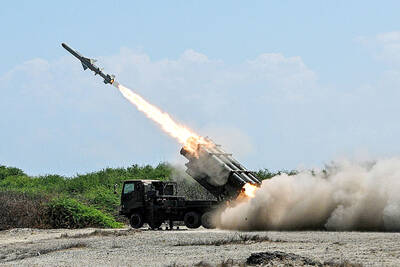
A MESSAGE: Japan’s participation in the Balikatan drills is a clear deterrence signal to China not to attack Taiwan while the US is busy in the Middle East, an analyst said The Japan Self-Defense Forces yesterday fired a Type 88 anti-ship missile during a joint maritime exercise with US, Australian and Philippine forces, hitting a decommissioned Philippine Navy ship in waters facing the disputed South China Sea, in drills that underscore Tokyo’s rising willingness to project military power on China’s doorstep. The drill took place as Manila and Tokyo began talks on a potential defense equipment transfer, made possible by Japan’s decision to scrap restrictions on military exports. The discussions include the possible early transfer of Abukuma-class destroyers and TC-90 aircraft to the Philippines, Japanese Minister of Defense Shinjiro Koizumi said. Philippine Secretary of
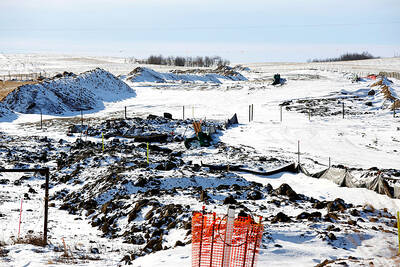
Separatists in Alberta are preparing to submit a petition tomorrow that they said has enough signatures to force a referendum on independence for the oil-rich Canadian province. Polls indicate the pro-independence camp remains a minority among Alberta’s 5 million people, but has hit a historic high of roughly 30 percent. Alberta separatists are also closer than ever to forcing a referendum, riding momentum fueled by intensifying grievances over Ottawa’s control of the provincial oil industry. They have also undeniably gotten a boost from the return to power of US President Donald Trump. After launching a petition in January, Stay Free Alberta, the group


 RSS
RSS