


As monks in red and orange robes stroll past tourists snapping photos of the temples, the quiet of the Kumbum Monastery seems a world away from the Olympics in far-off Beijing.
But for many of the monks in this monastery on the edge of the Tibetan plateau in the Chinese province of Qinghai, the Games have had a very real impact on their daily lives.
Most monks were unwilling to talk to foreigners or shied away from sensitive subjects when broached. But several who did speak out, anonymously and with great caution, described restrictions and security measures aimed at limiting their movements and communication around the Olympic Games period.
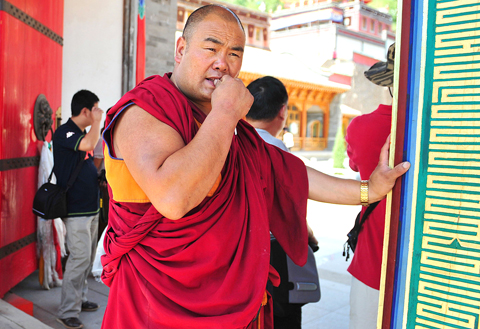
PHOTO: AFP
They said the authorities feared a repeat of the violence and anti-Chinese protests that gripped the Tibetan Autonomous Region as well as Tibetan areas in the provinces of Qinghai, Sichuan and Gansu five months ago.
“We can’t get e-mail until October after the Olympics,” said one monk out of earshot of the mainly Han Chinese tour groups.
“The Olympics?” said another monk. “We wouldn’t be able to go and watch them as the train station will not sell us any train tickets, so I don’t really care.”
The Kumbum Monastery, nestled on a hillside near the Qinghai capital Xining, is a popular tourist site and an important repository for Tibetan art and culture.
It is one of the most important monasteries of Tibet’s predominant Yellow Hat school of Buddhism, but since the communists came to power in China in 1949, the number of monks at Kumbum has fallen from 3,600 to about 800.
For many Tibetans living in Qinghai and around the monastery, there is no border with the Tibet Autonomous Region and they still consider their region part of Tibet.
The Tibet Autonomous Region is what many know as Tibet, but the other areas in the Chinese provinces are also regarded by Tibetans as part of their ancient homeland.
Unrest erupted in the Tibetan capital Lhasa on March 14 after four days of protests, turning into a day of riots targeting ethnic Han Chinese businesses and residents.
China reacted by sending in a massive military presence to quell the unrest as it spread, and sealed the regions off from foreign reporters and tourists — actions that drew condemnation from world leaders and human rights groups.
Pro-Tibet activists have carried off a series of small but eye-catching protests around the Olympic venues in Beijing in recent days, while security remains tight back on the Tibetan plateau.
“The slogan is now about a safe Olympics, and of course in the Chinese way of doing things, they impose more restrictions,” said Chan Kin-man (陳健民), director of the Center for Civil Society Studies at the Chinese University of Hong Kong. “And even if they are just Buddhist monks, religious forces are always regarded by the Chinese government as one of the political threats to the regime.”
In Kumbum, one monk said they were being watched constantly by the authorities and were pressured not to talk to foreigners.
“They always come to ask us ‘where have you been,’ and ‘who have you talked to,’” he said.
The monk confided that five of his fellow monks had been detained during the period of unrest, although he said they had since come back to the monastery.
“People say things will get better after the Olympics, but I’m not so sure,” he said. “I think things might get worse.”
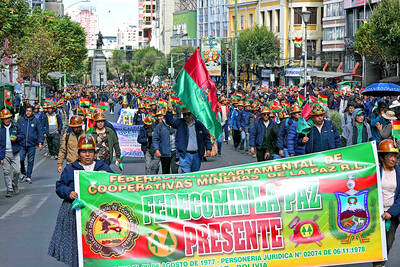
The Bolivian government on Friday struck a deal with protesting miners, but was still grappling with blockades and demonstrations by other workers across La Paz. Other groups are still blocking access roads into the city, which is also the seat of the government. Police on Thursday prevented the miners from entering the main square by using tear gas, while the demonstrators hurled stones and explosives with slingshots. Protests against the policies of Bolivian President Rodrigo Paz have convulsed the Andean nation since early this month, and roadblocks were choking routes into La Paz throughout Friday, the national road authority said. Miners demanded that Paz
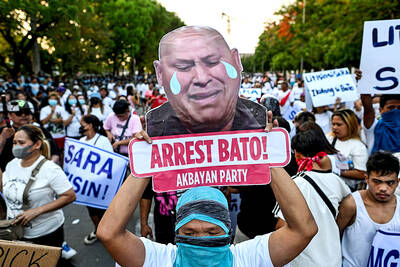
The Philippines said it has asked the country’s Supreme Court to allow it to arrest former Philippine president Rodrigo Duterte’s chief drug war enforcer to stand trial in an international tribunal. The International Criminal Court (ICC) last week unsealed an arrest warrant against Philippine Senator Ronald dela Rosa, accusing him along with Duterte and other “coperpetrators” of the “crime against humanity of murder.” Dela Rosa briefly sought refuge in the Philippine Senate last week while asking the Philippine Supreme Court to stop an ongoing attempt by government agents to arrest him. “By his own conduct, he has placed himself outside the protection of

A ship anchored off the United Arab Emirates (UAE) was seized and taken toward Iran and another — a cargo ship near Oman — sank after being attacked, authorities said on Thursday, as tensions escalated near the Strait of Hormuz. It was not immediately clear who was behind these incidents, but they happened as a senior Iranian official reiterated his country’s claim of control over the waterway and another said it had a right to seize oil tankers connected to the US. The turmoil in the strait has been a sticking point for weeks in talks between the US and Iran to
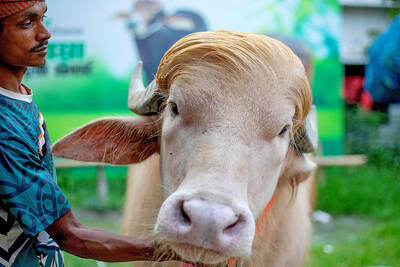
Crowds in Bangladesh are flocking to snap photographs with an unlikely social media star — an albino buffalo with flowing blond hair nicknamed “Donald Trump” that is due to be sacrificed within days. Owner Zia Uddin Mridha, 38, said his brother named the 700kg bull over its flowing helmet of hair resembling the signature look of the US president. “My younger brother picked this name because of the buffalo’s extraordinary hair,” he said at his farm in Narayanganj, just outside the capital, Dhaka. Mridha said that a constant stream of curious visitors — social media fans, onlookers and children — have come throughout


 RSS
RSS