


Egypt is considering copyrighting its pharaonic antiquities, from the pyramids to scarab beetles, in an attempt to get a cut from trinkets sold around the world, antiquities chief Zahi Hawass said on Thursday.
It was unclear whether such a copyright would be recognized internationally -- and Hawass said it would apply only on exact replicas of antiquities, including scale, meaning someone would have to build a full-scale replica of the giant pyramids for it to violate the copyright.
"If you [want to] build an exact copy of the Great Pyramid we will stop you," Hawass said.
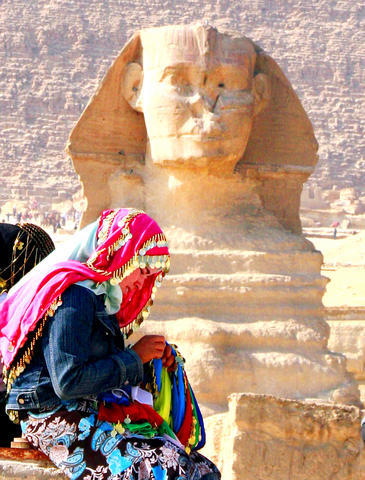
PHOTO: AP
The provision is part of a new draft antiquities law that Hawass has put before the Egyptian parliament that would also mandate life imprisonment for antiquities smugglers, an attempt to crack down on theft of Egypt's heritage.
Under the law, anyone seeking to make an exact replica of a copyrighted pharaonic artifact would have to seek permission -- and pay a fee to -- Egypt's Supreme Council of Antiquities.
"The New York Metropolitan Museum of Art makes replicas of the King Tut exhibit from 20 years ago and they are still selling it everywhere and Egypt gets nothing!" said SCA chairman Hawass.
The "Chinese are making lots of money selling [replicas of] our antiquities," he said, referring to the fact that many of the souvenirs sold to tourists in Egypt are actually made in China.
The draft bill comes amid recent complaints in Egyptian media about money being made by the pyramid-shaped Las Vegas Luxor casino in the US.
But Hawass said Las Vegas' Luxor -- and other parks and malls around the world with ancient Egyptian themes -- would not be affected by the copyright law.
"It is a resort that doesn't look like anything from antiquity, it is a replica of imagination, I can't stop them from doing that," he said.
Besides, "it is an ugly pyramid with fake hieroglyphics inside," he said.
The law will also cover images of the Pyramids, King Tutankhamun and several other famous sites around the country, whose use for commercial purposes would have to be permitted by the SCA, including a fee.
Egyptian lawyer Hossam Lufti, an expert with the UN's World Intellectual Property Organization, said the draft may be baffling since so far the term copyright has not been applied to cultural heritage because authors of the work in question are long gone.
However, UNESCO and Lufti's organization are trying to develop the idea -- which still hasn't won wide backing -- that a nation has the right to defend how its folklore and intangible heritage is used internationally.
"What we are defending is the integrity of the nation," Lufti said. "We are establishing this idea based on our right to bring protection to the expression of folklore."
Hawass, who became head of Egyptian antiquities in 2002, has achieved global prominence by appearing in a number of television specials heralding new Egyptology discoveries.
His media-savvy approach has helped his department acquire new funding, such as Egypt's new US$5 million DNA testing lab, paid for by the Discovery Channel in exchange for exclusive rights to film the process of identifying the mummy said to be that of Queen Hatshepsut.
Hawass said he's offering other companies a similar deal in exchange for a second lab.
Jeffrey Weingart, lawyer with New York-based Thelen Ried Brown Raysman & Steiner LLP, said the scope of the new Egyptian draft bill is unclear "in terms what it seeks to prohibit and what exceptions apply."
"It's also unclear how a novel law such as this one would play in terms of international copyright treaties, enforcement and subject matter," said Weingart, who has long experience with copyright laws in the US.
"Anytime someone seeks to promote and profit from artistic or photographic expression, one walks a fine line between promoting its use on the one hand and protecting material on the other," Weingart said.
The copyright proposal is part of a wider law whose main purpose is to protect the country's antiquities from smugglers by stiffening punishments. It would also increase penalties for building on archeological sites.
The draft bill is the result of five years of consultations among lawyers, experts and Egyptologists on ways to protect the monuments, Hawass said.
"The most important thing is that those who steal antiquities will be put in prison for good," he said.
The law calls for five-year prison sentences for those building on archeological sites, which until now were only minimally fined. There are 6,000 such cases pending in Egypt.
Rules would also change for dozens of foreign archeological missions excavating sites in Egypt, which in the past were allowed to take 10 percent of their finds out of the country.
"I canceled that. I feel it is an honor for any expert just to work in Egypt ... not to take things outside," Hawass said.

School bullies in Singapore are to face caning under new guidelines, but the education minister on Tuesday said it would be meted out only as a last resort with strict safeguards. Human rights groups regularly criticize Singapore for the use of corporal punishment, which remains part of the school and criminal justice systems, but authorities have defended it as a deterrent to crime and serious misconduct. Caning was discussed in the parliament after legislators asked how it would be used in relation to bullying in schools. The debate followed stricter guidelines on serious student misconduct, including bullying, unveiled by the Singaporean Ministry of

As evening falls in Fiji’s capital, a steady stream of people approaches a makeshift clinic that is a first line of defense against one of the world’s fastest-growing HIV epidemics. In the South Pacific nation — a popular tourist destination of just under a million people — more than 2,000 new HIV cases were recorded last year, a 26 percent increase from 2024. The government has declared an HIV outbreak and described it as a national crisis. “It’s spreading like wildfire,” said Siteri Dinawai, 46, who came to be tested. The Moonlight Clinic, a converted minibus parked in a suburban cul-de-sac in Suva, is

Jailed media entrepreneur Jimmy Lai (黎智英) has been awarded Deutsche Welle’s (DW) freedom of speech award for his contribution to Hong Kong’s pro-democracy movement. The German public broadcaster on Thursday said Lai would be presented in absentia with the 12th iteration of the award on June 23 at the DW Global Media Forum in Bonn. Deutsche Welle director-general Barbara Massing praised the 78-year-old founder of the now-shuttered news outlet Apple Daily for standing “unwaveringly for press freedom in Hong Kong at great personal risk.” “With Apple Daily, he gave journalists a platform for free reporting and a voice to the democracy movement in

A MESSAGE: Japan’s participation in the Balikatan drills is a clear deterrence signal to China not to attack Taiwan while the US is busy in the Middle East, an analyst said The Japan Self-Defense Forces yesterday fired a Type 88 anti-ship missile during a joint maritime exercise with US, Australian and Philippine forces, hitting a decommissioned Philippine Navy ship in waters facing the disputed South China Sea, in drills that underscore Tokyo’s rising willingness to project military power on China’s doorstep. The drill took place as Manila and Tokyo began talks on a potential defense equipment transfer, made possible by Japan’s decision to scrap restrictions on military exports. The discussions include the possible early transfer of Abukuma-class destroyers and TC-90 aircraft to the Philippines, Japanese Minister of Defense Shinjiro Koizumi said. Philippine Secretary of


 RSS
RSS